Elmworth: Five Residents, More Than a Century of History and a Community Much Bigger Than Its Population
How do you measure the size of a community?
By the number of people living within its boundaries? The number of businesses on its streets? The children attending its school? Or the families who have depended on it for generations?
Elmworth, southwest of Beaverlodge, presents an interesting answer.
According to the County of Grande Prairie's 2024 municipal census, the community had just five residents.
Yet its importance extends considerably beyond that number.
For more than a century, Elmworth has been part of the lives of farming families, teachers, homesteaders and children growing up in the western Peace Country.
Its story begins with people who arrived carrying little more than their belongings and the determination to establish a new life.
Before the Homesteads
The western Peace Country lies within Treaty 8 territory, a landscape with a human history extending far beyond agricultural settlement.
Indigenous peoples maintained longstanding relationships with the region's rivers, forests, wildlife and traditional territories.
The arrival of agricultural settlers introduced significant changes to land ownership and land use.
The surviving homestead records tell us much about the experiences of those settlers, but they represent only one part of the region's history.
Indigenous and Métis histories, including oral histories and traditional knowledge, remain essential to a fuller understanding of the western Peace Country.
1915: A Man Walking Toward a New Life
Gordon Moyer was born in Breslau, Ontario, on September 25, 1894.
He arrived in the Elmworth district in 1915, when transportation connections across the Peace Country were still developing.
According to his family's records, preserved at South Peace Regional Archives, Moyer walked from the Smoky River to the Elmworth area carrying a heavy pack.
He was approximately 20 years old.
There were no modern highways connecting the communities he passed through.
The journey required considerable physical effort, but it was only the beginning of his experiences in the district.
The Man Who Walked 40 Miles and Failed His Medical
Later that year, Moyer and two neighbours, Hubert and Harry Black, walked to Grande Prairie to enlist for military service during the First World War.
Harry was accepted.
Hubert was rejected because of his slight build.
Gordon was rejected because he had flat feet.
The family history notes the irony of that decision: Gordon had just walked approximately 40 miles, or 64 kilometres, to enlist.
It is a remarkable detail preserved in the family's archival records.
For the young men establishing themselves in the Peace Country, the First World War was not a distant event.
It influenced decisions about their futures, their families and their willingness to leave newly established homes.
Surviving the First Winter
Moyer spent his first winter in Carl Schieldge's cabin.
He shared the accommodation with George Grant and Irish Beggs.
The family's account describes a diet heavily dependent on rabbits and sourdough bread, with Grant teaching the others how to make the bread.
It is a glimpse into the practical realities of early settlement.
Establishing a homestead did not immediately provide a dependable income or a productive farm.
Shelter, food and assistance from neighbours could be particularly important during the first winter.
The surviving Moyer records give these experiences a human dimension that population figures and government land records cannot provide on their own.
1919: The Family That Came From Wyoming
Another important Elmworth family arrived through a very different set of circumstances.
Clyde Campbell had lived in the United States, where his daughter Isabel was born in Rock Springs, Wyoming, on March 18, 1907.
During the First World War, Clyde worked inspecting ammunition manufacturing facilities for the American military.
He subsequently experienced serious illness and the effects of wartime stress.
His doctor recommended a change of environment.
Clyde had encountered promotional material about the Peace Country during his travels and decided to investigate the region.
According to South Peace Regional Archives, he initially had no intention of settling permanently.
That changed after a visit in 1919.
The landscape and agricultural possibilities persuaded him to establish a homestead in the Elmworth district.
A Quarter Section With a Story
In April 1919, Clyde Campbell filed on the southeast quarter of Section 5, Township 70, Range 11, west of the Sixth Meridian.
The precise legal land description survives in the historical record.
It is the kind of detail that can help descendants locate the land where their families once lived.
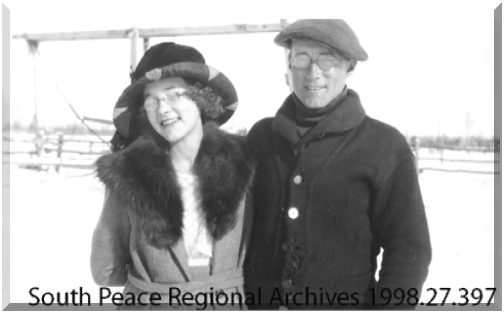
South Peace Regional Archives also preserves a photograph of Clyde and Isabel Campbell in the yard of their Elmworth homestead, taken around 1920.
Isabel would have been approximately 13 years old.
The photograph connects a recognizable name in Grande Prairie's educational history with a rural homestead southwest of Beaverlodge.
From Elmworth to a Grande Prairie School Name
Today, the name Isabel Campbell is familiar to many Grande Prairie families through Isabel Campbell Public School.
Her connection to Elmworth is a reminder that the histories of the region's rural communities and its largest city are closely intertwined.
People who grew up on rural homesteads went on to contribute to education, business, public service and community life elsewhere in the Peace Country.
Their stories did not necessarily remain within the communities where they spent their childhoods.
In February 2022, South Peace Regional Archives published a historical feature examining Isabel Campbell's life as part of its series about the people behind Grande Prairie school names.
Her family's Elmworth photograph accompanies that account.
For Elmworth residents, it is another piece of evidence that the influence of a small rural community can extend far beyond its geographical boundaries.
January 2, 1922: School Begins
The development of a local school was one of the most important milestones in Elmworth's history.
The original Elmworth School District was numbered 3791.
According to records preserved by South Peace Regional Archives, the first schoolhouse was constructed in 1921.
It opened on January 2, 1922.
The teacher was Miss Edna Small.
The opening represented a significant investment in the district's future.
Families establishing farms also needed educational opportunities for their children.
A school gave them another reason to remain in the district and establish permanent homes.
It also provided a gathering point for a population spread across the surrounding countryside.
From One Classroom to Four
The original Elmworth schoolhouse was a modest beginning.
But the district's educational requirements continued growing.
School division records document the expansion:
- 1921 — The first schoolhouse was constructed.
- 1922 — The school officially opened.
- 1937 — A two-room school opened.
- 1949 — The school expanded to three classrooms.
- 1952 — The number of classrooms increased to four.
The figures tell a story of changing educational needs.
As the district developed, the original one-room school could no longer accommodate the requirements of the surrounding population.
Elmworth was becoming a larger educational centre.
When the School Had Its Own Barn
One of the more revealing details in Elmworth's historical records is the existence of a school barn.
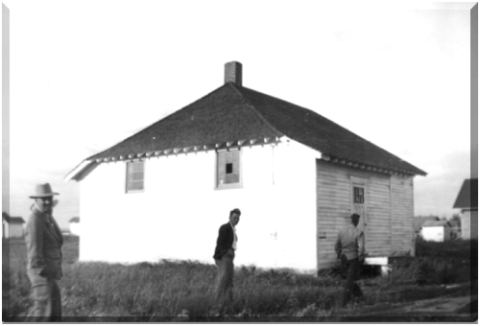
South Peace Regional Archives preserves a black-and-white photograph of the log barn, dating from approximately 1950.
The archives also hold photographs of the schoolhouse and its teacherage from the same period.
These buildings illustrate the infrastructure associated with rural education.
A school was not necessarily just a classroom.
Accommodation for teachers and facilities connected with rural transportation could also be important.
The photographs preserve a physical record of an educational system that operated under very different circumstances from those experienced by students today.
The precise everyday use of Elmworth's school barn is an interesting question for former students and local families.
The Teacherage
Another archival photograph documents the Elmworth teacherage around 1950.
Providing accommodation for teachers was a practical consideration in rural communities.
Teachers arriving from elsewhere needed somewhere to live, particularly in districts without extensive rental housing or dependable daily transportation.
The teacherage was therefore part of the infrastructure supporting education.
Its existence helps explain why establishing a rural school could require more than constructing a classroom and hiring a teacher.
Communities also needed to make it practical for teachers to live and work there.
The Schools That Disappeared
Elmworth's growth as an educational centre was closely connected to the closure of smaller schools in neighbouring districts.
Across the Peace Country, school consolidation gradually replaced many isolated rural classrooms with larger schools serving wider areas.
Children increasingly travelled by school bus.
This changed the relationship between families, schools and their immediate neighbourhoods.
Elmworth became one of the communities receiving students from surrounding districts.
Its school records preserve connections to places including Hazelmere, Craigellachie, Rio Grande and Halcourt.
Each had its own history before becoming part of a wider educational network.
Hazelmere and Beaverbrook School
The Beaverbrook School District, numbered 3979, served families in the Hazelmere area west of Elmworth.
Its history extended into the countryside toward Stony Lake and Monkman Pass.
An early log school was eventually replaced by a new building in 1948.
Just four years later, in 1952, Beaverbrook School closed and the district was amalgamated with Elmworth.
The newer building was subsequently sold in 1962.
The transition illustrates how quickly rural educational infrastructure could change.
A community could invest in a new school only to see its students transferred elsewhere a few years later.
The closure did not mean the surrounding families disappeared.
Instead, their children became part of Elmworth's growing school population.
Rio Grande: Keeping the Classroom Open
The records of Rio Grande School District No. 3657 preserve another important aspect of rural education.
Finding qualified teachers was not always straightforward.
According to the regional archives, local young people sometimes helped keep the school operating when teachers were unavailable.
Among those remembered in the records are Lawrence Ozust, Peggy Martin, Margaret Gould, Stella Holtz and Dorothy Edgerton.
Their contribution demonstrates the practical importance of local initiative.
When regular school bus transportation to Elmworth became available, Rio Grande School eventually closed.
Its former students continued their education in a larger regional school.
The names of those who helped sustain Rio Grande's classroom deserve to remain part of the historical record.
Halcourt: Another Community Joins Elmworth
Education in the Halcourt district began in 1912, with classes initially held in the community church.
Marion McNaught was the teacher.
A log school was subsequently constructed.
Over the following decades, Halcourt itself became a centre for students from surrounding rural schools.
Eventually, continued consolidation changed the educational geography again.
Halcourt School closed during the 1950s as Elmworth became the regional school.
The transition illustrates how the role of rural communities could change over time.
A place that once received students from neighbouring districts could later find its own students travelling elsewhere.
Building for a Larger School Population
South Peace Regional Archives preserves architectural drawings associated with Elmworth's school expansion.
Among them are plans for a two-classroom addition dating from approximately 1954.
Additional drawings from 1962 include building elevations, floor plans and landscaping details.
These records provide evidence of the physical changes associated with school consolidation.
The school was no longer serving only the families immediately surrounding its original site.
Its responsibilities had expanded.
The investment in additional facilities reflected the development of a regional educational centre.
A Community That Was Never Just Its Hamlet
The distinction between Elmworth and the surrounding district is important.
Rural communities often serve populations that are not counted within their immediate boundaries.
A family may live several kilometres from a school, library, curling rink or community hall but still consider that place its community.
Municipal population figures do not necessarily capture those relationships.
Elmworth is a particularly clear example.
Its residential population is small, but its institutions serve a much wider area.
That pattern has historical roots extending back to the establishment of its first school.
A Different Kind of Rural Economy
The wider Elmworth district is also associated with natural gas development.
Agricultural land and energy infrastructure now form part of the surrounding landscape.
The region's economic identity is therefore broader than its early homesteading history.
Farming, education and resource development have all contributed to the district's evolution.
The detailed history of the Elmworth natural gas field, including its discovery, early operators, construction and employment, deserves a separate historical investigation.
That industrial history is another chapter in the story of how the western Peace Country changed during the twentieth century.
What the County Says About Elmworth Today
The County of Grande Prairie's Municipal Development Plan provides a modern perspective on the community.
It places Elmworth approximately 19 kilometres southwest of Beaverlodge, along Highway 722.
The plan describes the community as an institutional centre serving the broader rural area.
It identifies several facilities and properties, including:
- Elmworth School.
- A library.
- A curling rink.
- A nearby community hall.
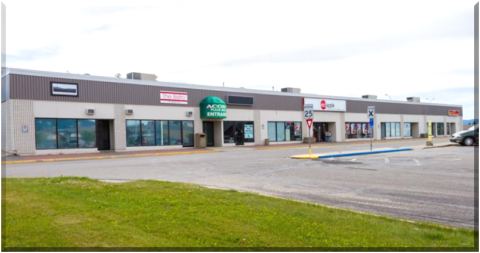
- A general store building identified as closed in the plan.
The County's 2024 municipal census recorded five residents.
That figure refers to the community itself, not the total number of people living in the surrounding district or using its facilities.
The distinction matters.
A population of five does not mean that only five people depend on Elmworth.
More Than a Century of Education
Elmworth School remains part of Peace Wapiti Public School Division.
Its official website continues to provide information for students, families and the school community.
More than a century separates today's school from the classroom opened by Edna Small in January 1922.
During that time, transportation, teaching methods, buildings and educational opportunities have changed substantially.
The geographical importance of the school, however, has endured.
It remains a point of connection for families living across the surrounding rural district.
The original schoolhouse helped establish Elmworth's identity.
Its modern successor continues that connection.
What Makes a Small Community Worth Preserving?
Elmworth raises a question relevant to many rural communities across the Peace Country.
Should a community's importance be measured only by its residential population?
Or should consideration also be given to the people who use its facilities, attend its school, participate in its organizations and identify with its history?
The County's planning document recognizes Elmworth's role as a rural centre and identifies the importance of sustaining its amenities.
That recognition reflects the difference between a residential settlement and a community that serves a wider district.
Elmworth's history demonstrates that the two are not always the same.
From Rabbits and Sourdough to a Regional School
Consider the changes that have taken place since Gordon Moyer arrived in 1915.
The young homesteader spent his first winter sharing a cabin and relying heavily on rabbits and homemade bread.
Four years later, Clyde Campbell established his own homestead nearby.
In 1922, Edna Small welcomed students into Elmworth's first purpose-built school.
Over the following decades, the school expanded as children from surrounding communities were brought together.
Today, the district is connected by modern roads and supported by educational, agricultural, recreational and industrial activity.
The experiences of its residents have changed enormously.
But the connection between Elmworth and the surrounding countryside remains.
Five Residents Does Not Tell the Whole Story
The County's population figure is an interesting statistic.
It is not, however, a complete description of Elmworth.
It does not count every child attending school there.
It does not measure the generations of families who have lived in the surrounding district.
It does not capture the memories of former students, the contributions of teachers or the importance of community organizations.
Those are different measures of a community's identity.
And they help explain why Elmworth deserves a place in the history of the Peace Country.
A century ago, families arrived looking for somewhere to establish a home. They created something that would serve generations of people beyond the boundaries of their own homesteads.
Historical Photographs Worth Preserving
Several authentic photographs documenting Elmworth's early history are preserved at South Peace Regional Archives.
Clyde and Isabel Campbell at their Elmworth homestead, approximately 1920
An informal photograph of father and daughter in the yard of their homestead.
Archival reference: SPRA 1998.27.397.
The photograph is publicly displayed in the archives' February 16, 2022, article about Isabel Campbell.
Elmworth School, approximately 1950
Archival reference: 0063.02.028.1 — photograph.
Elmworth Teacherage, approximately 1950
Archival reference: 0063.02.028.2 — photograph.
Elmworth School Barn, approximately 1950
Archival reference: 0063.02.028.3 — photograph.
These records provide a valuable starting point for families researching Elmworth's educational and settlement history.
Original sources
- South Peace Regional Archives — Behind the Name: Isabel Campbell, February 16, 2022
- South Peace Regional Archives — Gordon & Edna Moyer fonds, reference 0422
- South Peace Regional Archives — Grande Prairie School Division No. 14 fonds, including Elmworth, Beaverbrook, Rio Grande and Halcourt school district records
- County of Grande Prairie — Municipal Development Plan, Bylaw 3255, Elmworth community profile
- Peace Wapiti Public School Division — Elmworth School official website
Swan City Speaks: What Do You Think?
Elmworth, Hazelmere, Rio Grande, Halcourt, Craigellachie and surrounding Peace Country families — help us preserve your history.
- Does your family have photographs of Elmworth's original schoolhouse, teacherage or school barn?
- Were you among the students transferred to Elmworth when neighbouring rural schools closed?
- Do you remember the old general store, community hall, church or curling rink?
- Does your family have connections to Gordon Moyer, the Campbell family, Edna Small or other early residents?
- Did you or your relatives work in the early development of the Elmworth natural gas field?
- Can you identify people in historical photographs or tell us more about the buildings pictured?
- Which local families, businesses and community volunteers deserve to be remembered?
- Is there anything in this historical account that you can correct or expand?
Please include any known names, dates, locations and photograph ownership information when sharing historical material.
The history of Elmworth belongs not only to the people living within its boundaries today, but also to the generations of families who have called the surrounding countryside home.
Share your memories. Help preserve our past for the next generation.