The Most Dangerous Part of a Child's School Day May Be Getting There
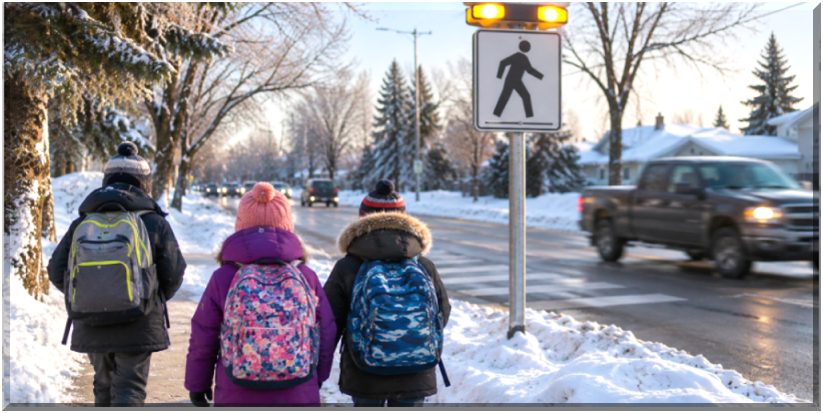
School zones protect children near their classrooms. But who is looking after the entire journey between home and school?
The school day begins at the front door
For many Grande Prairie children, the school day begins well before the first bell rings.
It begins when they put on their backpacks, close the front door and start walking.
Depending on where they live, their journey may involve residential streets, busy intersections, commercial entrances, sidewalks, crosswalks and roads where the speed limit is considerably higher than it is outside their school.
During a Peace Country winter, that journey can also take place in darkness, on icy sidewalks and alongside snowbanks that make it more difficult for drivers and pedestrians to see one another.
Parents can teach their children how to cross a street safely.
Drivers can be reminded to slow down.
Police can enforce traffic laws.
But who examines the entire journey to determine whether the infrastructure itself provides adequate protection?
249 speeding violations in just two weeks
On September 24, Grande Prairie Police Service released figures covering school-zone enforcement between September 3 and September 18, 2026.
Enforcement officers issued 140 speeding tickets. Automated traffic enforcement recorded another 109 speeding contraventions.
Together, that represents 249 recorded violations during the reporting period.
One ticketed motorist was travelling at 63 km/h — more than twice the posted school-zone limit.
Police also identified concerns involving parking too close to intersections and pedestrian crossings, vehicles occupying sidewalks and motorists stopping in restricted areas.
These figures establish that speeding and improper vehicle behaviour around schools are documented local concerns.
They do not, however, reveal how many children have been struck by vehicles or identify the most dangerous routes to school.
Where does a school zone end?
A child may spend only a small portion of their journey within a designated school zone.
The remainder can involve roads where drivers are legally permitted to travel faster.
A school-zone sign marks a change in the rules for motorists, but it does not mark the beginning or end of a child's journey.
Consider a hypothetical student who lives several blocks from school.
The student might cross a neighbourhood street, follow a sidewalk beside a busy road, cross another intersection and only then enter the designated school zone.
Which of those crossings presents the greatest risk?
Does anyone regularly assess that student's entire route?
Are the safest walking routes identified and communicated to parents?
And are those routes reassessed as neighborhoods grow, traffic increases and winter conditions change?
How does Grande Prairie decide where a crosswalk is needed?
The City has an established process for assessing requests for new or improved pedestrian crossings.
Its Transportation Department considers factors including:
- The number and characteristics of pedestrians using the crossing.
- The amount and speed of vehicle traffic.
- The number of traffic lanes.
- Visibility for motorists and pedestrians.
- Nearby crossing locations.
- Previous collisions.
The City follows national pedestrian crossing assessment guidance when determining whether a location qualifies for improvements.
Locations that meet the criteria are prioritised, with installation dependent on available funding.
The City's published procedures also indicate that an assessed location would not ordinarily be reviewed again within three years unless substantial new development occurs.
That raises several questions.
What happens when parents repeatedly report near misses at a crossing that has already been assessed?
Can a significant change in traffic behaviour trigger an earlier review?
How many crossings have qualified for improvements but are still waiting for funding?
The answers would help residents understand how the City's pedestrian safety system operates in practice.
Does someone have to get hurt first?
Collision records are one of several factors used in pedestrian crossing assessments.
But collisions tell only part of the story.
A near miss may leave no police report, no insurance claim and no hospital record.
A parent may witness a vehicle failing to stop while a child waits at a crossing.
A motorist may brake just in time after a pedestrian emerges from behind a snowbank.
A child may return home frightened after an encounter with traffic.
Those experiences may never become part of official collision statistics.
How are such incidents documented?
Can repeated reports from residents influence the priority assigned to a crossing before a serious collision occurs?
Understanding how near misses are collected and assessed could help identify hazards that collision records alone may not reveal.
Winter changes the equation
A crossing that operates reasonably well in September may present different challenges in December or January.
Snowbanks can obstruct sightlines.
Ice can increase stopping distances.
Road markings can disappear beneath snow.
Children wearing winter clothing can be harder to distinguish in poor light.
Vehicles may need considerably more distance to stop safely.
Are pedestrian crossing assessments conducted under winter conditions as well as during warmer months?
Are snow-clearing priorities around schools based only on designated school zones, or do they also consider the surrounding routes children use?
For a northern community, winter pedestrian safety is not an occasional concern. It is a recurring part of the school year.
Evidence that road design can make a difference
Grande Prairie has previously documented improvements in road safety following changes to speed limits.
In March 2025, the City released an analysis comparing injury collisions on four major arterial roadways before and after speed limits were reduced in 2020.
The three-year comparison showed:
- 294 injury collisions between 2017 and 2019.
- 130 injury collisions between 2021 and 2023.
- A reduction of approximately 56 per cent.
The analysis does not establish equivalent results for school routes specifically, nor does it isolate every factor that may have contributed to the reduction.
However, the findings provide a local example of how traffic management decisions can be evaluated using measurable safety outcomes.
Could a similar analysis be undertaken for routes children use to reach their schools?
Five years of unanswered questions
A more complete picture of school-route safety would require collision information from Grande Prairie Police Service, historical crossing assessments from the City and information from local school divisions.
Among the questions worth examining:
- How many pedestrians under the age of 18 have been struck by vehicles in Grande Prairie since 2021?
- How many collisions occurred within designated school or playground zones?
- How many occurred on surrounding streets during school travel hours?
- Which locations have generated repeated pedestrian safety complaints?
- How many requests for pedestrian crossings or flashing lights have been approved, rejected or deferred?
- How many approved crossing improvements are awaiting funding?
- Which schools have formally identified recommended walking routes?
- Are those routes reviewed regularly with parents, school administrators and transportation officials?
The figures required to answer these questions have not yet been established.
Without them, it is difficult to determine whether existing measures are addressing the locations where children face the greatest risks.
A map drawn by the people who walk the streets
Parents, students, school staff, crossing patrollers and neighbourhood residents have another source of information: daily experience.
They know which intersections become congested before school.
They know where snowbanks make it difficult to see approaching vehicles.
They know where drivers routinely fail to stop and where children sometimes struggle to find a safe opportunity to cross.
These observations do not replace professional traffic engineering assessments.
They can, however, identify locations that warrant closer examination.
What would a community-generated map of pedestrian safety concerns across Grande Prairie reveal?
Would the locations identified by parents match those identified through official traffic assessments?
Speak Up — Where is your concern?
If your child walks to school in Grande Prairie, is there a particular crossing or stretch of road that concerns you?
Have you witnessed a near miss?
Is there a location where flashing pedestrian lights, better lighting, improved snow removal or a crossing patroller could make a difference?
Share the intersection or street location and describe the problem.
Please do not identify individual children or disclose their home addresses or personal walking routines.
A collection of documented community observations could help establish where further investigation is needed.
School safety is not limited to what happens inside the classroom or within the boundaries of a school zone.
It includes the journey there and the journey home.
Original sources
- Grande Prairie Police Service — 140 school-zone speeding tickets issued during first two weeks of Grande Prairie school year, September 24, 2026
- City of Grande Prairie — Crosswalks, assessment procedures and pedestrian crossing infrastructure
- City of Grande Prairie — Road safety measures curb injury collisions, March 31, 2025
- City of Grande Prairie — 2025 Traffic Safety Plan
- City of Grande Prairie — Traffic Operations