Fox Creek Drug Bust Raises a Bigger Question: Is the Drug Trade Following the Money?
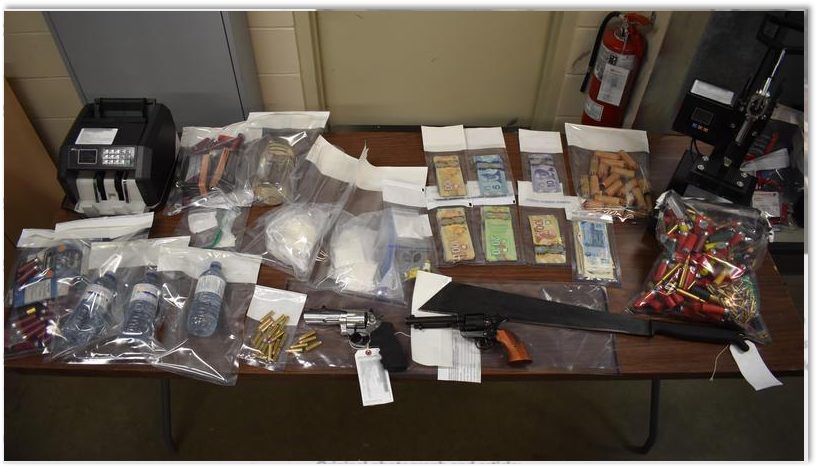
A major drug seizure in a small Alberta resource town raises questions about how illegal drugs reach communities across the Peace Country — and whether relatively high wages, younger workforces and resource-industry economies make some towns attractive markets for traffickers.
Back on top · first published Oct 31
A small town. A significant drug seizure. And a question that reaches well beyond Fox Creek.
On October 28, RCMP officers executed a search warrant at a Fox Creek residence following a multi-week drug trafficking investigation.
Police reported seizing approximately 300 grams of cocaine, 231 grams of methamphetamine, more than a litre of GHB, other suspected drugs, weapons and over $13,000 in cash.
Two Fox Creek residents, aged 45 and 34, were charged.
According to police, both individuals had also been subjects of an earlier drug investigation in April 2026 and were under release conditions when the latest arrests occurred.
The charges have not been proven in court.
For a community the size of Fox Creek, the seizure is significant. But it also raises a larger question:
Are drug traffickers deliberately seeking customers in smaller, relatively prosperous resource-industry communities across northwestern Alberta?
Fox Creek Is Not Alone
Grande Prairie has experienced its own substantial drug trafficking investigations.
In February 2026, RCMP reported arresting three Grande Prairie residents, aged 20, 22 and 24, following an investigation that resulted in the seizure of cocaine, methamphetamine, GHB, six firearms and more than $15,000 in cash.
In October 2025, another Grande Prairie investigation resulted in police reporting the seizure of approximately 1.7 kilograms of cocaine, 1.5 kilograms of methamphetamine, fentanyl, a firearm and more than $50,000 in cash.
And in April 2025, investigators announced charges arising from Project Glacier, an organized crime investigation involving Grande Prairie and the British Columbia Peace Region.
These are separate investigations. There is no publicly established evidence connecting the Fox Creek suspects to the Grande Prairie cases.
Nevertheless, they demonstrate that police are investigating drug trafficking activity in both the region's largest urban centre and its surrounding communities.
That leaves an important question unanswered: How connected are these markets, and where are the drugs coming from?
Are Drug Dealers Following the Money?
Grande Prairie and many surrounding communities have economies influenced by oil and gas, forestry, transportation, construction and other resource-related industries.
Some jobs in these sectors provide substantial earnings, particularly for skilled workers willing to travel, work extended shifts or spend time away from home.
Could that purchasing power make smaller communities attractive to illegal drug distributors?
It's a question worth investigating — but one that requires evidence rather than assumptions.
Research published by the Canadian Centre on Substance Use and Addiction has discussed wastewater findings in Alberta suggesting cocaine consumption can be more prevalent in higher socioeconomic neighbourhoods, while methamphetamine patterns may differ.
Those findings do not establish that Fox Creek residents, oilfield workers or young people with higher incomes are more likely to use illegal drugs.
Nor do they prove that traffickers deliberately target resource towns.
But they do challenge the assumption that illegal drug use is primarily associated with poverty or large urban centres.
Drug demand, drug trafficking and the harms associated with drug use can affect communities across the income spectrum.
What Makes a Smaller Community Vulnerable?
There are several characteristics of resource-industry communities that deserve closer examination.
Workers may have relatively high disposable incomes. Some work rotational schedules, spend extended periods away from family or face demanding physical and mental workloads.
Smaller communities may also have fewer specialized addiction treatment services and fewer confidential support options close to home.
None of these circumstances automatically causes drug use or trafficking. Most workers and residents have no involvement in illegal drugs.
However, understanding whether these conditions influence local drug markets could help communities develop more effective responses.
Are police seeing evidence of dealers travelling between towns? Are drugs being distributed through established local networks? Do employers and health providers observe changing patterns?
Those answers cannot be established from a seizure announcement alone.
Grande Prairie: A Regional Distribution Point?
Grande Prairie is the Peace Country's major centre for commerce, transportation, services and employment.
Its regional connections make it reasonable to ask whether illegal drugs move through the city before reaching surrounding communities.
But being a regional transportation hub does not, by itself, establish that Grande Prairie is a source or distribution centre for the Fox Creek drugs.
That distinction matters.
Investigators would need to identify supply chains, communications, financial transactions or other evidence before drawing conclusions about specific trafficking routes.
The question for police is straightforward:
Have investigations established trafficking connections between Grande Prairie and smaller communities such as Fox Creek, Valleyview, Grande Cache or other resource towns?
And if those connections exist, are they becoming more common?
Another Question: What Happens After the First Arrest?
One detail in the Fox Creek investigation deserves particular attention.
Police reported that the two accused had been involved in an earlier April 2026 drug investigation and were subject to release conditions.
The October arrests therefore raise questions about what happened between the two investigations.
Were the earlier charges still before the courts? What conditions were imposed? What evidence led investigators to pursue another search warrant?
The public should not assume that being charged previously proves someone committed another offence.
But the sequence does make the operation of release conditions, police monitoring and the court process legitimate subjects for further reporting.
Enforcement Is Only Part of the Story
Police seizures may remove drugs and weapons from circulation and disrupt suspected trafficking operations.
But arrests alone do not tell us whether local drug demand is increasing, whether treatment is accessible or whether another supplier will replace an arrested dealer.
There is also a difference between people organizing illegal drug distribution and people experiencing substance-use disorders.
A comprehensive community response may involve law enforcement, prevention, treatment, mental-health support, employers, families and schools.
For smaller communities, the challenge may be ensuring those services are available without residents having to travel long distances or sacrifice privacy.
That raises another question: Are Peace Country communities investing enough in prevention and recovery alongside enforcement?
What Swan City Now Wants to Find Out
The Fox Creek investigation gives us an opportunity to look beyond one police report and ask what is happening across the region.
Swan City Now would like to examine whether drug trafficking investigations are increasing in smaller communities, whether police have identified regional distribution networks, and whether resource-industry employment patterns play any documented role.
We also want to hear from health professionals, employers, addiction-support organizations, community leaders and residents.
The purpose is not to label Fox Creek or any other community as a drug problem town.
It is to understand whether there is a wider pattern, what evidence supports it, and what communities can do in response.
Because the most important story may not be what police found in one residence.
It may be what the investigation tells us — or doesn't yet tell us — about the movement of illegal drugs throughout the Peace Country.
Swan City Speaks: What Do You Think?
Are smaller resource-industry communities becoming attractive markets for drug traffickers, or is that an assumption that needs to be challenged?
Do higher wages and younger workforces influence illegal drug demand, or are other factors more important?
Should police release more regional information about trafficking patterns and connections between communities, where doing so would not compromise investigations?
Are smaller Peace Country towns receiving enough support for addiction prevention, treatment and recovery?
What should communities focus on first — stronger enforcement, better treatment access, education, or some combination?