Grande Prairie: From an 80-Acre Townsite to the City That Changed the Peace Country
Our Past, Our Peace Country — Before the highways, shopping centres, oilfields and industrial parks, Grande Prairie was a small settlement built around a promise: the railway was coming.
Before There Was a City, There Was the Prairie
Imagine standing near Bear Creek more than a century ago.
There is no modern downtown, no bypass carrying heavy trucks around the city and no large shopping district.
The landscape is a mixture of open prairie, forest, waterways and trails.
To the north lies productive prairie land. To the south are timber and the Wapiti River valley.
The place already has a name.
La Grande Prairie — the great prairie.
But it is not yet a city.
The name appeared on early geological survey maps, describing the extensive open grassland in this part of the Peace Country.
The area had a history long before European settlers began promoting town lots.
South Peace Regional Archives records that the prairie was once known as Buffalo Plains because of the large herds of bison and elk that ranged across the landscape.
Indigenous peoples, including Dane-zaa, Cree and Iroquois families, travelled through the region using established routes connecting Jasper, Sturgeon Lake, Flying Shot Lake, Saskatoon Lake, Spirit River and Dunvegan.
These routes were not created by the arrival of settlers.
They were part of longstanding Indigenous relationships with the land, connecting communities, hunting areas and trading places.
The history of Grande Prairie must therefore begin before the establishment of the municipality.
The arrival of homesteaders and commercial development changed the landscape, but did not mark the beginning of human history here.
The Métis Community at Flying Shot Lake
One of the important early communities near present-day Grande Prairie was Flying Shot Lake.
The County of Grande Prairie identifies it as the first surveyed community in the County, surveyed in 1907.
It was a Métis settlement established by families who had arrived from Lac Ste. Anne in the late nineteenth century.
The land was surveyed using long, narrow lots with frontage on the lake and access to prairie land for animal feed.
That arrangement reflected a different approach to landholding from the square quarter-sections later associated with homesteading.
The Flying Shot Lake community is an important reminder that the history of the area cannot be told solely through the later development of Grande Prairie's downtown.
Indigenous and Métis families were already part of the region's history before the new townsite was established.
The Man Who Saw a Town Before There Was One
In 1909, an Edmonton businessman named W.A. Rae visited the Grande Prairie district.
He recognized its agricultural and commercial potential.
The area offered prairie farmland, nearby timber, access to water and the possibility of railway development.
Rae believed that a town could succeed here.
He returned to Edmonton and helped organize a group of businessmen into the Argonaut Company.
The company purchased approximately 80 acres from Joe Germain near the proposed railway route.
A surveyor divided the land into town lots.
The proposed settlement was promoted under an ambitious name:
Grande Prairie City.
There was one significant problem.
There was no city.
There was not even a railway.
The name was a commercial ambition, not a description of the community's legal status.
The promoters were betting on future settlement, agriculture and transportation.
The railway was expected to arrive, but it had not yet reached the district.
For buyers of those early town lots, the future depended on promises becoming reality.
The Edson Trail: Getting Here Was Half the Battle
Today, travelling between Edmonton and Grande Prairie is a routine highway journey.
In the early settlement years, getting to the Peace Country was an undertaking that could test the endurance of travellers, animals and equipment.
The Edson Trail opened in 1911, offering a route north from the railway at Edson.
It was shorter than some earlier routes, but it was far from an easy road.
Much of the route passed through bush and difficult terrain.
Mud, weather and poor conditions could delay wagons carrying supplies and household possessions.
South Peace Regional Archives records that stagecoach passengers sometimes had to walk and push rather than ride.
Imagine transporting a heavy bank safe, printing press or industrial equipment over such a route.
Yet settlers and businesspeople did exactly that.
The arrival of machinery, household goods, building supplies and commercial equipment represented a considerable investment in a place that was still developing.
Every successful delivery helped the settlement grow.
The Edson Trail also created a connection between the emerging town and the larger provincial economy.
Before the railway arrived, that trail was one of Grande Prairie's lifelines.
A Community Begins to Take Shape
By 1911, the small settlement already had the beginnings of a commercial and administrative centre.
South Peace Regional Archives identifies a post office, store, bank, livery barn, stopping places, two churches, Royal North West Mounted Police barracks and a Dominion Land Survey Office.
The land office was especially important.
New settlers came to the district looking for homesteads.
The survey and registration system helped determine where they could establish farms.
The post office connected the community to the outside world.
The bank provided financial services.
Stores supplied food, tools and other necessities.
The livery barn supported the horses that remained essential to transportation.
The police barracks represented the growing presence of government authority.
These institutions helped transform a proposed townsite into a functioning settlement.
By 1913, the community had grown further.
There were schools, hospital services, hotels, trading companies and a Hudson's Bay store.
The Grande Prairie Herald also began publication that year.
The settlement was acquiring the services and institutions associated with a permanent community.
The Newspaper That Recorded the New Town
One of the most important early residents was William Crawford "Bill" Pratt.
Pratt arrived in the Grande Prairie district in 1912.
His wife, Florence Patterson Pratt, and their son Garnet followed in 1913.
That year, Pratt founded the Grande Prairie Herald.
The newspaper became an important record of the developing community.
In a settlement where new businesses were opening, roads were being improved and government institutions were taking shape, a local newspaper helped residents understand what was happening.
It also created a historical record.
Advertisements documented businesses.
Council reports recorded decisions.
Community notices preserved names and events.
Over time, the newspaper became a source for understanding how Grande Prairie changed.
Pratt later worked as an Imperial Oil agent and warehouse distributor and served in community organizations and municipal government.
His story illustrates how early businesspeople often held several roles in a small community.
The newspaper he founded also reminds us that local journalism is part of local history.
Without newspapers, many ordinary events and decisions would be much harder to reconstruct today.
Grande Prairie Becomes a Village
Grande Prairie officially became a village in 1914.
The South Peace Historical Society records that the first village council met on June 15, 1914, with J.B. Taft serving as reeve.
At the time, the settlement was still small.
But it already had businesses, public institutions and an active social life.
Residents organized dances, theatrical performances, sports and other gatherings.
The establishment of a municipal council meant local affairs could be managed through a formal government.
Streets, services, fire protection and other responsibilities required decisions and funding.
In 1915, residents organized a fire brigade.
That same year, electricity began arriving through equipment associated with Joseph Voz's flour mill.
When the mill could no longer meet the demand for electrical service, residents organized the Grande Prairie Electric Company and purchased a power plant.
This was a significant step.
Electricity was becoming part of everyday life, but the infrastructure had to be established locally.
The settlement was growing into a town even before it legally became one.
March 1916: The Railway Finally Arrives
For years, Grande Prairie's promoters had anticipated the railway.
Then, in March 1916, the Edmonton, Dunvegan and British Columbia Railway reached the settlement.
South Peace Historical Society accounts describe the first train arriving on March 25, 1916.
South Peace Regional Archives also holds photographs documenting railway construction, snow clearing and public celebrations during March 1916. Some archival descriptions identify March 22 or March 29 for particular railway scenes.
Those differences matter when identifying an exact photograph or ceremony.
But the larger event is firmly documented.
The railway reached Grande Prairie in March 1916.
The impact was enormous.
Farmers gained a more practical route to market.
Merchants could receive goods by rail.
New settlers could travel into the district more easily.
Building supplies and industrial equipment could be transported more efficiently.
Grande Prairie became the end of the railway line for a period, giving it a strategic position in the western Peace Country.
For the people who had invested in the settlement, the railway's arrival represented the fulfilment of a major promise.
The townsite promoted years earlier was no longer simply a speculative project beside a proposed rail route.
It had become a railway-connected commercial centre.
From Village to Town in Just Five Years
The arrival of the railway accelerated growth.
Although the First World War disrupted development and drew many residents into military service, the postwar years brought renewed settlement.
By 1919, Grande Prairie's population had reached approximately 1,000.
The community achieved town status in March 1919.
Only five years had passed since village incorporation.
Richmond Avenue had become an important business street.
Stores, hotels, restaurants and service businesses served residents and the surrounding agricultural district.
Homes appeared near Bear Creek and along developing streets.
The town was becoming a centre for a much larger rural population.
Its economy depended not only on people living within municipal boundaries, but also on farmers and families from surrounding communities.
That relationship between city and countryside would remain central to Grande Prairie's development.
Richmond Avenue: The Heart of Early Grande Prairie
One of the best ways to understand the city's early history is through photographs of Richmond Avenue.
The street, now part of the downtown core, was once lined with wooden commercial buildings, boardwalks, horses and wagons.
South Peace Regional Archives holds photographs showing the street in 1915, 1916 and later years.
A 1915 photograph shows people walking along a wooden sidewalk past businesses including a cigar shop, barber shop and Selkirk Trading Company.
A 1916 photograph identifies J.B. Lambert's store, the Royal North West Mounted Police barracks, Selkirk Trading Company and the Empire Hotel.
Another photograph records Richmond Avenue during the July 1916 Stampede.
Horse-drawn wagons line the street while people watch riders approaching.
These are not merely pictures of old buildings.
They show how people used the town.
They reveal the businesses that supplied the district, the transportation methods of the day and the public events that brought residents together.
They also provide a way to compare the downtown of today with the community's earliest commercial centre.
Schools, Hospitals and the Institutions of a Growing Town
As the population increased, Grande Prairie required more schools and health services.
The Kathryn Prittie Hospital became an important part of early community life.
South Peace Regional Archives holds photographs of the hospital during the railway era, including a July 1916 image showing patriotic decorations around its entrance.
Education was also expanding.
Montrose School opened in 1917.
An archival photograph records students and teachers on its front steps on November 26, 1917.
The school represented a major investment in the community's future.
Families were no longer simply establishing farms and businesses.
They were building institutions for the next generation.
Hospitals and schools also became important employers and gathering places.
Their development reflected a growing expectation that Grande Prairie would become a permanent regional centre.
The 1920s: Growth Was Not Guaranteed
It would be easy to imagine Grande Prairie's history as one uninterrupted period of expansion.
That would be misleading.
The 1920s brought economic difficulties and population decline.
The community had to contend with the uncertainty affecting many agricultural and railway-dependent towns.
Farm incomes could fluctuate.
Transportation remained expensive.
Businesses depended on the purchasing power of surrounding farms.
Grande Prairie's future was not guaranteed simply because the railway had arrived.
The town had to continue attracting residents, investment and services.
By the 1930s, however, the district experienced renewed settlement.
The Peace Country was less severely affected by the drought conditions that devastated parts of the southern Prairies.
That helped attract families looking for agricultural opportunities.
The town continued developing as a service centre.
War Brings a New Role to Grande Prairie
During the Second World War, Grande Prairie's transportation role expanded beyond roads and railways.
The region became connected to the Northwest Staging Route, which supported military aviation and northern transportation.
Aircraft travelling through northwestern Canada used a network of airfields and facilities.
Grande Prairie became an important stop along that route.
The construction of the Alaska Highway, beginning in 1942, also brought increased military and transportation activity to the wider region.
Dawson Creek was the highway's principal southern starting point, but Grande Prairie benefited from its position within the regional transportation network.
The war years brought new activity, employment and infrastructure demands.
They also connected a relatively remote northern Alberta town to international events.
The aircraft, military personnel and transportation activity of that period remain an important part of Grande Prairie's history.
The Road Changes Everything Again
For decades, the railway had been one of the most important factors in Grande Prairie's growth.
But improved highways gradually changed how people and goods moved.
Road transportation became more practical.
Trucks carried freight.
Families could travel greater distances by automobile.
Businesses were no longer as dependent on the railway station.
Improved connections to Edmonton and other centres helped Grande Prairie expand its commercial reach.
The development and paving of major highway routes during the mid-twentieth century helped reduce the community's isolation.
That shift affected more than transportation.
It changed where businesses located, how residents shopped and how communities interacted.
The city increasingly served a large area of northwestern Alberta and northeastern British Columbia.
Its commercial importance was no longer tied solely to the railway.
1958: Grande Prairie Finally Becomes a City
In 1958, Grande Prairie achieved city status.
It was a remarkable milestone.
Less than half a century earlier, businessmen had promoted an 80-acre townsite as "Grande Prairie City" before the railway had arrived.
Now the name had become a legal reality.
The community had developed from a small settlement into a regional centre with schools, hospitals, businesses, transportation facilities and municipal services.
City status did not mean that every challenge had been solved.
Roads, utilities, housing, public services and employment would continue to demand investment.
But it marked a major stage in Grande Prairie's development.
The original promoters had anticipated that the location could support a substantial community.
By 1958, Grande Prairie had demonstrated that potential.
Forestry, Oil and Gas Transform the Economy
The second half of the twentieth century brought another major transformation.
Agriculture remained important, but forestry and energy development expanded the regional economy.
In 1965, Canadian Forest Products, now commonly known as Canfor, centralized sawmill and plywood operations in Grande Prairie.
The company developed an integrated approach that used sawmill byproducts to produce pulp chips.
This helped establish the community as a major forestry and manufacturing centre.
The opening of a major pulp mill in 1972 further expanded the industrial economy.
At the same time, oil and natural gas development created demand for workers, equipment, transportation, maintenance and business services.
Grande Prairie became an important base for companies serving the surrounding resource-producing region.
The economic effects extended well beyond the city.
Workers travelled to industrial sites throughout the Peace Country.
Local businesses supplied equipment and services.
Families moved into the region for employment.
New housing, commercial development and public facilities followed.
But resource-based growth also brought vulnerability.
Oil and gas prices fluctuate.
Forestry markets change.
Industrial investment can rise or fall.
Grande Prairie's history includes both periods of rapid expansion and times when residents and businesses had to adjust to economic downturns.
A Second Railway Milestone in 1969
The original railway had helped establish Grande Prairie as a commercial centre.
More than fifty years later, another railway project marked a new stage in the region's development.
In May 1969, the Alberta Resources Railway was officially opened.
The new line connected Hinton and Grande Prairie.
The project was celebrated at the Northwest Resources Conference.
Premier Harry Strom participated in the opening ceremonies on May 28.
Former premier Ernest Manning and former Canadian National Railways vice-president G. Roger Graham took part in a symbolic ceremony involving the removal of an obstacle from the track.
The event reflected the continuing importance of transportation infrastructure to the Peace Country's economy.
Railways were no longer simply bringing homesteaders into the region.
They were supporting industrial development and the movement of resources.
The railway story had come full circle.
The People Who Preserved Grande Prairie's History
Much of what we know about early Grande Prairie survives because individuals and organizations preserved photographs, newspapers, maps and written records.
The South Peace Regional Archives holds municipal documents, family collections and historical photographs.
Its Town of Grande Prairie fonds contains records dating from 1917 to 1951.
The Pioneer Museum Society collection includes photographs of the railway's arrival, early streets, businesses, schools and public celebrations.
The Bill Pratt collection preserves photographs from a 1928 tour of the Peace Country by Canadian Pacific Railway officials and business leaders.
Grande Prairie Public Library also holds important historical resources.
The Isabel Campbell Collection includes indexes of local newspaper material from 1913 to 1961.
These records allow researchers to connect names, dates and events.
They also demonstrate why preserving local history matters.
A photograph without names can become a mystery.
A newspaper without an archive can disappear.
A family story that is never recorded may be lost when the people who remember it are gone.
Preserving history requires more than collecting old objects.
It requires identifying the people, places and events that give those objects meaning.
What Grande Prairie's History Tells Us About the Future
Grande Prairie's history is a story of changing transportation systems and economic opportunities.
The Indigenous trails came first.
Then came homesteading routes, including the Edson Trail.
The railway transformed the settlement.
Highways and aviation expanded its connections.
Forestry and energy development created new industries.
Each change affected the community's economy, population and physical development.
But growth also brought questions that remain relevant today.
Who benefits from major infrastructure projects?
Who pays for the roads, utilities and services required by development?
How should a growing city balance its own needs with those of surrounding rural communities?
What happens when an industry expands rapidly, then contracts?
These are not new questions.
The people who established Grande Prairie faced their own versions of them.
They invested in land before the railway arrived.
They built services before knowing how large the community would become.
They adapted to changing markets, transportation systems and industries.
The decisions made by those earlier generations shaped the city that exists today.
Grande Prairie was not built in one great moment. It was built through thousands of decisions made by people who believed there was a future here.
Historical Photographs Worth Sharing
1. The Railway Arrives, 1916
South Peace Regional Archives holds photographs of the Edmonton, Dunvegan and British Columbia Railway arriving in Grande Prairie.
Suggested caption: Residents gather as the Edmonton, Dunvegan and British Columbia Railway reaches Grande Prairie in March 1916, connecting the young settlement to larger markets and changing its future.
Credit: South Peace Regional Archives, City of Grande Prairie Historical Photograph Collection, items 0460.32–0460.36. Confirm the selected image's exact item number, photographer and reproduction rights before publication.
2. Richmond Avenue, 1915
A photograph shows early businesses and pedestrians along the wooden sidewalk.
Suggested caption: Richmond Avenue in 1915, when wooden sidewalks, horse-drawn transportation and small businesses formed the heart of Grande Prairie's commercial district.
Credit: South Peace Regional Archives, City of Grande Prairie Historical Photograph Collection, item 0460.27. Photographer not established in the catalogue.
3. Richmond Avenue During the Stampede, 1916
An archival photograph shows riders, wagons and spectators during the July 1–3, 1916, Stampede.
Suggested caption: Riders and spectators gather on Richmond Avenue during Grande Prairie's 1916 Stampede, illustrating the community's early social and sporting life.
Credit: South Peace Regional Archives, City of Grande Prairie Historical Photograph Collection, item 0460.29. Photographer not established in the catalogue.
4. Montrose School, 1917
A photograph shows students and teachers on the steps of Montrose School on November 26, 1917.
Suggested caption: Students and teachers gather at Montrose School on November 26, 1917, as Grande Prairie expands its educational facilities.
Credit: South Peace Regional Archives, Pioneer Museum Society of Grande Prairie & District fonds, item 2001.01.110. Photographer not established in the catalogue.
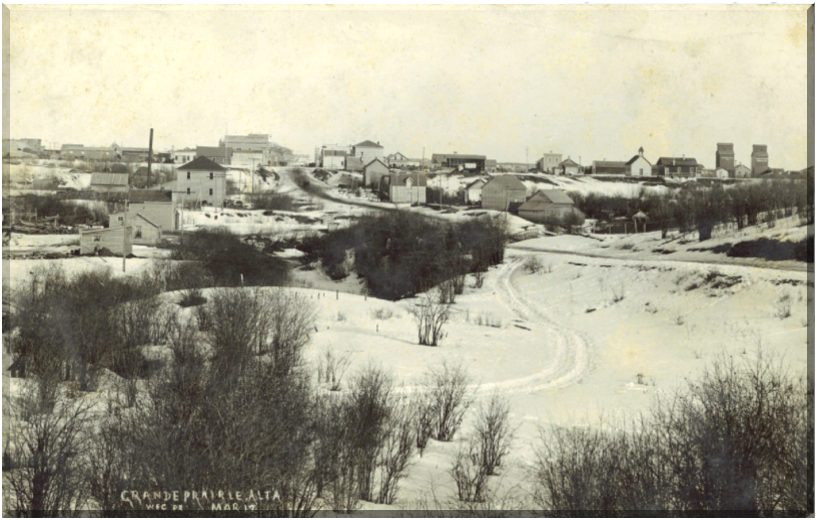
5. Grande Prairie From Bear Creek, 1917
A panoramic photograph shows the developing settlement from the west bank of Bear Creek.
Suggested caption: Grande Prairie in 1917, viewed from the west bank of Bear Creek, showing the young town as it developed following the railway's arrival.
Credit: South Peace Regional Archives, Pioneer Museum Society of Grande Prairie & District fonds, item 2001.01.039. Photographer not established in the catalogue.
Photograph publication note: These are verified archival catalogue entries, not confirmation that high-resolution copies are freely reusable. Obtain the selected image and confirm reproduction permission before publication.
Sources and Historical References
South Peace Regional Archives — Town of Grande Prairie Fonds
Municipal history, townsite development, railway arrival, early businesses, incorporation and municipal records.
https://www.southpeacearchives.org/finding-aid/fonds-450-town-of-grande-prairie-fonds/
South Peace Regional Archives — City of Grande Prairie Historical Photograph Collection
Historical photographs of Richmond Avenue, early businesses, the 1916 railway arrival and public celebrations.
South Peace Regional Archives — Pioneer Museum Society Collection
Historical photographs documenting early settlement, the railway, schools and community development.
South Peace Regional Archives — Bill Pratt Photograph Collection
Biographical information about William Crawford Pratt and photographs documenting the 1928 Canadian Pacific Railway inspection tour.
https://www.southpeacearchives.org/finding-aid/fonds-107-bill-pratt-photograph-collection/
South Peace Regional Archives — G. Roger Graham Photograph Collection
Records of the 1969 Alberta Resources Railway opening and Northwest Resources Conference.
https://www.southpeacearchives.org/finding-aid/fonds-057-g-roger-graham-photograph-collection/
South Peace Historical Society — Grande Prairie: Its History
Detailed account of early settlement, village incorporation, railway construction and town development.
https://calverley.ca/article/16-002-grande-prairie-its-history/
County of Grande Prairie — Establishing the County
Historical account of Flying Shot Lake, Métis settlement, homesteading, the Edson Trail and regional municipal development.
Grande Prairie Public Library — Local History and Genealogy
Information about the Isabel Campbell Collection, local newspaper archives and historical research resources.
https://gppl.ca/Using-the-Library2/Collections/local-history-genealogy
City of Grande Prairie — Canfor: A Cornerstone of Grande Prairie's Forest Industry
Municipal economic history describing the development of forestry operations beginning in 1965.
Swan City Speaks: What Do You Think?
Grande Prairie residents, former residents and families with deep roots in the Peace Country — your memories are part of this city's history.
-
Do you have old photographs of Grande Prairie? We'd especially like to see Richmond Avenue, the railway station, early neighbourhoods, schools, businesses and the downtown before modern redevelopment. Can you identify the people pictured?
-
What do you remember about the changing city? Perhaps your family operated a business, worked in forestry or the oilpatch, attended Montrose School, helped build a community facility or remembers when a familiar street looked completely different.
-
What have we missed? Are there important Indigenous or Métis histories, early families, community leaders, businesses, neighbourhoods or events that deserve greater recognition? Can you help correct or expand the historical record?
When sharing a photograph, please include any known names, approximate dates, locations and information about who owns the image.
The history of Grande Prairie is more than a collection of dates and buildings. It is the history of the people who lived here, worked here, raised families and helped shape the community.
Share your memories and thoughts in the comments. Your opinion matters.