Will a High School Diploma Mean Something Different in 2028?
More choices, fewer compulsory academic credits and new life-skills requirements — what will Alberta's education changes mean for Peace Country students?
What should a young person know before leaving school?
Imagine two students graduating from a Peace Country high school in 2031.
One wants to become an engineer.
The other wants to become a heavy-duty equipment technician and eventually operate a business.
Both need an education. Both need literacy, numeracy and practical life skills. But their career paths may require different combinations of knowledge and experience.
Should their high school education look the same?
Alberta is preparing to give future students more flexibility in answering that question.
The provincial government announced changes to high school graduation requirements on November 13, with implementation beginning in the 2028–29 school year.
The changes will affect how students earn their diplomas and how schools prepare them for life beyond the classroom.
What is changing?
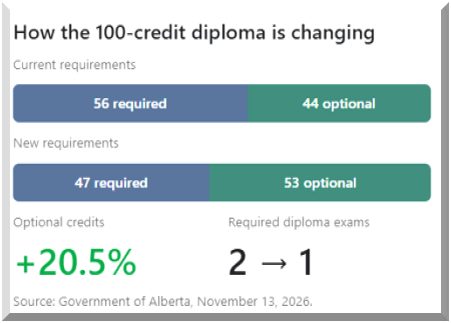
The Alberta High School Diploma will remain a 100-credit qualification.
The difference is how those credits can be earned.
| Credit category | Current | New |
|---|---|---|
| Required credits | 56 | 47 |
| Optional credits | 44 | 53 |
| Total credits | 100 | 100 |
Grade 10 will retain its foundation in English, social studies, mathematics and science.
In subsequent grades, students will have greater freedom to choose among humanities, mathematics and science subjects.
Physical education, personal wellness and financial education will receive additional attention.
The minimum number of compulsory provincial diploma examinations will fall from two to one, although students taking other examination-based courses will still be subject to their respective requirements.
The provincial government's stated objective is to allow young people to build an education around their interests and future careers.
Finally, learning about money
One of the changes that may attract considerable interest from families is mandatory financial literacy instruction in Grades 11 and 12.
Consider the financial decisions facing a young person shortly after graduation.
They may purchase their first vehicle, apply for a credit card, rent an apartment, receive their first full-time paycheque or borrow money for further education.
Each decision can have consequences lasting well beyond graduation day.
Financial education could help students understand subjects such as:
- Household budgeting.
- Credit scores and borrowing.
- Compound interest.
- Income taxes and payroll deductions.
- Vehicle financing.
- Saving and investing.
- Insurance and financial risk.
These are examples of practical topics that could be explored. The detailed content of the new financial literacy courses is not yet established in the published framework.
That leaves an important question for students, parents and educators: what financial knowledge should every young Albertan possess before entering adulthood?
Is more choice always better?
The Alberta School Councils' Association has raised concerns about the new direction.
The organisation, which represents school councils across Alberta, questions whether reducing compulsory academic credits could weaken the foundational knowledge students receive before graduating.
There is a distinction between allowing students to pursue their interests and ensuring they retain the knowledge needed to change direction later in life.
A 15-year-old may have a clear idea of what they want to become.
At 19, that same person may have an entirely different career ambition.
Will the decisions made during high school leave enough doors open?
A student who graduates without the mathematics, science or English courses necessary for a particular post-secondary programme may subsequently need academic upgrading.
Greater flexibility could provide valuable opportunities, but informed course selection will become increasingly important.
The diploma is not necessarily the destination
Completing high school and qualifying for a particular post-secondary programme are two different things.
Alberta's own graduation guidance makes that distinction clear.
Universities, polytechnics and other post-secondary institutions can establish their own admission standards.
A student hoping to pursue engineering, nursing, business or another specialised profession may need particular high school courses and minimum grades, even if those courses are no longer compulsory for graduation.
For Peace Country families, Northwestern Polytechnic will be an important part of this discussion.
Will its admission requirements remain unchanged?
Will students and parents receive clear information about which high school courses they should select?
Could more students require academic upgrading after graduation because their chosen high school courses do not meet admission requirements?
The diploma alone may not answer those questions.
The Peace Country opportunity
The region's economy provides a wide range of potential career pathways.
Agriculture, energy, forestry, construction, transportation, healthcare, technology and entrepreneurship are all part of the local employment landscape.
Greater flexibility could allow schools to develop educational experiences that connect students with these industries.
A student interested in agriculture might explore equipment technology, plant science, farm management and business accounting.
A future tradesperson might develop skills in welding, electrical systems, mechanics or construction.
A student interested in operating a business might explore finance, marketing, technology and entrepreneurship.
Students pursuing professional careers could continue selecting advanced academic subjects.
These are possible educational pathways rather than confirmed new programmes at local schools.
Their availability will depend on how individual school authorities implement the changes.
Will students in smaller communities have the same choices?
Giving a student permission to take an optional course is not the same as making that course available.
A large urban high school may have enough students to support several specialised courses, dedicated instructors, workshops and laboratories.
A smaller rural school may face different practical considerations.
Will there be enough students interested in each specialised subject?
Will qualified instructors be available?
Will schools need additional equipment and facilities?
Could students travel to regional centres for certain programmes?
Could online instruction, shared teachers and partnerships with local businesses help expand their opportunities?
These questions are particularly relevant to families in smaller Peace Country communities.
The true measure of educational flexibility may be the number of meaningful choices available to each student, regardless of where they live.
What local employers would like to see
The changes also create an opportunity to involve Peace Country employers in a broader conversation about education.
What knowledge and abilities do businesses expect from young people entering the workforce?
How important are communication, mathematics, problem-solving, reliability and technical skills?
Where could additional practical training help?
Would employers participate in work experience, mentorship, apprenticeship preparation or specialised classroom programmes?
Local businesses may have valuable experience to contribute as school divisions consider how to implement the new requirements.
Those contributions could help connect classroom learning with the realities of working in the Peace Country.
Direct consultation with employers would be needed to establish their priorities.
Which students will be affected?
The implementation will take place over three school years.
| School year | Grades covered by new requirements |
|---|---|
| 2028–29 | Grade 10 |
| 2029–30 | Grades 10 and 11 |
| 2030–31 | Grades 10, 11 and 12 |
Children currently in Grade 8 during the 2026–27 school year would ordinarily be among the first students entering Grade 10 under the new requirements.
That means the conversation is particularly relevant to families with children currently attending junior high school.
Transition arrangements for older students are still being developed.
The province anticipates public information sessions in spring 2027, followed by implementation guidance for school authorities in June 2027.
Separate consultation will help determine how the changes apply to francophone education.
Questions for our local school divisions
Grande Prairie Public School Division, Grande Prairie and District Catholic Schools and Peace Wapiti Public School Division will all have important roles in implementing the new framework.
Among the questions worth asking:
- Which additional courses could become available to local students?
- Will smaller schools receive additional resources to expand their course offerings?
- Will new teachers, specialised instructors or facilities be required?
- How will students receive career and academic guidance?
- Will employers and Northwestern Polytechnic participate in developing educational pathways?
- How will schools ensure students retain the qualifications needed if their career ambitions change?
- Will transportation or additional costs limit access to specialised programmes?
- How will the success of the new graduation requirements be measured?
Local implementation plans and associated costs have not yet been established in this reporting.
What does it mean to be educated?
A high school diploma is often regarded as the first major educational milestone in a young person's life.
But what should that milestone represent?
The ability to understand the world?
The foundation for further education?
The skills needed to earn a living?
The ability to manage one's finances?
The confidence to make informed decisions?
Or a combination of all these things?
Alberta's new graduation requirements will change the balance between compulsory learning and individual choice.
For Peace Country students, their experience will also depend on the educational opportunities available in their own communities.
Next Gen — Your education, your future
If you could design your own high school education, what would you include?
Would you spend more time learning about money, technology, agriculture or skilled trades?
Would you prefer more mathematics, science, history or literature?
What practical skills do you believe every student should learn before graduation?
We invite Peace Country students, parents, teachers and employers to share their perspectives through The Local Wire.
Today's students will be tomorrow's employees, entrepreneurs, parents and community leaders.
Their voices belong in the conversation about what they learn.
Original sources
- Government of Alberta — Upcoming changes to graduation requirements
- Government of Alberta — New high school graduation requirements fact sheet, November 13, 2026
- Alberta School Councils' Association — Statement concerning changes to graduation requirements, November 16, 2026
- Government of Alberta — Graduation requirements, credentials and credits
- Alberta ALIS — Plan Your High School Journey