A Good Crop Still in the Field: Peace Country Farmers Race Against Winter
While most of Alberta has nearly finished harvesting, Peace Country farmers are still fighting wet fields, cool weather and a shrinking window to bring in their canola.
For many Peace Country farmers, the 2026 growing season has delivered an uncomfortable contradiction: potentially strong yields, but a harvest that refuses to end.
While farmers across much of southern and central Alberta have nearly finished combining, producers around Grande Prairie, Sexsmith, Beaverlodge, Rycroft, Fairview and the wider Peace Country are still working to get crops off the fields before winter settles in.
According to Alberta's October 20 Crop Report, 94 per cent of the province's major crops had been harvested.
In the Peace Region, that figure was only 81 per cent.
The biggest concern is canola, one of the region's most important cash crops.
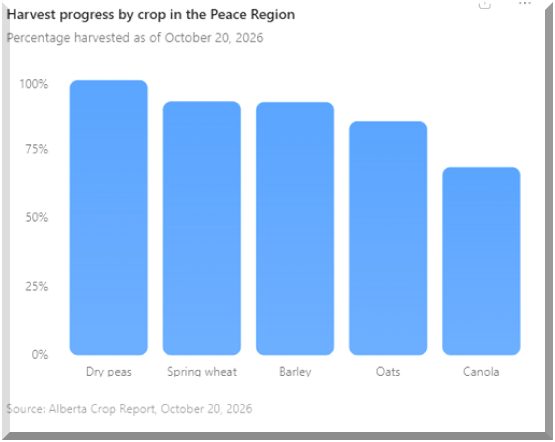
Only 68.2 per cent of Peace Region canola had been combined as of October 20, leaving nearly one-third still unharvested.
And with November approaching, the pressure is growing.
Canola Is the Crop Holding Farmers Back
Most other major Peace Country crops are much closer to completion.
The October 20 report provides the following harvest estimates:
| Crop | Harvested |
|---|---|
| Dry peas | 99.9% |
| Spring wheat | 92.1% |
| Barley | 91.9% |
| Oats | 84.9% |
| Canola | 68.2% |
Canola is clearly the exception.
Provincially, approximately 86 per cent of canola had been harvested, putting Peace Region producers almost 18 percentage points behind the Alberta average.
However, there is an important distinction.
Another approximately 23 per cent of Peace Region canola had already been swathed, meaning it had been cut and laid in rows to dry before combining.
That crop is not necessarily lost.
But it remains exposed to weather until it can be picked up, threshed and safely stored.
For producers with hundreds or thousands of acres still waiting, every suitable harvest day matters.
The Problem Isn't Just Rain — It's Drying Time
The provincial crop report identifies several reasons for the delayed harvest.
Moisture remains in both the crop and the soil, while cooler temperatures are reducing the amount of time available for natural drying.
During warmer weather, a wet field or damp crop may become workable after a few hours of sunshine and wind.
By late October, shorter days and lower temperatures make that process considerably slower.
Even when the crop itself is dry enough, saturated ground can prevent heavy combines and grain trucks from operating safely.
Low-lying areas present particular problems.
The report also notes that strong winds have moved swathed crops around some fields, creating additional challenges for farmers trying to pick them up.
The result is frustrating: a field may contain a valuable crop, but conditions may prevent a farmer from harvesting it.
The Surprising Part: Yields Could Be Above Average
Despite the difficult harvest, there is some encouraging news.
Alberta's October 20 crop report estimates that dryland major-crop yields in the Peace Region could finish approximately 14 per cent above the five-year average.
Provincially, yields are estimated at approximately 21 per cent above average.
That suggests the growing season may have produced strong crops in many areas.
But there is an important difference between what grows in the field and what ultimately reaches the grain bin.
A yield estimate does not guarantee that every acre will be harvested or that every bushel will receive a premium grade.
If weather prevents combining, or grain quality deteriorates before harvest, the financial result can be very different from the original yield potential.
A good crop is only good business when a farmer can harvest it, store it and sell it.
What Happens If Canola Is Left Over Winter?
Canola is a valuable crop, but leaving it in the field over winter introduces risks.
Swathed canola can be exposed to snow, wind, moisture and wildlife.
Standing canola can also suffer losses through pod shattering, lodging and other weather-related damage.
Some producers may eventually attempt spring harvesting if conditions prevent them from finishing this fall.
That is possible in certain circumstances, but it carries additional uncertainty.
Crop losses can increase, grain quality may deteriorate, and spring fieldwork can be delayed while producers finish harvesting the previous year's crop.
There is also the question of financing.
Farmers generally incur most of their production costs long before harvest, including seed, fertilizer, fuel, machinery, land payments and operating expenses.
Delays in harvesting can mean delays in delivering grain and receiving income.
Additional grain drying, equipment repairs or extra fieldwork can further increase costs.
Not every farm faces the same circumstances, but the financial consequences of an extended harvest can be substantial.
A Different Kind of Moisture Problem
One of the most interesting findings in the October 20 report is the Peace Region's soil moisture situation.
Approximately 93 per cent of surface soil moisture and 98 per cent of sub-surface soil moisture were rated good to excellent.
That is encouraging for longer-term moisture reserves.
But right now, the same moisture that may help support future crops is making it difficult for some producers to finish harvesting this year's crop.
It is one of agriculture's recurring challenges: too little moisture can limit production, while too much at the wrong time can prevent a successful harvest.
The timing can be just as important as the amount.
The Livestock Side of the Story
The approaching winter also affects Peace Country cattle producers.
As pasture growth slows and temperatures fall, ranchers are beginning to bring cattle home from summer grazing areas.
The provincial report rated approximately 47 per cent of Peace Region pasture growth conditions as good to excellent.
Peace Region dryland hay production averaged approximately 1.8 tons per acre for the first cut, with no second-cut production reported.
For cattle producers, the focus now turns toward winter feed supplies, hay quality, feed costs and ensuring sufficient forage is available until spring.
For mixed farms that produce both grain and livestock, the demands of a late harvest can overlap with the work of preparing animals and facilities for winter.
Why This Matters Beyond the Farm Gate
Agriculture is a major part of the Peace Country economy.
When harvest is delayed, the effects can extend beyond individual farms.
Grain elevators, trucking companies, equipment dealers, repair shops, fuel suppliers and agricultural service businesses all depend on the seasonal movement of crops.
A strong harvest can support spending and investment throughout the region.
A difficult harvest can create financial pressure, delay deliveries and increase operating expenses.
For residents who do not farm, it is easy to overlook how much of the local economy depends on a relatively short window of suitable weather.
A few weeks can make an enormous difference.
What Will the Next Crop Report Tell Us?
The next Alberta Crop Report is expected October 30.
That report should provide a clearer picture of whether Peace Country farmers were able to make further progress during the final days of October.
Three questions will be particularly important:
First: How much of the remaining canola has been harvested?
Second: Have wet fields and cooler temperatures continued to limit combining?
Third: Are crop quality and yield expectations holding up as the harvest stretches into November?
For now, the October 20 figures remain the latest confirmed regional snapshot.
They show that the Peace Country has made progress, but still faces the largest remaining harvest challenge among Alberta's agricultural regions.
The Harvest Isn't Finished Until It's in the Bin
Farmers know that growing a crop and harvesting it are two very different accomplishments.
The Peace Country may be looking at an above-average production year, but a significant amount of canola remains exposed to the elements.
The coming days will determine how much more of that potential production makes it safely into storage.
And for the farmers still watching the weather and waiting for fields to dry, the 2026 harvest is far from over.
Swan City Speaks: What Do You Think?
We would particularly like to hear directly from Peace Country farmers and ranchers.
1. Farmers: How much of your 2026 crop is still in the field, and what has been your biggest challenge this fall?
2. Are you expecting above-average yields this year, or have weather and harvest delays affected crop quality?
3. Have you ever had to leave canola or other crops standing over winter? What happened when you returned in the spring?
Share your thoughts in the comments. Your opinion matters.
Sources:
Alberta Crop Report — October 20, 2026, produced by Agriculture Financial Services Corporation and the Government of Alberta.
Agricultural market analysis, Syngenta Canada, October 23, 2026:
https://www.syngenta.ca/market-news/cool-temps--wetness-slow-last-of-alberta-harvest
Alberta crop statistics by region: