Alberta's Bill 42: Who Makes the Rules, Who Can Change Them — and Who Can Be Exempted?
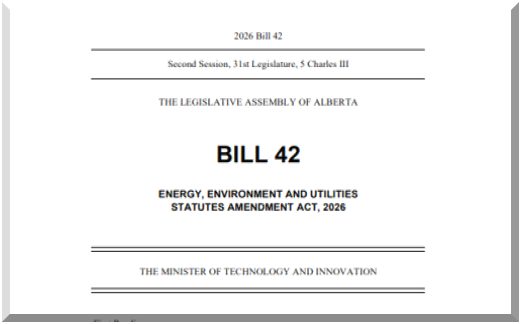
When Alberta introduced Bill 42 on November 18, the provincial government presented it as legislation that would strengthen protections for communities, farmland, water resources and electricity consumers.
Back on top · first published Nov 25
A follow-up to our earlier article, Alberta Wants Ottawa to Stay Out of Its Business. Will It Stay Out of Ours?
The Other Side of Bill 42
Those objectives are clearly outlined in the government's public announcements.
But legislation is not simply about the rules a government promises to introduce. It is also about the authority to make exceptions to those rules.
A closer examination of Bill 42, formally titled the Energy, Environment and Utilities Statutes Amendment Act, 2026, reveals provisions that have received considerably less public attention.
Among them is an amendment extending existing regulatory exemption powers to data centres.
For Peace Country residents concerned about proposed developments near their homes and agricultural land, understanding those powers may be just as important as understanding the proposed protections themselves.
Two Words That Deserve Attention
On printed pages 50 and 51 of Bill 42, the government proposes amendments to Section 5 of the Hydro and Electric Energy Act.
The existing legislation allows the Alberta Utilities Commission to establish regulations excluding certain facilities from provisions of that Act or its regulations.
Bill 42 would extend that authority to include a data centre.
The existing exemption provision contains the words:
either generally or in a particular case
That wording matters because it allows for exemptions that could apply broadly to categories of facilities or to individual circumstances.
The exemption-making authority is not new. Its proposed application to data centres is.
This does not mean data centres would automatically be exempt from provincial requirements. Nor does it give the Commission unlimited authority over every piece of Alberta legislation.
Nevertheless, it raises legitimate questions.
Which requirements could be subject to exemptions? What criteria would be used? Would affected residents be notified? Would the reasons for an exemption be made public?
The distinction between what the legislation permits and how regulators ultimately exercise that authority is important.
The 600-Metre Protection
One of the most prominent elements of Alberta's announcement was a proposed minimum distance of 600 metres between large data centres and nearby homes.
The government says the requirement would apply to facilities of 10 megawatts or larger.
It also says municipalities could request alternative setbacks for certain stand-alone facilities between 10 and less than 75 megawatts that do not have on-site electricity generation.
This would provide some flexibility where municipal planning supports compatible development.
However, the 600-metre figure itself is not written into Bill 42. The legislation provides the authority to establish setback requirements through regulations.
That distinction matters.
A protection established through regulation can generally be amended without introducing a new bill through the Legislature, although changes remain subject to the applicable legal requirements.
Residents awaiting the final legislation should therefore also be paying attention to the regulations that follow it.
Will Previously Approved Data Centres Be Protected From the New Rules?
Perhaps the most immediately relevant provision for Grande Prairie County is the proposed treatment of projects already underway.
The provincial government's official data-centre information identifies several project milestones that could qualify developments for exceptions to the new setback and farmland requirements.
These include:
- An existing Alberta Utilities Commission decision.
- An Alberta Utilities Commission review already underway.
- A signed electricity transmission service agreement with the Alberta Electric System Operator.
- An existing municipal development permit.
The precise qualifying milestones are to be established through regulations.
The province is attempting to provide continuity and certainty for developments that have already progressed through approval processes.
For neighbouring landowners, however, this raises a different question.
Will their properties receive the same protections as properties located near data centres proposed after the regulations take effect?
The answer could depend on when a project received its approvals.
What About Emerson Trail?
On September 4, 2026, the County of Grande Prairie issued a development permit for a data processing establishment near Emerson Trail.
The application was handled under the existing industrial zoning framework, and residents subsequently challenged the approval through the provincial appeal process.
The government's proposed treatment of existing municipal development permits makes this particular development especially relevant.
Could the Emerson Trail project qualify for exceptions to Alberta's new setback and farmland regulations?
Would an outstanding appeal affect its eligibility?
Would amendments to an existing development permit change its status?
Would an expansion of the original project be treated differently?
These questions remain unanswered.
There is currently no confirmed determination that the Emerson Trail development qualifies for an exemption under Bill 42.
The same uncertainty applies to the proposed Wonder Valley development in the MD of Greenview, although its circumstances and approval history are different.
Farmland Protection and a Date Worth Remembering
The provincial government has also announced restrictions intended to protect Alberta's highest-quality agricultural land.
Bill 42 includes an interim requirement for Cabinet approval of applicable developments on designated high-quality agricultural land.
However, proposed Section 11.1(7) of the Hydro and Electric Energy Act specifies that this particular Cabinet approval requirement would cease to have effect on September 20, 2027.
That does not mean all farmland protections would disappear on that date.
Longer-term protections could be established through regulations.
Nevertheless, the transition raises further questions about what permanent agricultural protections will look like, when they will be established and what exceptions may be available.
For a region in which agriculture is a significant contributor to the local economy, these are more than technical legislative details.
Will Residents Be Guaranteed a Public Hearing?
Bill 42 also proposes changes to Section 9(3)(b) of the Alberta Utilities Commission Act.
That section already allows the Commission to proceed without a hearing in certain circumstances involving other regulated energy facilities.
Bill 42 would extend that provision to data centres.
Where the Commission is satisfied that an applicant has complied with applicable rules concerning potentially affected landowners, a hearing would not necessarily be required under that provision.
This does not eliminate public participation rights.
It does, however, raise questions about when residents would be entitled to a formal hearing and how objections would be considered.
Would a municipal public hearing be sufficient?
Would neighbouring residents have another opportunity to present their concerns at the provincial level?
What happens if a municipality opposes a development but the provincial regulator considers it acceptable?
These questions become particularly important when provincial approvals can prevail over conflicting municipal planning decisions.
Who Has the Final Word?
Our earlier coverage examined Section 619 of Alberta's Municipal Government Act, which gives certain provincial regulatory approvals precedence over conflicting municipal planning decisions.
Bill 42 would expand the Alberta Utilities Commission's responsibilities to include major data centres.
The provincial government's stated objective is consistent regulation across Alberta.
For developers, a consistent provincial framework could reduce uncertainty, establish clearer infrastructure obligations and avoid substantially different requirements from one municipality to another.
For municipalities, however, that consistency could come with limitations on local decision-making.
Municipal governments remain responsible for many of the services and infrastructure that support development within their boundaries.
Local residents also live with the consequences of decisions involving neighbouring industrial projects.
How those responsibilities will be balanced against provincial regulatory authority remains a central question.
Alberta's Argument for Provincial Autonomy
The earlier article examined the relationship between Alberta's demands for greater independence from Ottawa and the authority Alberta exercises over its municipalities.
There is an important legal distinction.
Provinces have constitutionally established powers, while municipalities exercise authority granted through provincial legislation.
They are not legally equivalent relationships.
The underlying governance question, however, remains relevant: how much influence should the people closest to a development have over decisions affecting their communities?
Alberta's government argues that provincial jurisdiction allows it to pursue economic development according to Alberta's circumstances and priorities.
Municipalities may similarly have local circumstances and priorities that differ from those of the province as a whole.
Bill 42 provides an opportunity to examine how those competing responsibilities will be reconciled.
What the Province Is Trying to Accomplish
Alberta's proposed framework is not solely about expanding provincial authority or creating exemptions.
The government has also announced measures intended to:
- Reduce water consumption associated with data-centre cooling.
- Establish noise and lighting requirements.
- Encourage the recovery and beneficial use of waste heat.
- Protect electricity consumers from specified project infrastructure costs.
- Increase penalties for serious environmental contamination.
- Provide investment certainty and consistent development requirements.
These are substantial objectives.
The effectiveness of those protections will depend on the final regulations, enforcement practices, eligibility requirements and the circumstances under which exceptions are permitted.
Ten Questions That Still Need Answers
Before the new regulatory framework is finalised, residents and municipal representatives may wish to seek clarification on the following:
-
Which provisions of the Hydro and Electric Energy Act could data centres be exempted from?
-
What criteria would the Alberta Utilities Commission use when establishing exemptions?
-
Would exemptions and the reasons for granting them be publicly accessible?
-
Would neighbouring landowners be notified before an exemption affecting them is considered?
-
Could existing projects near Emerson Trail and within the MD of Greenview qualify for transitional exemptions?
-
Would an appealed municipal development permit qualify as an existing approval?
-
Could municipalities establish residential setbacks greater than the provincial minimum and have those setbacks remain enforceable?
-
What permanent farmland protections will replace the interim Cabinet approval requirement in September 2027?
-
Under what circumstances could a data-centre development proceed without a provincial public hearing?
-
If a provincial approval conflicts with a municipal decision, what legal options would remain available to the municipality and affected residents?
These questions concern both the protections Alberta is proposing and the processes through which those protections could be modified.
Two Days Left to Register
The County of Grande Prairie is preparing to hold its own public hearing concerning proposed changes to its data-centre land-use regulations.
Proposed Bylaw: 2680-26-046 — Data Centre Campus District
When: Wednesday, December 2, 2026, at 1 p.m.
Where: County Administration Building, Council Chambers, 10001 – 84 Avenue, Clairmont.
Deadline to register to speak: Friday, November 27, 2026.
Contact: Legislative Services at 780-532-9842, extension 3393.
Email: legislativeservices@countygp.ab.ca
The hearing concerns municipal land-use regulations, not the passage of Bill 42 itself.
However, the emerging provincial framework could directly influence how the County's regulations operate in the future.
Residents should consult the County's official notice for participation requirements and written submission instructions.
The Story Is Far From Over
Bill 42 remains proposed legislation. The final regulations, exemption criteria and treatment of individual local developments have not been established.
The province has announced a framework intended to protect communities while attracting significant technology investment.
Whether that framework delivers the protections residents expect will depend not only on the rules it establishes, but also on how those rules are applied, who can be exempted and what role local communities retain.
The next important chapter of this story may not be written in the legislation itself.
It may be written in the regulations that follow.
YOU'RE THE REPORTER NOW!
Do you support a consistent provincial framework for data-centre development, or should municipalities have greater authority to establish their own requirements?
What protections do you believe should apply equally to every data centre, regardless of when it was approved?
Share your thoughts through Speak Up!
Original sources
- Legislative Assembly of Alberta — Bill 42: Energy, Environment and Utilities Statutes Amendment Act, 2026 — Full legislative text
- Government of Alberta — Protecting Land and Communities
- Government of Alberta — AI Data Centres in Alberta: Proposed Requirements and Treatment of Existing Projects
- Government of Alberta — Public Input in the Data-Centre Approval Process
- Alberta Utilities Commission — Module A Inquiry Report, 2024
- County of Grande Prairie — Data Centres and Municipal Development Information
- Rural Municipalities of Alberta — Legislative Update, November 16–20, 2026
Previous coverage
Alberta Wants Ottawa to Stay Out of Its Business. Will It Stay Out of Ours?