Highway 40X — Planned for Years, Still Waiting
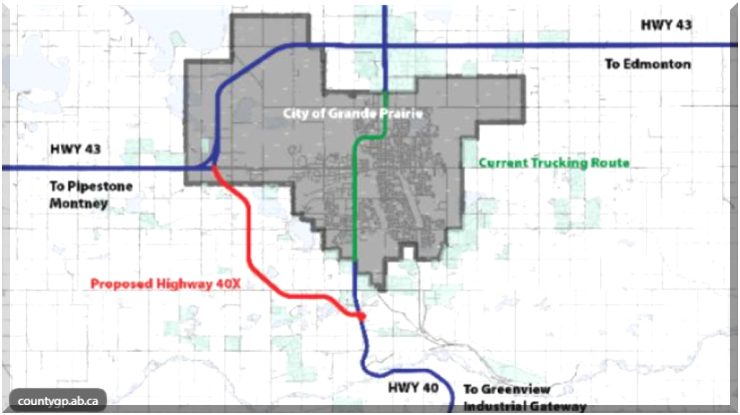
The proposed Highway 40X bypass connecting Highways 40 and 43 near Grande Prairie remains listed in the provincial planning stage, despite a published timetable anticipating construction in 2026. The County of Grande Prairie has made construction funding one of its leading advocacy priorities, while the City also supports the project. The delay raises questions about how Alberta chooses its highway investments. Calgary and Edmonton have completed major ring roads and continue receiving funding for transportation improvements.
Back on top · first published Nov 8
As Calgary and Edmonton benefit from major highway investments, Grande Prairie's proposed southwest bypass raises a larger question: Should provincial road funding reflect population alone, or also the resources, industries and economic activity that depend on rural Alberta?
A Highway Planned for Years, but Still Waiting
Highway 40X is intended to connect Highway 40 south of Grande Prairie with Highway 43 west of the city, providing an alternative route for commercial and industrial traffic.
According to Alberta Transportation, the project builds on a functional planning study approved in 2010.
The Province's project information anticipated completion of detailed design in 2025 and the beginning of construction in 2026.
A public information session was held in Grande Prairie on December 5, 2025.
The information presented for the project described Stage 1 as a two-lane undivided highway, with provision for future expansion. Some interchange components would depend on additional timing and funding approvals.
Yet, as of November 8, 2026, Alberta's Major Projects website continues to classify Highway 40X as a proposed project in the planning stage.
Its published estimated cost is listed as unavailable.
That does not prove construction has been formally delayed. It does mean the public project listing does not confirm that construction has begun.
The current construction contract status, approved funding amount and revised completion date have not been established from the published project information reviewed for this article.
The County of Grande Prairie has made the project a leading advocacy priority for 2026–2027, specifically requesting provincial capital funding for construction.
The City of Grande Prairie has also identified the highway as part of its economic corridors advocacy.
The project therefore has support from both local governments, but a confirmed construction timetable remains an unanswered question.
Calgary and Edmonton Have Their Ring Roads. What About Grande Prairie?
The comparison with Alberta's two largest cities is difficult to avoid.
Edmonton's Anthony Henday Drive was completed in 2016, providing approximately 80 kilometres of ring-road connections.
Calgary's Stoney Trail fully opened in December 2023, providing more than 101 kilometres of free-flowing roadway around the city.
These highways are not simply conveniences for urban commuters. They also carry commercial vehicles, connect industrial areas and support provincial and interprovincial trade.
Grande Prairie's proposed Highway 40X serves a similar general purpose, although on a smaller scale: improving the movement of traffic around an important regional centre.
The Province continues to invest in transportation infrastructure serving Calgary and Edmonton.
During a March 11, 2026, legislative committee meeting, Alberta Transportation outlined $265 million over two years for Deerfoot Trail improvements in Calgary.
The department also identified $125 million over three years in capital grants supporting Yellowhead Trail, Terwillegar Drive and Ray Gibbon Drive improvements in the Edmonton area.
These investments respond to significant traffic volumes, population growth and economic activity.
But the comparison raises an important question.
Should the population of a city be the primary consideration when deciding where to build a highway, or should the economic activity moving along that highway carry comparable weight?
The answer matters particularly in northern Alberta.
Does Population Determine Who Gets the Roads?
Population is an important consideration in infrastructure planning.
A highway carrying tens of thousands of vehicles daily can create substantial economic and safety benefits when congestion is reduced.
For example, Alberta Transportation reports approximately 125,000 vehicles daily on portions of the Highway 2 corridor between Calgary and Airdrie.
That volume helps explain the attention given to highway expansion in the Calgary region.
But traffic volume is not the only measure of a highway's importance.
A rural road may carry fewer vehicles while supporting heavy industrial equipment, timber transportation, agricultural shipments and other commercial activities.
One heavy commercial vehicle can also impose different demands on road infrastructure than a passenger vehicle.
A comparison based exclusively on the number of vehicles would therefore overlook some important differences between urban and industrial transportation.
Alberta's economic corridor policy recognizes the importance of connecting industries and communities to provincial, national and international markets.
Highway 43 is part of the CANAMEX trade corridor connecting Alberta with other Canadian regions and the United States.
Highway 40X would provide an additional connection to that network.
The question is not whether Calgary and Edmonton need transportation infrastructure. Their traffic demands are well documented.
The question is whether Alberta's project-ranking process gives sufficient weight to the economic importance of roads serving smaller population centres.
What Does Rural Alberta Contribute?
The Peace Country supports several important sectors of Alberta's economy.
Oil and natural gas development, forestry, agriculture, transportation, construction and related service industries all depend on reliable road access.
These industries are not confined to the municipalities where their workers live.
Their products and services move through regional transportation networks, creating economic activity across Alberta and beyond.
The Grande Prairie region also serves a wider trading area extending into northwestern Alberta and northeastern British Columbia.
The County of Grande Prairie describes that market as serving more than 280,000 people.
That figure represents a regional trading area, not the population of Grande Prairie itself.
It nevertheless illustrates why measuring the region's transportation needs by city population alone would provide an incomplete picture.
The economic value of resource extraction should be part of the discussion, but it must also be measured carefully.
Oil and gas royalties, corporate taxes, employment income, municipal taxes and business investment are different economic measures. They cannot simply be added together to produce a regional contribution figure.
A credible comparison would need to establish how much economic activity depends on the Highway 40 corridor, how much commercial traffic could use Highway 40X and what benefits construction would generate.
Those figures have not been established in the publicly reviewed material.
Is Rural Alberta Being Shortchanged?
There is an important piece of evidence that challenges a simple urban-versus-rural argument.
During the March 11, 2026, legislative committee meeting, Alberta Transportation reported the following allocations in its three-year capital plan:
| Region | Reported funding |
|---|---|
| Rural Alberta | More than $5.1 billion |
| Calgary region | $1.7 billion |
| Edmonton region | $1.5 billion |
| Total departmental capital plan | $8.3 billion |
These figures show that rural Alberta receives substantial transportation investment.
They do not support a blanket claim that Calgary and Edmonton receive all the money.
However, they also do not establish whether the Peace Country receives funding proportionate to its transportation needs or economic contribution.
Rural Alberta encompasses an enormous geographical area with thousands of kilometres of highways, bridges and resource transportation routes.
The reported figures also cover the department's broader capital plan, not just comparable bypass projects.
A proper assessment would require regional project spending, highway condition, traffic demand, safety records and the economic benefits expected from each investment.
The more useful question may therefore be:
How much of Alberta's rural transportation investment reaches the northwest, and how does that compare with the region's demonstrated needs?
Another Funding Formula Raises Questions
Alberta's Local Government Fiscal Framework provides an example of how population influences infrastructure funding.
For 2026, the Province allocated approximately $800 million in municipal capital funding.
Of that, approximately $423 million was allocated to Calgary and Edmonton combined, with the remainder allocated to other municipalities.
For Calgary and Edmonton, the distribution formula weights population at 48 per cent, education property tax requisitions at 48 per cent and local road length at four per cent.
For other local governments, the formula uses population at 65 per cent, tangible capital assets at 15 per cent, local road length at 10 per cent and amortization of tangible capital assets at 10 per cent, following base and needs-based allocations.
This formula demonstrates the substantial role population plays in municipal infrastructure funding.
However, the Local Government Fiscal Framework is not the funding formula for Highway 40X.
Provincial highway construction is funded and evaluated through separate transportation capital processes.
The municipal formula cannot be used as proof that Highway 40X has been disadvantaged.
It does, however, raise a related public-policy question: Should economic production, industrial transportation demand and the cost of maintaining resource corridors receive greater consideration in infrastructure funding decisions?
Is Rural Alberta Mainly Supplying the Wealth?
There is a broader question behind the Highway 40X debate.
Many of Alberta's important natural resources are produced outside Calgary and Edmonton.
Oil, natural gas, timber, grain and other agricultural products are developed or produced across rural and northern Alberta.
The economic benefits extend well beyond the communities where those resources originate.
Businesses in Calgary and Edmonton provide financing, engineering, transportation, administration, manufacturing and other services connected to those industries.
Provincial revenues also help finance public services and infrastructure throughout Alberta.
The relationship is therefore more complicated than one region producing wealth and another receiving it.
But there is a legitimate question about how the costs and benefits are distributed.
Communities supporting resource extraction may face heavy commercial traffic, road deterioration, infrastructure demands and public safety concerns.
They also benefit from employment, business development, investment and municipal tax revenue associated with those industries.
Does Alberta's infrastructure system adequately recognize both the economic benefits produced by resource regions and the local costs of supporting that production?
That is a question which can be examined through public spending records, industrial traffic data, road maintenance costs and provincial revenue information.
It cannot be answered simply by comparing city populations.
What Would Highway 40X Actually Accomplish?
Alberta Transportation identifies several anticipated benefits from the proposed connector.
These include reducing heavy truck traffic on existing routes, improving driver safety, supporting future traffic demand and strengthening the regional transportation network.
The project could also provide a more efficient connection between industrial activities south of Grande Prairie and Highway 43.
However, the actual benefits depend on the final design, traffic patterns and the number of vehicles that would use the new route.
Several questions remain important:
- How many commercial vehicles currently travel between Highways 40 and 43 through existing Grande Prairie-area roads?
- How many would be expected to divert to Highway 40X?
- What reduction in congestion or collision risk is projected?
- Would the connector reduce maintenance costs on existing municipal roads?
- What land would be required, and how would nearby property owners be affected?
- What is the estimated cost of Stage 1 compared with the ultimate four-lane design?
- Which interchanges would be included initially, and which would require later funding?
These questions would help establish the measurable public benefit of construction.
They would also allow a more meaningful comparison with highway investments elsewhere in Alberta.
Why Has Highway 40X Not Advanced to Construction?
The project has a long planning history.
The Province identifies an approved functional planning study dating to 2010.
Detailed design work and public consultation have continued in subsequent years.
The Province's published timetable anticipated construction beginning in 2026.
The County's August 2026 advocacy announcement specifically requested provincial construction funding.
But the public information reviewed does not establish the precise reason the project remains listed in planning.
Possible factors in highway project scheduling generally include design completion, land acquisition, environmental requirements, construction costs and competition for capital funding.
None of those factors should be presented as the confirmed cause of Highway 40X's current status without supporting evidence.
The Province needs to clarify whether the project has completed detailed design, whether a construction budget has been approved and whether the anticipated schedule has changed.
How Does Alberta Decide Which Highway Gets Built First?
The Province's economic corridor strategy recognizes the importance of moving people and products efficiently.
Alberta Transportation also considers traffic conditions, safety, future growth and infrastructure requirements in its project planning.
During the March 2026 legislative committee meeting, provincial officials explained that engineering and design work helps define project scope and construction costs before funding is requested through future budgets.
That provides some context for the distinction between a project being approved for planning and receiving money to begin construction.
However, a publicly documented, project-specific comparison showing where Highway 40X ranks against other proposed highway investments was not established in the material reviewed.
Such a comparison could answer several important questions.
Does a project serving 100,000 commuters receive more weight than one carrying fewer vehicles but supporting major industrial operations?
How is collision risk measured?
How are freight transportation savings calculated?
Does the Province consider the revenue generated by industries that rely on a transportation corridor?
And are the same evaluation standards applied to highway proposals in Calgary, Edmonton, Grande Prairie, Fort McMurray and other regions?
Without comparable information, claims that one region receives preferential treatment remain interpretations rather than established findings.
The Bigger Issue: A Provincial Highway or a Regional Responsibility?
Highway 40X would serve local residents and businesses, but its purpose extends beyond municipal boundaries.
The connection would support traffic travelling between major provincial highways and link industrial and commercial activities with the broader transportation network.
That creates an important distinction.
A municipal street primarily serving a local neighbourhood has different responsibilities and funding considerations than a highway carrying regional or interprovincial commerce.
The Province identifies Highway 40X as a project under Alberta Transportation and Economic Corridors.
Both the City and County of Grande Prairie are advocating for its construction.
The remaining issue is not whether the highway has regional support.
It is whether the provincial government has committed the construction funding and schedule necessary to deliver it.
The Questions That Still Need Answers
As of November 8, 2026, several key questions remain unresolved in the publicly available information reviewed:
-
Has Alberta Transportation completed the detailed engineering design for Highway 40X?
-
Has construction funding been formally approved, and if so, how much?
-
Does the Province still expect construction to begin in 2026?
-
What is the current estimated cost of Stage 1 and the eventual completed bypass?
-
How does Highway 40X rank against other provincial highway projects awaiting construction funding?
-
What are the projected safety, freight transportation and economic benefits?
-
How much transportation capital funding is allocated specifically to the Grande Prairie and Peace Country region?
-
Does Alberta's highway evaluation process adequately account for resource extraction and commercial freight activity?
These are questions about published government decisions and infrastructure priorities, not evidence of wrongdoing or favouritism.
Swan City Speaks: What Do You Think?
-
Should Alberta give greater weight to resource extraction, agriculture and industrial transportation when deciding where to build highways, rather than relying heavily on population and traffic counts?
-
Do you believe the Peace Country receives a fair share of provincial infrastructure investment, considering its economic contribution and transportation needs?
-
Should the Province publish a clear ranking of major highway proposals, including estimated costs, safety benefits and reasons for funding decisions, so residents can see why some projects proceed before others?
Share your thoughts in the comments. Your opinion matters.
Sources and References
- Government of Alberta — Highway 40X Bypass
- Alberta Major Projects — Highway 40X Southwest Bypass
- Alberta Transportation — Highway 40X Public Information Display Boards
- County of Grande Prairie — 2026–2027 Advocacy Priorities
- County of Grande Prairie — Highway 40X Connector
- City of Grande Prairie — Advocacy Priorities
- Government of Alberta — Economic Corridor Development
- Government of Alberta — Budget 2026 Capital Plan
- Legislative Assembly of Alberta — March 11, 2026 Transportation Estimates Proceedings
- Government of Alberta — Local Government Fiscal Framework Capital Funding Formula