Prairie Chicken Pranks
If you are ever out walking or riding the trails around Grande Prairie, one might think the cities bird should be the Sharp-tailed Grouse often referred to as "The Prairie Chicken", instead of the Trumpet Swan. There are few things funnier on the farm than watching a full-grown horse leap sideways because a bird the size of its hoof has exploded out of the grass like it pays rent there. Around our place near Wembley, the Prairie Chicken has perfected this art. One minute I am walking calmly through the pasture; the wind is doing its usual Alberta thing, which is to say rearranging my hair and my life plans. Then, from a clump of grass, a prairie chicken launches itself straight into chaos.
Wings thunder. Horses snort. I jump. The bird flies off like it has just committed the perfect crime. And honestly, it has. I can’t count how many times my horses have jumped sideways because one of these birds burst out of the grass at the worst possible moment. The horses react as if a cougar, a helicopter, and a feed bag full of snakes have appeared all at once.
The Prairie Chicken does not care. It flies up with a dramatic flap, lands a short distance away, and resumes being a potato with wings. That is part of their charm. They are not graceful in the Trumpet Swan sense. They are graceful in the “I survived another day by making everyone else panic first” sense. The Prairie Chicken may be the official bird for Saskatchewan, but only because they claimed this bird before Peace Country had a chance to.
Every season, my husband heads out hunting for Prairie Chickens with all the confidence of a man who believes this will finally be the day. He gets his gear ready. He checks the weather. He talks about where he thinks they’ll be. He leaves looking determined, hopeful, and slightly too serious for a man who is about to be outsmarted by a bird with a round body and tiny dinosaur energy. Then he comes home empty handed.
Every single time, I try to be supportive. I really do. I ask how it went. I nod. I make the right sympathetic sounds. Then I look out the window and there they are. Prairie chickens. Walking through our pasture. Not sneaking. Not hiding. Not even pretending to be rare. Just strolling along like a little feathered committee has called a meeting between the fence posts. Meanwhile, I’ve been outside with my camera, quietly photographing them like they signed up for a fall family portrait session. There is nothing that tests a marriage quite like saying, “Oh, you didn’t see any? That’s funny, because I got some lovely shots of three of them by the water trough.” To his credit, he has a sense of humour about it. Mostly.
By now, the Prairie Chickens have become part bird, part legend, and part running joke. They are the creatures my husband cannot find when he looks for them, and the creatures I can’t avoid when I’m carrying a camera instead of a shotgun. Prairie chickens are like that best friend who hides around a corner, waits until you’re holding something hot, then jumps out yelling “boo.” Except this best friend has feathers, no shame, and apparently enjoys spooking livestock and humans alike.
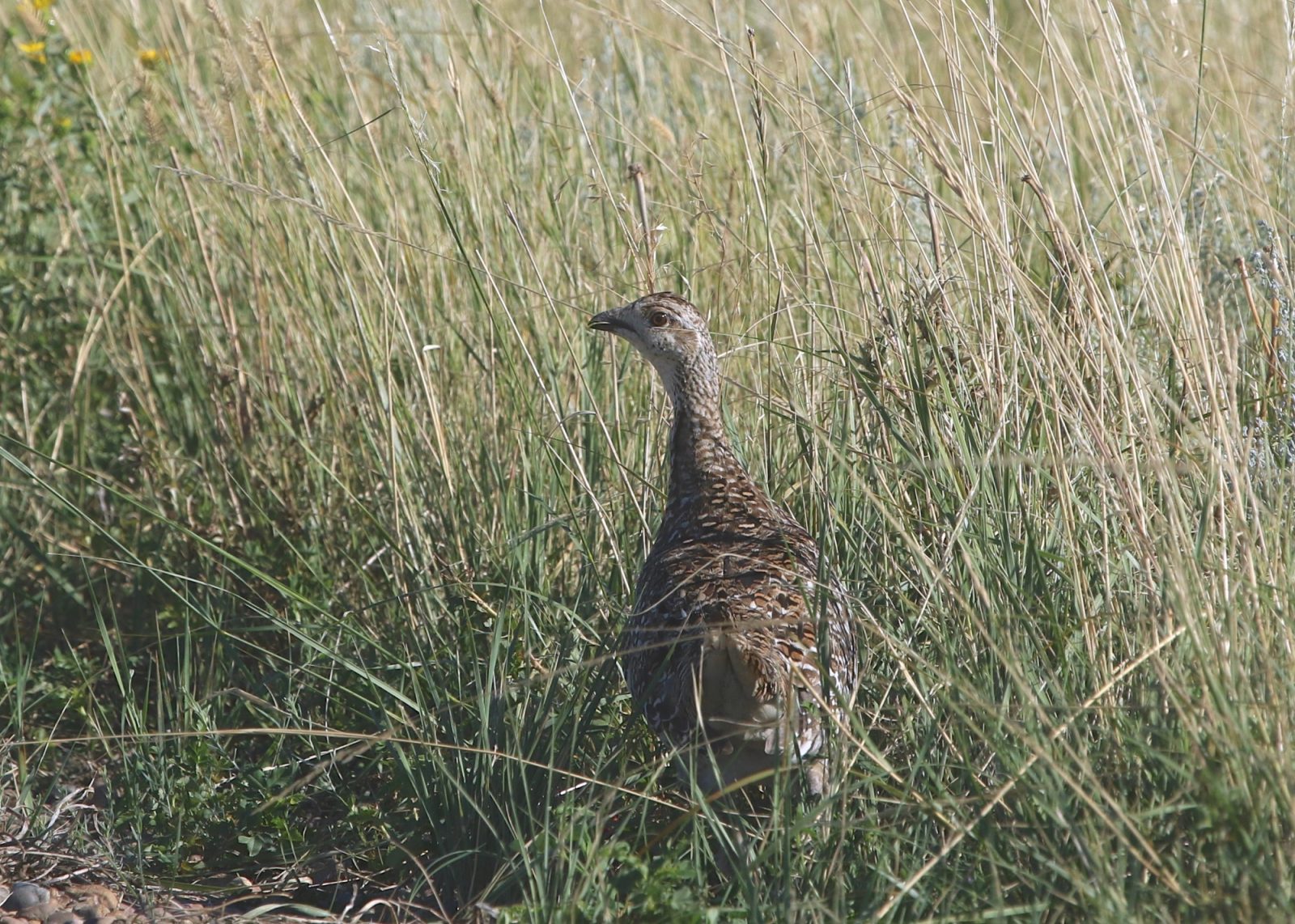
They also blend beautifully into prairie grass. Their mottled feathers match the land so well that you can walk past one and never know it is there. Then it flushes from underfoot, and suddenly your soul leaves your body for a brief moment. They are masters of the surprise exit. There is a special kind of comedy in watching such a small bird cause such large reactions. A horse can handle wind, trucks, dogs, tarps, and suspiciously shiny puddles. But a prairie chicken? Absolutely not. At least not mine anyway. The bird pops up, the horse teleports three feet to the left, and I sit there wondering how an animal that weighs so little can cause so much drama.
The prairie chicken’s defence plan seems to be simple:
Sit very still
Trust the camouflage
Wait until the last possible second
Detonate upward like a feathered jack-in-the-box
It works. Every time.
For all their comedy, prairie chickens put on one of the most entertaining mating displays on the prairie. In spring, males gather on open dancing grounds called leks. Think of a lek as a rural singles mixer, except everyone is wearing feathers and nobody brought snacks. The males puff themselves up, stamp their feet, fan their tails, bow, charge, and make low booming or clucking sounds. Depending on the species people are talking about, they may inflate colourful air sacs, raise feather tufts, and strut around like they have just won the local fair. It is not subtle.
A male prairie chicken during mating season has the energy of someone wearing cologne you can smell from the next township. He dances. He poses. He challenges the other males. He tries to convince the hens that he is the finest bird on the whole patch of grass. The hens, on the other hand, are the real judges. They watch. They compare. They stroll through the display with the calm authority of someone inspecting pies at a fall supper. The males perform their hearts out, but the hens decide who is worth their time. There is something deeply funny and kind of wonderful about that. All that booming, stomping, puffing, and posturing happens because one small brown hen might glance over and think, “Fine. You’ll do.”
My Dad always used the name "Prairie Chicken" for birds in the grouse family, especially the sharp-tailed grouse. Depending on where you grew up, local names like Prairie Chicken can stick harder than burrs in a saddle blanket. Whatever name you use, grouse or prairie chicken, these birds belong to the open country. They suit the pasture, the boreal forest, the stubble field, crown-land and the rough grass where wild things still have places to hide. They are funny because they catch us off guard. They are impressive because they survive in a place that can be harsh, windy, dry, frozen, muddy, and sometimes all of those in the same week. Grande Prairie and area was made for them.
They are also beautiful, though I hate to say it too loudly in case my husband hears and decides he is being mocked by photogenic poultry. Their feathers are patterned in soft browns, creams, and bars that match the prairie perfectly. When they stand still, they vanish. When they move, they become little walking jokes. When they dance, they turn the pasture into a stage.
I used to think the joke was that my husband could search all day and find none, while I could step outside and photograph them between chores. Now I think the joke is bigger than that. The prairie chicken is not just hiding from him. It is hiding from all of us until it chooses the funniest possible moment to appear. It waits until the horse is relaxed. It waits until I’m carrying a tea. It waits until my husband says, “I don’t know where they all went.” Then it strolls across the pasture in plain sight, pauses just long enough for a photo, and disappears back into the grass like a tiny feathered magician.
That is the real charm of Grande Prairie's prairie chickens. They prank, they pose, they spook the horses, and every spring, they flirt like the whole prairie is watching. And at our place, it usually is.
**The Prairie chicken actually refers to either the lesser or greater prairie chickens that occur in the US. Prairie chickens no longer occur in Alberta. In Alberta we still have the greater sage grouse in the extreme SE corner of the province but they are endangered. Then we have the sharp-tailed grouse, which is erroneously called prairie chicken (as I have done here), the ruffed grouse that some people wrongly call partridge, the spruce grouse, which some folks wrongly call partridge or fool hen, and the dusky (blue) grouse. The only 'partridge' we have is the gray partridge, which is an introduced species that is doing very well. The last confirmed sighting of the greater prairie-chicken in Alberta was in the 1920s, and the final unconfirmed or rare Canadian sightings vanished by the late 1980s. Widespread conversion of native grasslands into agricultural crops and urban areas destroyed the open prairie ecosystem they needed to survive. Heavy hunting in the early 1900s—including commercial harvesting shipped to Eastern markets—also contributed to their sharp decline. Over a million greater prairie chickens lived in Canada 100 years ago, primarily in southern and central Manitoba, Saskatchewan and Alberta.