Striped Skunks in the Peace Country
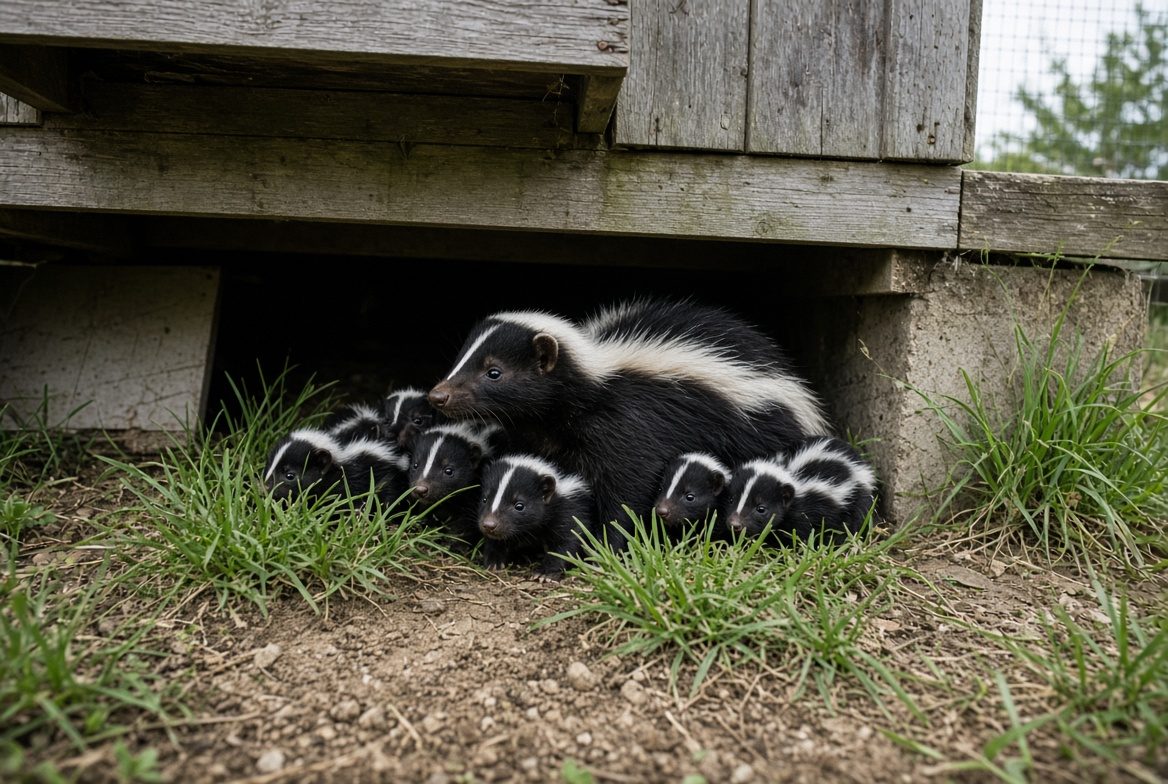
Striped Skunks have become more common in the rural parts of the Grande Prairie County. Recognizing their habitat and habits goes a long way in understanding their lifecycle.
Striped skunks (Mephitis mephitis) have become more common in the agricultural parts of the Peace Country, including the Grande Prairie County area. During the 1960s and 1970s they were largely eliminated from the region as part of Alberta’s rabies-control efforts. They have since been resettling, first appearing around High Prairie and Valleyview, then spreading west of the Smoky River. By 2021 they were established and becoming more common in the Grande Prairie area.
How They Nest and Den
In the Peace Country’s farmland, parkland, and rural yards, striped skunks prefer ready-made shelter. They commonly use abandoned burrows of woodchucks, foxes, or ground squirrels; hollow logs; rock or brush piles; and spaces under decks, sheds, porches, granaries, or other farm buildings. When they dig their own, entrances are typically about 15–20 cm across and may lead to a chamber with one or more escape routes. They line the nesting chamber with dry leaves or grass. In winter they select deeper dens and often share them communally (groups of several animals) to conserve heat. They enter a state of torpor rather than true hibernation and may emerge on milder days. Females use separate maternity dens in spring and early summer to raise litters of typically 4–7 kits, born in late May to early June.
What They Eat
Striped skunks are opportunistic omnivores well suited to the Peace Country’s mix of crops, insects, and small mammals. Insects form the bulk of the diet in warmer months—beetles, grasshoppers, crickets, grubs, larvae, and even wasps—which they dig for with their strong front claws. They also take mice, voles, shrews, young rabbits, bird eggs, amphibians, and carrion. Plant matter (berries, grains, and other vegetation) makes up a larger share in fall and winter. Around farms they readily eat pet food left outside, spilled grain, fallen fruit, garbage, farm eggs, and sometimes raid beehives. Roughly 70% of their natural diet is considered beneficial through insect and rodent control.
Do Coyotes and Bears Eat Them?
Coyotes occasionally kill and eat striped skunks, especially when other prey is scarce. Dietary studies show skunks are usually a minor or rare item in coyote diets; the spray is an effective deterrent for most encounters. Bears rarely hunt live skunks because of the spray and their excellent sense of smell, though they may scavenge carcasses. The main natural predator is the great horned owl. Roadkill and disease typically kill far more skunks than predators.
Who Handles Skunk Control in the County of Grande Prairie
The County of Grande Prairie’s Problem Wildlife Officers (Agricultural Services) assist landowners with animals regulated as pests or nuisances under the Agricultural Pests Act, including skunks. Skunks are not protected wildlife in Alberta. Landowners may hunt or trap them year-round on their own property (check local firearm restrictions). The County can provide advice, and in some cases practical assistance, for problem animals affecting livestock, crops, farmland, or rural properties.
Contact Agricultural Services / Problem Wildlife Officers:
Phone: 780-532-9727 Email: ProblemWildlife@countygp.ab.ca or agfieldman@countygp.ab.ca Office: 10001 – 84 Avenue, Clairmont, AB
Also review the County’s “Skunk Facts that Don’t Stink!” handout on the Problem Wildlife page. Scenarios Where You Should Call for Help
Call the County’s Problem Wildlife Officers when prevention has not worked or the situation poses ongoing risk to people, pets, livestock, or structures. Examples include:
- Farm buildings (barns, granaries, machine sheds, chicken coops): Skunks dens under or inside, or are raiding eggs, poultry, or stored feed. Persistent occupation makes exclusion hard and raises the chance of repeated spraying or damage.
- Multiple animals or a family group: Several skunks or a mother with kits denning under a building, deck, or crawlspace. Removing or excluding them without proper timing (especially in spring/summer with young) can orphan kits or simply open the site for the next animal.
- Ongoing property damage or conflict: Repeated digging under foundations, porches, or sheds; strong odour near living or working areas; or skunks regularly entering outbuildings despite sealed food sources.
- Risk to livestock or farm operations: Skunks accessing poultry, eggs, or beehives, or creating dens that interfere with livestock handling or equipment storage.
- Daytime activity, aggression, or unusual behaviour: Any skunk active in daylight, approaching people or pets without fear, or acting ill. While skunk rabies has not been recorded in Alberta since 1994, report abnormal behaviour promptly. You need practical assistance or live traps: The County can advise on trapping options; some municipal offices loan or rent live traps. Winter is often the safest and most effective time to address dens because animals are less active and kits are not present.
What to do before and while contacting the County
- Remove attractants: Secure pet food, garbage, spilled grain, and fallen fruit. Clean up brush piles, unused vehicles, and debris that provide cover.
- Seal access points only after confirming no animals are inside: Use ½-inch hardware cloth or solid barriers under decks, sheds, and buildings, extending the material underground where possible. Check at night or use flour at entrances to confirm activity.
- Do not use poison (illegal for skunks) or attempt to corner or handle animals.
- Document the problem (photos of dens, damage, or animals, plus location details) when you call or email.
- For immediate public-safety concerns involving aggressive wildlife, contact Alberta Fish and Wildlife or Report a Poacher (1-800-642-3800) as well.
In most cases, prevention and exclusion solve the problem without needing removal. When dens are established under farm buildings or conflict continues, the County’s Problem Wildlife Officers are the local contact for advice and assistance on your property. References
- Peace Country Sun (2021). “Naturally yours - Learning to live with the stinkers — Skunks becoming more common throughout the Peace Country.” https://www.peacecountrysun.com/opinion/columnists/naturally-yours-learning-to-live-with-the-stinkers-skunks-becoming-more-common-throughout-the-peace-country
- County of Grande Prairie. Problem Wildlife page and “Skunk Facts that Don’t Stink!” handout. https://www.countygp.ab.ca/agriculture-livestock/animals-and-livestock/problem-wildlife/
- Alberta Agriculture. Biology and Control of Skunks (and related Agricultural Pests Act guidance). https://www1.agric.gov.ab.ca/
- Alberta Institute for Wildlife Conservation. “Our Smelly Neighbour – The Striped Skunk” and related skunk resources. https://www.aiwc.ca/blog/our-smelly-neighbour-the-striped-skunk/
- Hinterland Who’s Who – Striped Skunk. https://www.hww.ca/wildlife/mammals/striped-skunk/