Uncertainty or Risk Management? Why the Bank of Canada Raised Interest Rates Today
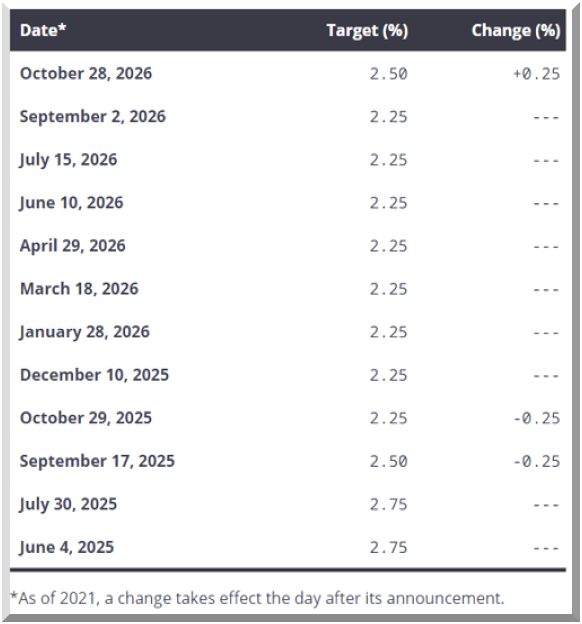
The Bank of Canada raised its benchmark interest rate by 0.25 percentage points today, bringing it to 2.50%, as Governor Tiff Macklem warned that rising global oil prices could drive inflation throughout the Canadian economy. But is raising borrowing costs during uncertain economic times a necessary precaution, or another financial burden on Canadian families and businesses?
Three Choices: Lower, Hold or Raise Interest Rates
When the Bank of Canada meets to decide the direction of interest rates, it essentially has three choices. Each serves a different purpose.
1. Lower interest rates — Encourage economic growth.
When the economy is slowing, unemployment is rising or inflation is too low, the Bank may lower interest rates. Cheaper borrowing encourages consumers to purchase homes and vehicles, while businesses may be more willing to expand, hire employees and invest.
2. Keep interest rates unchanged — Wait and observe.
When the economy is relatively stable, or when economic signals are mixed, the Bank may leave rates unchanged. This allows time to evaluate inflation, employment, consumer spending and the effects of previous decisions.
3. Raise interest rates — Control inflation and manage risk.
When prices are increasing too quickly, the Bank may raise interest rates. Higher borrowing costs generally discourage spending and investment, reducing demand and helping prevent inflation from becoming entrenched.
The Bank's objective is to maintain inflation near its 2% target, not simply to make borrowing cheaper or more expensive.
Today, Governor Tiff Macklem Chose to Raise Rates
On Wednesday, October 28, the Bank of Canada increased its policy rate from 2.25% to 2.50%, its first increase since July 2023.
The primary concern is the continuing rise in global energy prices, driven partly by the ongoing conflict in the Middle East.
Oil is not simply a commodity purchased at the gas pump. It affects transportation, agriculture, manufacturing, construction and the delivery of almost everything consumers purchase.
When diesel prices increase, transporting groceries becomes more expensive. Farmers pay more to operate equipment, contractors face higher operating costs, and businesses must decide whether to absorb those expenses or pass them along to customers.
Canada's inflation rate reached 3.1% in September, and the Bank now forecasts inflation could reach 3.5% by the end of 2026.
Macklem's concern is that higher energy costs could spread throughout the economy, creating inflation that becomes much harder to control.
The Bank is therefore acting before those increases become more widespread.
However, there is a difficult trade-off: raising interest rates cannot directly lower global oil prices. It can only reduce demand and help prevent higher costs from spreading into persistent inflation.
What Does a Quarter-Point Increase Actually Cost?
A 0.25-percentage-point increase may sound insignificant, but it can make a noticeable difference for households and businesses carrying debt.
For example, consider a $400,000 mortgage amortized over 25 years.
If the mortgage rate increases from 4.00% to 4.25%, the monthly payment would rise by approximately $55, or roughly $660 annually.
The actual impact depends on the mortgage type, renewal date and lender. Fixed-rate mortgages generally do not change immediately, while variable-rate mortgages and lines of credit may be affected sooner.
For families already struggling with groceries, fuel, insurance and property taxes, another expense is rarely welcome.
What Does This Mean for Grande Prairie?
Grande Prairie occupies an unusual position in the Canadian economy.
Unlike many communities, the Peace Country has a significant connection to oil and natural gas production, agriculture, forestry, construction and transportation.
Higher global oil prices can create both opportunities and challenges.
The potential benefits:
- Stronger oil prices may encourage exploration, drilling and investment.
- Energy companies may increase spending on equipment, services and infrastructure.
- Greater activity can support employment, local businesses and housing demand.
The potential challenges:
- Higher interest rates increase financing costs for homebuyers and businesses.
- Construction companies face more expensive borrowing and operating costs.
- Farmers may pay more for fuel, transportation and financing.
- Households carrying variable-rate debt may have less disposable income.
This creates an interesting situation for Grande Prairie.
The same oil prices that encourage investment and employment in our region can also contribute to inflation and higher borrowing costs across Canada.
What About Grande Prairie's Housing Market?
Grande Prairie's housing market has experienced tight inventory conditions, although sales have moderated compared with previous periods.
Canadian Real Estate Association data from earlier in 2026 showed home sales below the previous year's levels and below the five-year average. Active listings were also substantially below their historical average, indicating that available housing remained relatively limited.
That combination is important.
Higher interest rates can reduce the purchasing power of buyers, particularly first-time homebuyers who must qualify under mortgage stress-test requirements.
However, limited housing inventory can help support prices even when borrowing becomes more expensive.
And if stronger oil and gas activity brings additional workers and families into the region, demand for housing could increase.
For Grande Prairie, the question is whether employment growth and demand will be strong enough to offset higher borrowing costs.
The effect could also extend beyond residential homes to acreages, development land, rental properties and commercial construction.
A developer borrowing several million dollars to build housing will pay more in financing costs if lending rates rise. Those costs may ultimately influence whether a project proceeds, is delayed or becomes more expensive.
The latest October sales and inventory figures will be important in determining whether Grande Prairie's housing market is strengthening, stabilizing or beginning to slow.
Uncertainty or Risk Management?
Governor Macklem and the Bank of Canada face a difficult decision.
Leaving rates unchanged could allow inflation to spread further, making larger increases necessary later.
Raising rates now could prevent that outcome, but it also risks slowing economic activity and increasing financial pressure on households.
And there is another uncertainty: nobody knows how long elevated global oil prices will last.
If energy prices decline, today's inflation pressures could ease. If they remain elevated, the Bank may face additional decisions about raising rates.
The Bank has indicated that further increases may be necessary, but it intends to proceed cautiously.
For Grande Prairie, where energy prices influence employment, business investment and housing demand, the outcome may be different from that experienced in other Canadian communities.
The real question is whether today's interest rate increase represents prudent risk management — or whether Canadians are being asked to pay more to borrow money because of global events beyond their control.
Swan City Speaks: What Do You Think?
Was the Bank of Canada right to raise interest rates today?
Should the Bank have waited to see whether global oil prices stabilize?
And what effect do you think this decision will have on Grande Prairie's housing market, local businesses and employment?
Share your thoughts in the comments. Your opinion matters.