Winter Tires in Grande Prairie: Could the Right Set Save You From an Accident?
Winter driving is back in the Peace Country. Which tires are best for cars, SUVs and pickup trucks? Do winter tires really prevent collisions? And where can local drivers shop, including Costco?
It happens every year.
The temperature drops, the roads become slippery, and drivers across Grande Prairie and the Peace Country begin asking the same question:
Are my tires good enough for another winter?
For some drivers, that means booking a seasonal tire change. Others are considering their first set of dedicated winter tires.
And some believe that having a four-wheel-drive pickup means winter tires are unnecessary.
But what does the evidence actually tell us?
Do Winter Tires Really Prevent Accidents?
There is evidence that they do.
Manitoba Public Insurance studied collision claims involving 111,872 vehicles and estimated that installing winter tires reduced winter collision claim frequency by 6.3%.
The study also found that collision damage severity was approximately 5.7% lower for vehicles equipped with winter tires.
These are meaningful results, although they do not mean that every collision involving summer or all-season tires could have been prevented.
Winter driving accidents involve many factors, including speed, visibility, driver behaviour, road maintenance and weather conditions.
There is no reliable published figure establishing exactly how many Grande Prairie collisions are caused specifically by poor tires.
But there is a clear safety advantage to having tires designed for cold weather.
What About Alberta?
According to the Tire and Rubber Association of Canada's 2025 consumer survey, approximately 70% of Alberta drivers use winter tires.
That means an estimated 30% do not.
The national figure was 80%.
Alberta does not generally require winter tires on passenger vehicles, although provincial transportation officials recommend them for severe winter conditions.
Should that change?
It's a worthwhile discussion, particularly in a region where snow, freezing rain, drifting snow and icy highways are part of life for several months.
Why Winter Tires Work Better
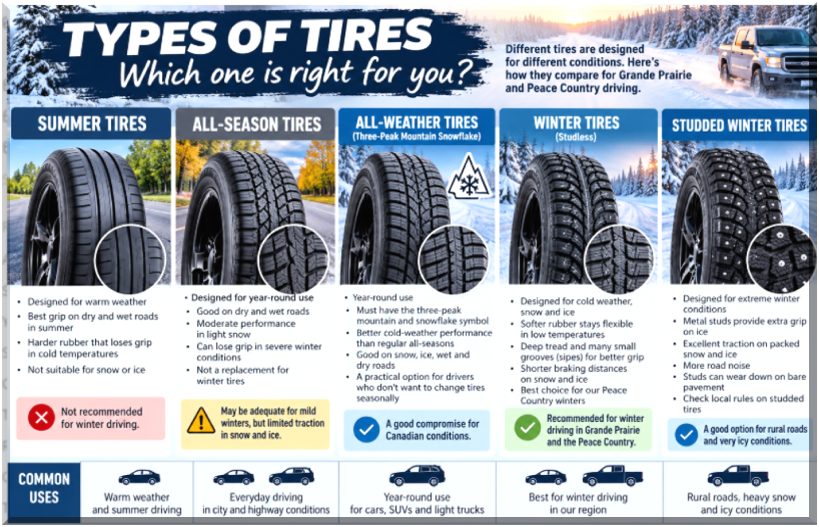
Winter tires use rubber compounds designed to remain flexible in cold temperatures.
When temperatures fall below approximately 7°C, conventional all-season tires begin losing some of their flexibility and grip.
Dedicated winter tires also use specialized tread patterns and small grooves called sipes to improve traction on snow and ice.
Transport Canada recommends looking for the three-peaked mountain and snowflake symbol.
That symbol indicates the tire meets specific snow-traction performance requirements.
A tire marked only M+S, meaning mud and snow, does not necessarily provide the same severe-snow performance.
And remember:
Four-wheel drive helps a vehicle accelerate. It does not give it four-wheel stopping power beyond the traction available at the tires.
A four-wheel-drive pickup still needs adequate tire grip to brake and turn.
What Are the Best Winter Tires for Cars?
Several tire models consistently perform well in Canadian recommendations and independent testing.
Bridgestone Blizzak IcePeak
A leading new winter tire for 2026–27. In Tire Rack's October 2026 comparison, it delivered the shortest snow and ice braking distances among the three new models tested.
Michelin X-Ice Snow / X-Ice Snow+
A strong choice for drivers seeking winter traction, ride comfort and long tread life. The newer Snow+ performed particularly well in wet-road testing.
Continental VikingContact 8
A well-rounded winter tire with excellent snow and ice capability and particularly good road comfort.
Nokian Hakkapeliitta R5
A strong studless winter tire for cold climates, with an emphasis on snow and ice performance.
General Altimax Arctic 12
A model worth considering for budget-conscious drivers, subject to size availability and current pricing.
There is no single best tire for every vehicle.
The best choice depends on tire size, road conditions, driving habits and budget.
What About SUVs and Pickup Trucks?
Drivers of Ford F-150s, Chevrolet Silverados, GMC Sierras, Ram pickups and larger SUVs should pay particular attention to tire load ratings.
Some popular winter options include:
Nokian Hakkapeliitta LT3
Designed for heavier light trucks and demanding winter conditions. Studded versions are available.
Nokian Hakkapeliitta R5 SUV
A premium studless choice for SUVs and suitable crossovers.
Bridgestone Blizzak IcePeak
The new model is offered for a range of passenger vehicles, SUVs and pickup trucks. Buyers must confirm the correct load rating and size.
Michelin X-Ice Snow / Snow+
Available in a variety of passenger and SUV sizes, offering strong cold-weather performance.
Toyo Observe winter tire range
Worth comparing for SUVs and trucks, depending on the exact vehicle and available sizes.
For work trucks, towing vehicles and heavy-duty pickups, the correct load index and tire construction are essential.
Never select a tire solely because it has an aggressive tread pattern or looks suitable for a truck.
Winter Tires Versus All-Weather Tires
Not every driver wants to maintain two sets of tires.
All-weather tires carrying the mountain-and-snowflake symbol can be a practical year-round compromise.
They are different from conventional all-season tires.
However, drivers who frequently travel icy rural highways, commute before roads are cleared or encounter extreme winter conditions may benefit more from dedicated winter tires.
A good all-weather tire can be a sensible option.
A good winter tire is generally the stronger choice for demanding winter conditions.
What Should Drivers Expect to Pay?
The Automobile Protection Association's 2025–26 recommendations listed example tire prices of approximately:
- $165 to $259 per tire for selected small-car winter tires.
- $165 to $279 per tire for selected compact-SUV winter tires.
- $243 to $362 per tire for selected three-row SUV winter tires.
These are reference prices for particular sizes and models, not verified current Grande Prairie quotations.
A complete set of four could therefore represent a substantial purchase before installation, balancing, taxes and optional wheels.
Larger pickup-truck tires may cost considerably more.
Before buying, ask for an all-in price for four tires installed.
Also ask whether the quotation includes balancing, new valve components, tire pressure sensor service, future rotations, puncture repairs and seasonal storage.
A lower advertised tire price does not always mean a lower total cost.
Where Can You Buy Winter Tires in Grande Prairie?
Grande Prairie has a substantial selection of national retailers, independent tire specialists and automotive service shops.
Local options include:
- Costco Tire Centre — 9901 116 Street.
- Kal Tire — 10744 117 Avenue.
- Fountain Tire — 13003 100 Street.
- Fountain Tire — 10205 156 Avenue.
- Canadian Tire — 11601 104 Avenue.
- OK Tire South — 8525 109 Street.
- OK Tire North — 12501 100 Street.
- Integra Tire and Auto Centre — 10022 124 Avenue.
- Tiresmith Trail Tire — 13755 100 Street.
- Tire Pro — 9522 97 Street.
- Auto-Trac Tire & Auto — 9910 111 Avenue.
- Canada Custom Autoworks — 8610 112 Street.
- Midas — 11211 100 Street.
- Quick Lane Grande Prairie North — 10001 139 Avenue.
- Goodfriends Tire — 10811 97 Avenue.
- Triple S Tire Service — 13502 99 Street.
- Majestic Tire Distributors — 11013 100 Avenue.
- Grant Wert Select Auto & Tire — 10017 115 Avenue.
Many vehicle dealerships also sell and install winter tires.
Not every location necessarily stocks every brand, and some businesses focus more on commercial or specialized tire services.
Call ahead to confirm inventory, installation appointments and services.
Costco shoppers: The Grande Prairie warehouse has a dedicated tire service centre. Appointments are recommended, and membership requirements apply.
Five Things to Check Before Buying
-
Tire size: Check the vehicle manufacturer's recommended specifications.
-
Winter certification: Look for the three-peaked mountain and snowflake symbol.
-
Tread depth: Transport Canada advises against using tires worn close to 4 mm of tread on snow-covered roads.
-
Four matching tires: Installing only two winter tires can create an unsafe handling imbalance.
-
Total installed cost: Compare the complete quotation, not just the advertised price per tire.
And don't forget tire pressure.
Cold temperatures reduce tire pressure, and underinflated tires can affect handling, wear and fuel consumption.
Can You Afford Not to Have Winter Tires?
A good set of winter tires is not inexpensive.
For families already dealing with higher housing, grocery and transportation costs, the expense can be difficult.
But the cost of even a minor collision can be much greater.
There may be an insurance deductible, towing charges, vehicle repairs, lost work time and increased premiums.
More importantly, there is the risk of injury.
Winter tires cannot prevent every collision.
But evidence suggests they can reduce the risk.
The real question may not be whether winter tires are expensive, but whether driving without adequate winter traction is a risk worth taking.
Swan City Speaks: What Do You Think?
-
Do you use dedicated winter tires, all-weather tires or regular all-seasons? Have you noticed a meaningful difference in braking and handling?
-
Where do you buy your tires in Grande Prairie? Costco, Kal Tire, Fountain Tire or a locally owned shop? Tell your neighbours about price, service and your experience.
-
Should Alberta require winter tires during the winter months, or should that remain the driver's choice?
Share your thoughts in the comments. Your opinion matters.
Swan City Now welcomes advice from local tire shops, mechanics and drivers. Have a favourite winter tire for Peace Country roads? Tell us why.