320 Acres of Farmland Could Become Industrial Land Near Sexsmith — But Are County Planning Rules Being Applied Consistently?

Approximately 320 acres of agricultural land near Sexsmith could eventually be designated for industrial development under planning amendments now before the County of Grande Prairie.
Back on top · first published Nov 16
**Editorial disclosure: The people depicted are fictional, not actual landowners or individuals involved in the County's planning decisions.
When Is Farmland Worth Protecting?
The proposal is significant not simply because of the amount of land involved, but because it raises a broader question about municipal planning.
Are the same principles being applied consistently when individual landowners seek to develop their property and when larger industrial proposals come before council?
The County confirmed on October 20 that council had given first reading to Bylaws #3289 and #3290 following a privately initiated application.
The amendments would change the planning designation of approximately 320 acres from agricultural to industrial.
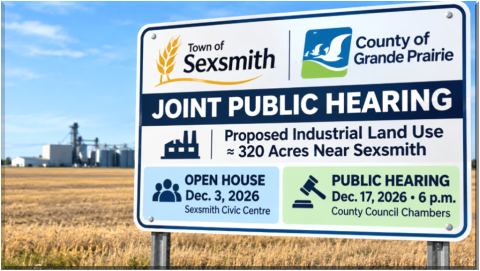
A November 9 council decision established a joint public hearing with the Town of Sexsmith for December 17.
No final approval of the proposed amendments has been confirmed.
The Four-Parcel Question
Agricultural subdivision restrictions are familiar to many rural property owners.
The County's planning framework limits the amount of agricultural land that can be subdivided from a quarter-section, with different allowances depending on farmland quality and other planning considerations.
A recently reported situation involving a County resident raises a question about how those restrictions are applied.
According to the account, the resident was advised that no additional parcels could be subdivided from a quarter-section because four parcels had already been taken out.
The land was reportedly considered poor agricultural land.
The individual subdivision decision, its legal description and the specific policy cited have not been independently verified.
Nevertheless, the account raises a legitimate public-policy question.
If a landowner cannot create another relatively small parcel because of agricultural subdivision restrictions, how does the County justify considering the conversion of approximately 320 acres of farmland to industrial use?
There may be valid planning reasons for treating the applications differently.
But those reasons should be understandable, documented and consistently applied.
What the County's Own Policies Say
The County's Municipal Development Plan, Bylaw #3255, sets out agricultural subdivision limits based on farmland quality.
Under Policy 6.3.1, the maximum amount of land generally available for subdivision from a quarter-section varies by agricultural category.
For the best agricultural land, the limit can be as little as five acres.
For poorer or marginal agricultural land, the maximum can reach 40 acres, subject to the plan's conditions.
Policy 6.3.2 also identifies circumstances in which variances may be considered.
This is an important distinction.
The County's published rules are not simply a universal four-parcel limit applying identically to every property.
Parcel numbers, agricultural quality, land-use designation, previous subdivisions and the nature of an application can all matter.
Furthermore, subdivision and rezoning are different legal processes.
Subdivision divides land into separate parcels. Rezoning or an amendment to a municipal development plan changes how land may be used or planned for future development.
The proposed Sexsmith amendments involve planning designations rather than a straightforward application to create another residential parcel.
That distinction helps explain why the applications may be considered under different rules.
It does not eliminate the need for consistency.
If protecting agricultural land is a central objective of municipal policy, residents are entitled to understand when that protection takes priority and when other development objectives can outweigh it.
What Makes These 320 Acres Different?
The County has confirmed the proposed agricultural-to-industrial change, but several important details deserve public examination.
What is the farmland assessment rating of the affected properties?
How much of the land is currently being cultivated or otherwise used for agricultural production?
Is the proposed industrial designation consistent with the County's long-term agricultural protection policies?
What evidence demonstrates that an additional 320 acres of industrial land is needed?
And how much land already designated for industrial use remains vacant or undeveloped?
The amount of available industrial land is especially important.
A municipality may reasonably plan for future employment, industrial investment and economic growth.
However, designating additional agricultural land for industry should be supported by evidence of demand, infrastructure capacity and long-term community benefit.
Industrial development can create employment, expand the tax base and support local businesses.
Agricultural land also has lasting economic value, including food production, farm operations and the preservation of opportunities for future generations.
Both deserve consideration.
Once farmland is developed for industrial purposes, returning it to agricultural production may be difficult or impractical.
Does Industrial Growth Receive Different Consideration?
The County has been dealing with increasing interest in industrial development around the Emerson Trail area.
Recent data centre proposals have brought attention to land-use planning, public consultation, electricity requirements and the long-term consequences of major industrial projects.
The newly proposed 320-acre industrial designation has prompted speculation on Facebook about whether additional data centres could eventually be considered.
However, no verified evidence reviewed for this article establishes that the 320-acre proposal is intended for a data centre.
The distinction matters.
Residents can reasonably question whether the County has enough industrial land without assuming that a particular development has already been planned.
The larger issue is whether industrial growth is being evaluated against the same long-term agricultural preservation objectives that influence decisions affecting smaller landowners.
A policy can allow exceptions and still be consistent.
What matters is whether those exceptions follow established criteria, are supported by evidence and are available through a transparent process.
Who Is Responsible for Consistent Planning Decisions?
Questions about planning consistency also bring attention to the relationship between elected council and municipal administration.
Planning staff review applications, interpret policies and provide recommendations.
Council adopts bylaws and makes decisions within its legislative authority. The Municipal Planning Commission serves as the County's subdivision authority.
The County has also experienced reported changes in planning leadership. The circumstances of those personnel changes, including claims about a dismissal and reassignment of responsibilities, have not been independently established.
Personnel matters should not be confused with evidence of improper planning decisions.
However, the broader administrative question remains relevant.
When planning leadership changes, what safeguards ensure that established policies continue to be interpreted consistently?
Are previous decisions reviewed when similar applications receive different recommendations?
Does council receive clear explanations when a proposed amendment would depart from existing land-use objectives?
And can residents readily obtain the policies and reasons used to support or refuse an application?
Consistency does not require every application to receive the same outcome.
It requires comparable applications to be assessed fairly, using identifiable criteria, with reasons for different outcomes that can withstand public scrutiny.
Two Important December Meetings
The proposed industrial expansion is moving toward public consultation.
December 3, 2026 — Applicant Open House
The applicant is scheduled to hold a public open house at the Sexsmith Civic Centre.
The publicly circulated notice identifies a proposed time of 4 p.m. to 6 p.m., although that time should be confirmed against the applicant's formal notice.
The meeting will provide an opportunity for residents to learn more about the proposed 320-acre industrial expansion.
December 17, 2026 — Joint Public Hearing
The County of Grande Prairie and Town of Sexsmith will hold a joint public hearing concerning Bylaw #3289.
Time: 6 p.m.
Location: County Council Chambers, Clairmont.
This hearing concerns proposed changes to the intermunicipal development plan affecting the land near Sexsmith.
Residents should also be aware of a separate County hearing on December 2 concerning proposed new Data Centre Campus zoning regulations.
That hearing begins at 1 p.m. in County Council Chambers.
Registration to speak at the December 2 hearing closes November 27.
Although the two planning matters concern industrial development, they are separate proposals and should not be treated as a single application.
The Story Isn't Over
The proposed conversion of 320 acres of agricultural land raises questions that extend beyond one development application.
Before final decisions are made, several issues deserve clear answers:
- What agricultural land classifications apply to the proposed industrial expansion?
- How much vacant, serviced and undeveloped industrial land already exists within the County?
- What planning evidence supports the need for another 320 acres?
- How does the proposal align with policies intended to prevent unnecessary agricultural land fragmentation?
- Under what circumstances can an individual landowner receive an exception to agricultural subdivision limits?
- How does the County ensure that planning policies are applied consistently between smaller private applications and major industrial proposals?
- What long-term infrastructure costs and municipal tax benefits are anticipated if the land is eventually developed?
- What opportunities will residents have to challenge or question the planning rationale before final approval?
The question is not whether industrial development should be prohibited or whether every landowner should automatically receive subdivision approval.
It is whether the County can clearly demonstrate that its decisions follow a consistent and defensible planning framework.
A rural landowner who is told that agricultural land must be protected should be able to understand why hundreds of acres elsewhere may be considered for industrial development.
There may be sound reasons for the difference.
The public deserves to know what they are.
Sources and References
- County of Grande Prairie — October 20, 2026 Council Highlights
- County of Grande Prairie — November 9, 2026 Council Highlights
- County Municipal Development Plan — Bylaw #3255
- County of Grande Prairie — Subdivision Process
- County of Grande Prairie — Scheduled Public Hearings
- County of Grande Prairie — Data Centre Information
Community discussion on Facebook also brought attention to the proposed industrial expansion and questions surrounding agricultural land protection. The County's published planning records provide the basis for the confirmed information in this article.