Four Years to a Prison Sentence: Is Grande Prairie Winning or Losing the Fight Against Drugs?
An investigation that began with a major drug seizure in 2022 has ended with a four-year prison sentence. But as Grande Prairie begins a new era with its own municipal police service, bigger questions remain about organized crime, drug use, court delays and the safety of young people.
Back on top · first published Nov 5
A Drug Investigation That Took Four Years to Reach Sentencing
On September 29, 2022, Grande Prairie RCMP arrested a man during a drug trafficking investigation.
Police reported finding substantial quantities of illegal drugs and cash.
The seizure included:
- 900 grams of cocaine.
- 650 grams of methamphetamine.
- 300 grams of fentanyl.
- Approximately $4,500 in cash.
The investigation resulted in multiple criminal charges.
More than four years later, on October 26, 2026, Trysten Wyatt La Porte was sentenced in Edmonton court to four years in prison after pleading guilty to one count of possession for the purpose of trafficking.
According to an Alberta Justice update reported November 5, two additional possession-for-trafficking charges were withdrawn.
Two counts of failing to comply with a release order, one count of possession of stolen property and one count of resisting a peace officer were also withdrawn.
The guilty plea and sentence establish the outcome of the charge on which La Porte was convicted.
The reported seizure quantities come from the original police investigation; they should not automatically be treated as the quantities established in the guilty plea without reviewing the court record.
The case demonstrates that a significant police investigation can eventually produce a prison sentence.
But it also raises several questions.
Why did the proceedings take four years?
What led to the withdrawal of the other charges?
And how much did the investigation and prosecution cost?
Why Did It Take Four Years?
Four years between an arrest and sentencing is a substantial period.
But the elapsed time alone does not establish that police, prosecutors or the courts acted improperly.
Criminal proceedings can involve disclosure of evidence, defence applications, court scheduling, negotiations, changes of counsel and other procedural steps.
Some delays may be attributable to the prosecution, some to the defence and others to the court system.
The precise reasons in this case have not been established from the available public report.
A complete court chronology would be needed.
There is also an important legal distinction.
Under the Supreme Court of Canada's Jordan framework, the presumptive ceiling for many criminal proceedings is 18 months in provincial court or 30 months in superior court, subject to important qualifications and exceptions.
Those ceilings generally concern the period from charge to the actual or anticipated end of trial, not necessarily the entire period through sentencing.
Therefore, a four-year interval between arrest and sentence does not, by itself, establish a constitutional delay violation.
For this particular case, the public deserves to know the procedural history before drawing conclusions.
Why Were Six Other Charges Withdrawn?
This is another question that deserves careful examination.
Charges can be withdrawn for various reasons.
For example, a guilty plea to one charge may form part of a resolution that avoids the need to proceed with other counts.
Prosecutors may also reassess the evidence or determine that continuing particular charges is not in the public interest.
A withdrawn charge is not a conviction.
Nor does withdrawal automatically mean that police made an error or that the original allegation was false.
Without the court record or an explanation from Alberta Justice, it cannot be established why the additional charges were withdrawn.
But it is a legitimate accountability question.
When a major investigation begins with multiple charges and ends with one conviction, residents should be able to understand how that outcome was reached.
Grande Prairie Has a New Police Service. Will It Make a Difference?
This case began under the RCMP.
But Grande Prairie's policing structure has now changed.
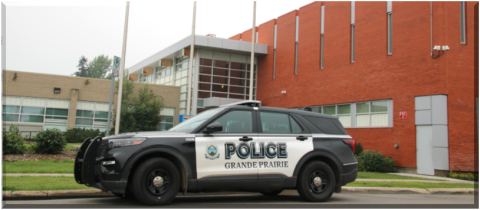
On October 21, 2026, the Grande Prairie Police Service officially became the police service of jurisdiction for the City of Grande Prairie.
The RCMP continues to serve the County of Grande Prairie and surrounding jurisdictions.
The transition creates an opportunity to examine whether locally controlled policing can improve the investigation of drug trafficking and organized crime.
According to GPPS, its capabilities include:
- A Specialized Investigations Section dealing with organized crime, gangs and drug activity.
- A Criminal Investigative Section for major offences.
- Forensic specialists.
- A tactical team.
- A canine unit.
- Partnerships with the RCMP, ALERT and other agencies.
- Community and youth engagement programs.
- A tiered policing model involving police, municipal enforcement and outreach teams.
These are significant capabilities for a municipal service.
However, establishing specialized units does not automatically guarantee better investigative results.
Their effectiveness will depend on staffing, experience, intelligence sharing, resources and cooperation with other agencies.
Could Local Policing Improve Drug Investigations?
There are several potential advantages.
Local priorities
A municipal police service can place particular emphasis on problems identified by Grande Prairie residents.
If drug trafficking becomes a leading local concern, resources may be directed accordingly.
Continuity
A dedicated municipal service may develop long-term relationships with neighbourhoods, schools, businesses and community organizations.
Those relationships can help police understand recurring problems and obtain information.
Specialized investigators
GPPS says it has experienced detectives and specialized officers capable of investigating organized crime and drug trafficking.
Community involvement
Local engagement programs may help identify emerging concerns before they become more serious.
But these are potential advantages, not yet demonstrated improvements.
GPPS has only recently assumed full responsibility for policing the city.
It is too early to claim that the new service has reduced drug trafficking or improved major-case outcomes.
Could the Change Also Create Problems?
There are legitimate questions on the other side.
Drug trafficking rarely respects municipal boundaries.
A person selling drugs in Grande Prairie may obtain supplies from Edmonton, Calgary, British Columbia or elsewhere.
The same investigation may involve the city, the County, neighbouring communities and multiple police jurisdictions.
That means cooperation is essential.
The RCMP has extensive provincial and national policing connections.
Municipal police services also participate in integrated investigations, but they must maintain effective arrangements for sharing information and coordinating operations.
A new policing structure creates questions about:
- Access to provincial and national intelligence.
- Cooperation with neighbouring RCMP detachments.
- Joint investigations across municipal boundaries.
- Specialized forensic and technical resources.
- Investigative costs and staffing.
- Responsibility for cases started before the transition.
The City and GPPS say cooperation with the RCMP will continue.
The question is how effectively those arrangements will work in practice.
Drug dealers do not stop at the city limits. Police investigations cannot stop there either.
How Does Grande Prairie Compare With the Rest of Canada?
The latest available annual police-reported crime statistics provide an important starting point.
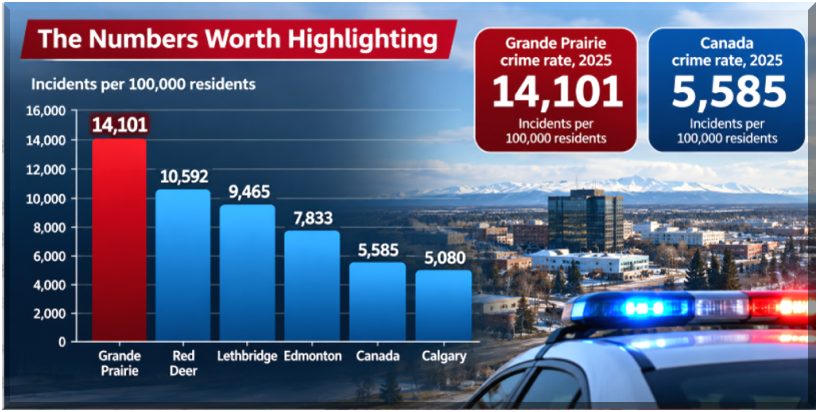
For 2025, the Grande Prairie RCMP service area recorded approximately 14,101 Criminal Code incidents per 100,000 residents, excluding traffic offences.
The comparable national rate was 5,585.
That means Grande Prairie's reported rate was approximately 2.5 times the Canadian rate.
The Grande Prairie figure represented a decrease of about 2.6% from 2024.
For comparison, reported 2025 rates included:
- Grande Prairie RCMP: 14,101 per 100,000.
- Red Deer RCMP: 10,592.
- Lethbridge Police Service: 9,465.
- Edmonton Police Service: 7,833.
- Calgary Police Service: 5,080.
- Canada: 5,585.
These are police-reported crime rates, not drug-use rates.
They also reflect police-service reporting areas, which are not necessarily identical to municipal boundaries.
That matters particularly during Grande Prairie's transition to a municipal police service.
The numbers establish that Grande Prairie had a relatively high police-reported crime rate in 2025.
They do not establish that every neighbourhood is equally affected or that residents face the same risks from every type of crime.
Nor should the conventional crime rate be confused with the Crime Severity Index, which assigns greater weight to more serious offences.
Is Grande Prairie One of Canada's Most Dangerous Cities?
That question cannot be answered responsibly with a single statistic.
Different rankings measure different things.
Some compare total Criminal Code incidents.
Others use the Crime Severity Index.
Some examine violent crime, while others include property offences.
Police reporting practices, local population estimates, service boundaries and reporting behaviour can also affect comparisons.
Grande Prairie's 2025 rate is high relative to the national figure and several Alberta municipalities.
But a verified national ranking for Grande Prairie using a consistent 2025 measure has not been established here.
It would be misleading to assign the city a specific national position without that comparison.
The more useful question is whether particular categories of crime are improving or deteriorating over time.
Residents need to know whether violent offences, break-ins, thefts, drug trafficking and repeat victimization are changing.
A single overall rate cannot provide all those answers.
Is Drug Use Increasing or Decreasing?
This is where the statistics become more complicated.
Nationally, the Public Health Agency of Canada reported 5,608 opioid-related deaths in 2025.
That represented a 23% decrease from 2024.
Stimulant-related deaths also declined nationally.
Those are encouraging developments.
But the federal government cautioned that drug-related harms remained above pre-pandemic levels.
And the improvements were not uniform across the country.
Emergency medical responses associated with opioid-related harms increased nationally in 2025, largely driven by substantial increases in Alberta and Saskatchewan.
The federal report identified a 67% increase in Alberta's emergency medical responses.
This creates an important distinction.
Fewer deaths do not necessarily mean fewer people are using drugs.
Deaths may change because of differences in the illegal drug supply, emergency responses, treatment access or other factors.
Similarly, a larger number of police drug seizures may reflect increased enforcement activity rather than increased consumption.
To determine whether drug use is rising or falling in Grande Prairie, we would need consistent local information on substance use, overdoses, hospital visits, treatment demand and other indicators.
The available national figures cannot answer that local question by themselves.
The Fentanyl Problem Has Changed the Risks
The original 2022 investigation involved cocaine, methamphetamine and fentanyl.
These substances present different risks.
Fentanyl is a powerful synthetic opioid associated with serious overdose risk.
Methamphetamine is a stimulant that can cause significant health and behavioural harms.
Cocaine is another stimulant with risks involving the cardiovascular system, dependence and other complications.
The illegal drug supply can also be unpredictable.
People may encounter unexpected substances or mixtures, making overdose risks difficult to assess.
The federal government has identified emerging concerns involving fentanyl analogues, benzodiazepines and other substances in the unregulated drug supply.
That means drug enforcement and public-health responses must adapt as the market changes.
A strategy focused only on the drugs common several years ago may not address today's risks.
Are Grande Prairie's Young People Safer?
This may be the most important question for parents.
Nationally, Statistics Canada reported that the police-reported youth crime rate decreased 3.8% in 2025.
That is a measure of young people accused of crime, not a direct measure of their exposure to drugs or risk of overdose.
A decline in youth crime does not establish that youth substance use has declined.
Likewise, an increase in adult drug trafficking cases does not prove that more teenagers are using drugs.
To determine whether Grande Prairie's youth are safer, we need several kinds of information:
- Local youth substance-use trends.
- Drug-related emergency visits involving teenagers and young adults.
- School-based prevention and education programs.
- Access to youth counselling and addiction services.
- Youth involvement in drug trafficking investigations.
- Reports of drug activity around schools and recreation facilities.
These indicators need to be examined together.
The new GPPS Youth Engagement program may create opportunities for prevention and early intervention.
But its effectiveness should be measured, not assumed.
Prevention or Enforcement — Which Works Better?
Drug trafficking creates serious public-safety concerns.
Police investigations can disrupt criminal activity, seize dangerous substances and hold offenders accountable.
But arrests alone do not address every reason people begin or continue using drugs.
Addiction, trauma, mental-health challenges, unstable housing and other social conditions can contribute to substance-related harm.
That does not excuse trafficking.
It means enforcement and prevention address different parts of the problem.
An effective community response may require police, schools, health professionals, treatment providers, families and social-service organizations to work together.
The key question is whether those efforts are coordinated and whether their outcomes are being measured.
For example:
Does arresting a dealer reduce local availability over time?
Are people experiencing addiction able to obtain timely treatment?
Are schools receiving appropriate prevention resources?
Are young people who need help being identified early?
And are repeat offenders being investigated effectively?
These are questions that deserve more than occasional announcements about drug seizures.
Should the New Police Service Publish a Drug-Crime Scorecard?
Grande Prairie has an opportunity to establish transparent measures as its new police service develops.
Rather than relying only on announcements of arrests and seizures, GPPS could regularly report on broader outcomes.
Possible measures include:
Drug investigations
How many trafficking investigations begin, and how many result in charges?
Court outcomes
How many cases result in convictions, withdrawals or other dispositions?
Investigation timelines
How long do major investigations take from opening to charge approval?
Regional cooperation
How many investigations involve the RCMP, ALERT or other agencies?
Drug-related harm
What do public-health indicators show about overdoses and emergency responses?
Youth safety
What trends are visible in youth crime, prevention participation and substance-related harms?
Community confidence
Do residents feel safer, and are their concerns being addressed?
Not every measure is controlled by police.
Court outcomes depend on prosecutors, judges, evidence and legal processes.
Overdose rates are influenced by many factors beyond enforcement.
But a coordinated public report could give residents a more complete picture of whether the community is making progress.
The Story Isn't Over
The October 26 prison sentence closes an important chapter in a 2022 investigation.
It does not close the broader questions about drug trafficking and community safety.
Questions That Remain Unanswered:
1. The four-year court timeline
What happened between the September 2022 arrest and October 2026 sentencing? We will seek a court chronology and clarification of the withdrawn charges.
2. The policing transition
How will GPPS and the RCMP coordinate investigations that cross city and County boundaries? What formal arrangements govern cooperation?
3. Local crime trends
How have Grande Prairie's drug offences, violent crimes and property crimes changed over five years?
4. Drug use and overdoses
Are Grande Prairie's drug-related emergency visits and deaths rising or falling? We will seek the latest available local public-health figures.
5. Youth safety
What evidence shows whether young residents are experiencing more or fewer substance-related harms?
6. Results from the new police service
Will GPPS publish measurable outcomes that allow residents to compare policing performance before and after the transition?
We will report meaningful developments as they emerge.
And if there is no meaningful change, we will say so.
Swan City Now — Because the story doesn't end with the headline.
Swan City Speaks: What Do You Think?
1. Local policing: Do you believe Grande Prairie's new municipal police service will be better positioned to investigate drug trafficking, or are you concerned about losing some of the RCMP's regional and national connections?
2. Community safety: Do you feel Grande Prairie has become safer or less safe over the past five years? What changes have you personally noticed in your neighbourhood?
3. Protecting youth: Should the community place more emphasis on drug enforcement, addiction treatment, school prevention programs or a combination of these approaches?
Share your thoughts in the comments. Your opinion matters.
Sources
Grande Prairie Police Service — Policing Transition and Specialized Investigations
https://www.gppolice.com/transition
RCMP — Statement on Grande Prairie Policing Transition, October 21, 2026
https://rcmp.ca/en/alberta/news/2026/10/4358046
Statistics Canada — Police-Reported Crime Statistics in Canada, 2025
https://www150.statcan.gc.ca/n1/daily-quotidien/260722/dq260722a-eng.htm
Statistics Canada — Crime Severity Index and Weighted Clearance Rates
https://www150.statcan.gc.ca/t1/tbl1/en/tv.action?pid=3510019001
Police-Reported Crime Rates by Alberta Police Service, 2025 — Statistics Canada Data Compilation
https://statistics.crimecanada.ca/alberta/rankings
Public Health Agency of Canada — National Substance-Related Harms, June 15, 2026
Editor's note: Court details are based on the November 5 report citing Alberta Justice; the underlying court file was not independently reviewed. The reasons for charge withdrawals and the four-year case timeline remain unverified. Crime statistics are based on 2025 police-service reporting areas, and should not be interpreted as a direct assessment of GPPS performance since its October 2026 transition. National drug-harm trends do not establish Grande Prairie-specific trends.