Data Centres and the Environment: When the Machines Hum, Can the Birds Still Sing?
Back on top · first published Nov 17
Imagine the Peace Country From Above
Imagine being a bird flying over the Peace Country on a spring morning.
Below are fields beginning to turn green, patches of woodland, wetlands, rivers and farmyards. The sounds of the countryside rise into the air.
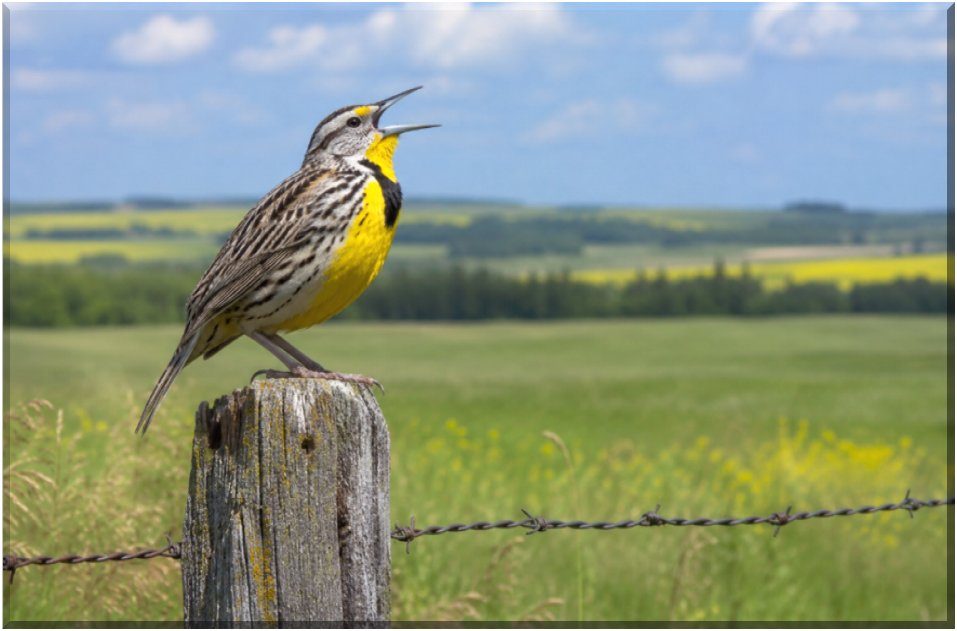
A meadowlark sings from a fence post. Blackbirds call across a wetland. Songbirds establish their territories in the trees. Somewhere nearby, a hawk circles above the fields.
To us, birdsong is part of the pleasure of living in the country.
To birds, it is something much more important.
It is communication.
And communication can mean the difference between finding a mate, raising young, defending a territory or surviving a predator.
Now imagine adding a large industrial complex to that landscape.
Cooling fans operate around the clock. Electrical transformers produce a steady hum. Generators may operate or undergo testing. Depending on the design, other mechanical equipment adds to the background sound.
The countryside has acquired a new voice.
But what happens when that voice begins competing with the birds?
Birds Don't Just Sing for Our Enjoyment
Birdsong serves several biological purposes.
Male songbirds often sing to establish territories and attract potential mates. Parents and young use calls to maintain contact. Alarm calls can warn other birds of approaching danger.
Different species communicate using different combinations of frequencies, rhythms and patterns.
Their ability to hear one another matters.
Scientists have studied how human-made noise affects these communications, particularly near roads, cities and industrial developments.
One important finding is that noise does not have to injure a bird's hearing to cause problems.
It can simply make important signals harder to hear.
Researchers call this acoustic masking.
Imagine trying to have a conversation while a large ventilation system operates beside you.
You may raise your voice, move closer or repeat yourself.
Birds face similar challenges.
Some species respond to noise by changing the pitch, timing or volume of their songs.
But adapting a song does not necessarily eliminate the problem.
When a Bird Cannot Hear Another Bird
A scientific review titled Birdsong and Anthropogenic Noise: Implications and Applications for Conservation examined how increasing human-made noise can interfere with bird communication.
The researchers identified territory defence and mate attraction as two important functions that may be disrupted.
They also discussed evidence connecting noisy environments with changes in bird abundance and reproductive success.
That does not mean every noisy development causes birds to abandon an area.
Different species respond differently. Some adapt to human activity, while others appear more sensitive.
The type of sound, its frequency, duration, intensity and surrounding habitat all matter.
But the research establishes something important for environmental planning.
Noise is not merely a nuisance for people. It can be an ecological disturbance.
And unlike a construction project that eventually becomes quiet, some industrial facilities produce mechanical noise throughout their operating lives.
What Makes Data Centres Different?
Data centres are often described as buildings filled with computers.
But the computers are only part of the infrastructure.
Servers generate heat, and that heat must be removed. Depending on the facility, cooling systems may require large fans, pumps, chillers or other mechanical equipment.
Electrical infrastructure can also produce sound.
Backup generators introduce another potential noise source, although their operating schedules depend on the facility.
The result can be a combination of continuous background noise and intermittent louder events.
Not every data centre produces the same noise levels. Equipment design, acoustic enclosures, operating conditions and distance can make substantial differences.
That is why site-specific acoustic studies are important.
A development surrounded by existing heavy industry may have a very different effect from one located beside relatively quiet farmland, wetlands or woodland.
For wildlife, the question is not simply how loud a facility sounds to a person standing at its property line.
It is how the new sound changes the environment in which animals communicate.
What About the Emerson Trail Development?
The County of Grande Prairie has confirmed that development permit PLDEV20250629 was approved September 4, 2026, for a proposed data processing establishment in the Emerson Trail industrial area.
According to the County, the approval includes five buildings, 15 generators and 15 make-up air or cooling units.
Those numbers describe approved infrastructure, not measured noise emissions.
They do not establish how frequently generators would operate, how loud the completed development would be or how far its sound would travel.
The County also makes clear that a development permit does not guarantee construction or operation. Other regulatory approvals may be necessary.
Nevertheless, the approved equipment raises legitimate environmental questions.
Has an acoustic impact assessment been completed?
Does it consider nearby wildlife habitat?
Would noise measurements account for the quieter background conditions common in rural areas?
And would any assessment examine the frequencies used by local bird species?
These questions should be answered with project-specific evidence rather than assumptions about what the facility might produce.
Do Alberta's Noise Rules Protect Wildlife?
Alberta already has rules governing noise from certain industrial facilities.
The Alberta Utilities Commission's Rule 012, updated effective April 17, 2026, establishes permissible sound levels and noise-assessment requirements for facilities under its jurisdiction.
The rule provides a framework for assessing noise at affected dwellings and addressing complaints.
However, not every component of every data-centre development necessarily falls under the same regulatory authority.
A municipal development permit, a power-generation approval and an environmental authorization can involve different requirements.
More importantly, compliance with a noise limit intended to protect people does not automatically demonstrate that nearby wildlife communication will be unaffected.
That is a separate ecological question.
It requires consideration of the species present, their habitats and the sounds they depend upon.
The Bird's-Eye View Changes the Question
Consider what a bird experiences when flying across a changing landscape.
It does not recognize municipal boundaries.
It does not know whether a cooling system is operating under a County development permit or a provincial authorization.
It experiences the combined environment.
A highway contributes traffic noise. Agricultural equipment operates seasonally. Industrial facilities add their own sounds. New transmission infrastructure and construction activity may introduce further disturbances.
Each development may be assessed individually.
But birds and other wildlife experience the combined result.
This raises an important planning question for the Peace Country:
If several industrial developments are approved across an area, who examines their cumulative effects on the surrounding environment?
One facility may satisfy its applicable noise requirements.
Another may do the same.
Yet their combined effects on habitat and wildlife communication may deserve additional examination.
That does not establish that cumulative harm will occur. It establishes why cumulative effects should be considered rather than overlooked.
What Should Be Studied Before Construction?
A meaningful wildlife-noise assessment could begin by documenting existing conditions.
What birds are present?
Which habitats are used for nesting, feeding and migration?
How quiet is the area before development?
What sound frequencies and levels are expected from the proposed equipment?
How will those sounds vary between daytime and nighttime, and between seasons?
Researchers can use acoustic monitoring to identify bird activity and compare conditions over time.
Where warranted, monitoring could continue after construction to determine whether actual conditions match predictions.
Such studies would not guarantee that wildlife remains unaffected.
But they would replace speculation with measurable evidence.
They could also help determine whether equipment placement, acoustic barriers, operating procedures or other design changes would reduce potential disturbances.
Economic Development and Environmental Protection
Data centres represent a potential source of investment, employment and municipal revenue.
They may also support technologies that have become important to businesses, governments and households.
Those potential benefits deserve fair consideration.
So do the environmental consequences.
The question is not whether the Peace Country should reject technology.
It is whether new technology can be developed while protecting the characteristics that make this region valuable in the first place.
Clean water, productive farmland, healthy wildlife populations and the relative quiet of rural communities are all part of that picture.
A data centre may be an appropriate use of some industrial lands.
But determining that requires understanding the surrounding environment, not simply the boundaries of the development site.
A Decision Is Approaching
The County of Grande Prairie has scheduled a public hearing for December 2, 2026, concerning proposed changes to its Land Use Bylaw that would establish a dedicated Data Centre Campus District.
The changes would affect how future data-centre proposals are considered.
That creates an opportunity to discuss not only where these facilities may be located, but what environmental information should accompany future applications.
Noise, wildlife habitat and cumulative environmental effects are reasonable subjects for that discussion.
The County's published information confirms that noise management and environmental requirements may involve additional provincial approvals.
What remains to be established is how wildlife-related acoustic concerns would be addressed for individual developments.
The Story Isn't Over
Several questions deserve answers:
- Have wildlife-specific acoustic assessments been completed for proposed Peace Country data centres?
- What existing noise levels have been measured near the Emerson Trail development?
- Will continuous cooling-system noise and intermittent generator operation be assessed separately?
- Are nearby nesting areas, wetlands and other sensitive habitats identified in the development review?
- Do applicable noise requirements consider wildlife communication, or primarily human receptors?
- Who is responsible for assessing cumulative noise from multiple developments?
- Will monitoring continue after facilities begin operating, and will the results be publicly available?
There is no verified evidence presented here that the Emerson Trail development has harmed birds or other wildlife.
The facility's future operating noise has not been established in the information reviewed.
But the broader scientific evidence makes the question worth asking before large facilities are operating.
The View From Above
Return to that bird flying over the Peace Country.
Below it, the landscape is changing.
Some changes are necessary. Some bring economic opportunities. Others carry environmental costs that may not become obvious until years later.
A bird does not understand artificial intelligence, municipal tax assessments or industrial zoning.
It understands its environment through sight, movement and sound.
For countless generations, birds have used those sounds to find one another, defend their territories and raise their young.
As the Peace Country considers a new generation of industrial development, perhaps one of the simplest questions is also one of the most important.
When the machines begin to hum, will the birds still be able to hear one another?