Beaverlodge: The Town That Moved Down the Hill When the Railway Arrived
Our Past, Our Peace Country — From oxen pulling settlers across the wilderness to a town that relocated itself, Beaverlodge has a remarkable story of determination, agriculture, art and community.
**Our Past, Our Peace Country **
The story in 30 seconds
- Settlers arrived in the Beaverlodge district in 1908 and 1909, including a group travelling with 18 teams of oxen.
Imagine Moving an Entire Town
Picture Beaverlodge nearly a century ago.
You own a store, a house or perhaps a small business.
The railway is finally coming, bringing the promise of easier transportation, new customers and a better connection to the outside world.
There is just one problem.
The railway isn't going through the centre of your community.
It is going down the hill.
Today, we might expect a town to build a new subdivision or commercial district closer to a transportation route.
But the people of Beaverlodge did something far more extraordinary.
They moved much of their town.
Buildings were relocated from the original settlement on the hill to a new townsite beside the railway.
According to historical records, approximately 100 buildings were moved.
Think about that for a moment.
These were not lightweight portable structures designed for easy transportation.
They were homes, shops and other buildings constructed by people who had already worked extraordinarily hard to establish themselves in the Peace Country.
Yet they moved them because the railway represented their future.
It is one of the most fascinating chapters in the history of Beaverlodge.
And the story begins long before the first train arrived.
Before the Homesteaders
The Beaverlodge district was not an empty wilderness waiting to be discovered.
Indigenous peoples lived, travelled, hunted, traded and maintained relationships with the land throughout the Peace Country long before European settlement.
The region is part of the traditional territories of Indigenous peoples, including Beaver (Dane-zaa) and Cree communities.
Even the name Beaverlodge reflects an Indigenous connection.
Local historical accounts associate the name with the Beaver people and the lodges or dwellings found along the river.
The precise history of the place name deserves further research with Indigenous knowledge holders and historical records.
The arrival of homesteaders in the early twentieth century brought major changes to the land.
Farms were established, forests were cleared, transportation routes expanded and new communities developed.
Those changes created opportunities for settlers, but they also transformed landscapes and Indigenous relationships with the territory.
A complete history of Beaverlodge must acknowledge both.
The First Settlers Arrive
The Town of Beaverlodge identifies Rede Stone and Oliver Johnson among the earliest settlers to arrive in the district in 1908.
An early Alberta government survey also records the arrival of Robert Stone and his son Archie.
These families established themselves before the township survey was completed.
At that time, reaching the Peace Country was an undertaking that required considerable planning, endurance and physical effort.
There was no modern Highway 43.
No convenient drive from Edmonton.
No moving company waiting to deliver furniture.
Settlers had to bring essential supplies, farm equipment, tools and household goods over difficult trails.
The journey could take months.
And in 1909, a remarkable group made that journey together.
The Bull Outfit: Eighteen Teams of Oxen and a Journey Into the Unknown
One of the best-known stories in Beaverlodge history concerns the group remembered as the Bull Outfit.
They received the nickname because they travelled with teams of oxen.
According to an early Alberta government survey, 31 settlers belonging to a religious group called the Christian Association left Toronto on March 16, 1909.
They travelled by train to Edmonton.
From there, the journey became considerably more difficult.
Their route took them through Athabasca, the Lesser Slave River region, Grouard, Peace River Crossing, Dunvegan, Spirit River and other locations before reaching the Beaverlodge district.
The survey records that they travelled with 18 teams of oxen and arrived on July 14, 1909.
Imagine the undertaking.
Oxen moved slowly.
Wagons carried essential possessions.
Roads were primitive or nonexistent.
Weather, rivers, mud and difficult terrain could delay progress.
The group was bringing more than personal belongings.
They carried the tools, equipment and supplies needed to begin farming in a region where few of the conveniences of established communities existed.
Among the families associated with the Bull Outfit were the Sherks, Smiths, Crabbs, Waltons, Lossings, Gaudins, Flints, Truaxes, Cranstons and Millers.
These surnames remain part of the historical record of the district.
The group's arrival became a significant event in the settlement history of the western Peace Country.
But reaching Beaverlodge was only the beginning.
The settlers still had to build homes, clear land, establish farms and create the institutions needed for a permanent community.
The First Store, Post Office and School
The settlement began developing quickly.
The Town of Beaverlodge records that the first store opened in 1909.
A school was established in a bachelor's shack, with nine pupils taught by Mrs. C.A. Drake.
The first post office opened in 1910.
It was called Redlow, with R.C. Lossing serving as postmaster.
The name Beaverlodge was already being used for a post office at Lake Saskatoon, so the new settlement initially required a different postal name.
Later, the post office took the name Beaverlodge.
These early institutions were essential.
A store meant settlers could obtain supplies without making lengthy journeys.
A post office connected families with relatives and businesses elsewhere.
A school meant children could receive an education close to home.
For a new settlement, these were major steps toward becoming a community.
Education Began With Handmade Desks
South Peace Regional Archives provides an especially interesting account of Beaverlodge's early schools.
The Beaverlodge School District No. 2341 was established in the spring of 1910.
The archives identify it as the first public school district in the Grande Prairie area.
The original school was constructed of logs at the old townsite.
Even the desks were handmade.
Mrs. C.A. Drake, later Mrs. J.W. Wilkie, was the first teacher.
Elizabeth Johnson followed her.
As the community grew, the original school became inadequate.
A two-room frame school was built in 1922.
By 1929, a new two-room brick-faced school had been constructed at the new townsite.
For a period, classes also had to use community buildings when the schools became overcrowded.
The educational history of Beaverlodge reflects the determination of early families to provide opportunities for their children.
Schools were not simply places of instruction.
They were gathering places and important parts of community life.
The Research Station That Put Beaverlodge on the Agricultural Map
Beaverlodge's agricultural history extends beyond individual homesteads.
In 1917, W.D. Albright established the Dominion agricultural research station in the district.
It became one of the community's most important institutions.
The Peace Country presented farmers with unusual challenges.
The growing season was relatively short.
Winter temperatures could be severe.
Farmers needed crops and agricultural practices suited to northern conditions.
Research was essential.
The station helped investigate agricultural production in a region that was still being developed for large-scale farming.
Over time, research included crops, soils, forage production, plant diseases and other agricultural subjects.
The Town of Beaverlodge describes its research facility as Canada's most northerly Agriculture Research Station.
Its work has included canola breeding, soil fertility, plant pathology, entomology and honey bee research.
The importance of the research station goes beyond the town itself.
Scientific work carried out in Beaverlodge has contributed to agricultural knowledge relevant to farmers across northern regions.
For a relatively small community, that is a substantial legacy.
Then Came the Railway
By the 1920s, Beaverlodge had established itself as an agricultural settlement.
But transportation remained a major obstacle.
Farmers needed better access to markets.
Merchants needed reliable freight services.
Residents needed easier connections to other communities.
The railway offered all three.
In 1928, the Edmonton, Dunvegan and British Columbia Railway was extended westward through Beaverlodge toward Hythe.
The railway transformed the community's prospects.
But its route created a difficult choice.
The original settlement stood on higher ground, away from the new railway line.
Businesses and residents could remain where they were.
Or they could move closer to the tracks.
Many chose to move.
When Beaverlodge Moved Down the Hill
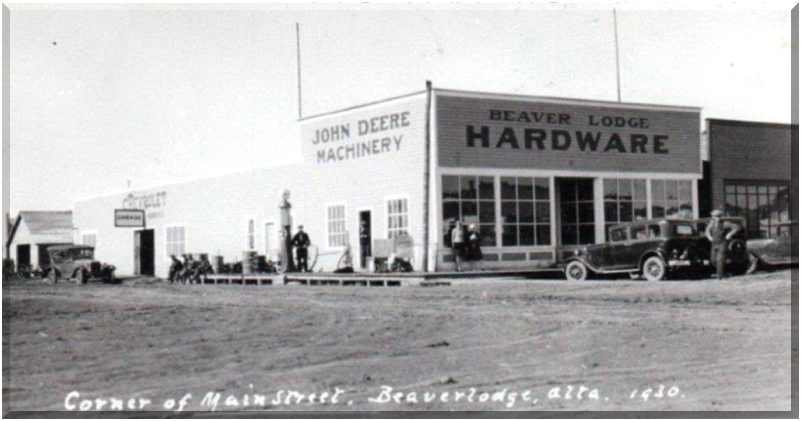
The original settlement became known as the Old Town.
The new development beside the railway became the New Town.
According to historical accounts preserved by the South Peace Historical Society, approximately 100 buildings were moved from the old location to the new townsite.
The Town of Beaverlodge also confirms that much of the settlement relocated when the railway arrived.
This was a major undertaking.
Moving a building required preparation, equipment, labour and careful planning.
It was particularly challenging in an era before modern hydraulic lifting systems and heavy transportation equipment were widely available.
Not every building moved, and the relocation was not a single event involving the entire community at once.
But the cumulative result was remarkable.
A new commercial centre developed beside the railway.
The old settlement gradually lost its importance.
The centre of Beaverlodge had effectively shifted.
Today, the story is easy to overlook.
A visitor driving through town may see an established community without realizing that its original centre once stood elsewhere.
Yet the railway's arrival changed the geography of Beaverlodge.
The town did not merely adapt to a new transportation system. It physically reorganized itself around it.
Grain Elevators and the New Downtown
The railway made agricultural shipping considerably easier.
Farmers could bring grain to elevators beside the tracks.
Railway cars transported grain toward larger markets.
Businesses developed around the station.
The town became an agricultural service centre for the surrounding district.
Historical municipal material describes six large grain elevators that eventually stood beside the railway.
Those elevators were symbols of the local economy.
They represented the productivity of surrounding farms and the importance of rail transportation.
But they also represented a major change.
Before the railway, farmers faced difficult overland transportation.
After its arrival, Beaverlodge had a more direct connection to the regional and national grain-handling system.
The railway helped turn a settlement into a more established commercial town.
The McNaught Homestead: A Family's Farm Becomes Part of Alberta's Heritage
South of Beaverlodge stands one of the district's most important historic places.
The McNaught Homestead is a provincially designated historic resource.
Its buildings and landscape preserve evidence of early settlement in the Peace Country.
The property includes residences, barns, granaries, sheds and other agricultural buildings.
The original homestead dates to 1911.
The McNaught family became closely associated with the district's history.
But one family member would become particularly well known for a different reason.
Her name was Euphemia McNaught.
Euphemia McNaught: The Artist Who Painted the Peace Country
Euphemia McNaught, often known as Betty McNaught, was born in 1902 and died in 2001.
She became an important Alberta artist whose work captured the landscapes and character of northwestern Canada.
Her family established its homestead in the Beaverlodge district during the early settlement period.
McNaught later studied at the Ontario College of Art.
Her teachers included artists associated with the Group of Seven, among them J.E.H. MacDonald and Arthur Lismer.
She returned to the Peace Country and continued developing her artistic career.
Her work helped preserve visual impressions of a landscape undergoing enormous change.
Fields, buildings, hills and the natural environment became subjects of artistic expression.
This is an important part of Beaverlodge's story.
The community was not shaped only by farmers, railway workers and merchants.
It also produced artists and cultural figures who helped document and interpret life in the region.
The McNaught Homestead received provincial historic designation in 2003.
Its preservation recognizes both the history of early settlement and Euphemia McNaught's contribution to Alberta's artistic heritage.
A Community That Built Its Own Gathering Place
Another remarkable Beaverlodge story involves the construction of its community centre.
South Peace Regional Archives records how several local residents investigated the possibility of obtaining a surplus building associated with Alaska Highway construction.
Les Harris, Doug McFarlane, Walter Bond and S.H. Andrews travelled to Dawson Creek to inspect the structure.
It was approximately 190 feet long.
The proposed building could accommodate a dance hall, theatre and lobby.
The idea initially appeared too ambitious.
But Les Harris and Walter Bond remained determined.
They purchased the building and offered the community an opportunity to take it over.
The village set aside seven acres.
Volunteers helped dismantle the building and bring it to Beaverlodge.
This story says a great deal about community life in the Peace Country.
People did not always wait for governments or outside investors to provide facilities.
Sometimes residents identified a need, found a practical solution and supplied the labour themselves.
A community centre was more than a building.
It was a place for dances, entertainment, meetings and shared experiences.
It helped turn a collection of homes and businesses into a community.
The Newspaper That Recorded Everyday Life
Beaverlodge also developed its own local newspaper tradition.
South Peace Regional Archives holds records of the Beaverlodge Advertiser.
The newspaper's history includes Peter and Trevor Harris, a father-and-son team who purchased the Beaverlodge Herald Tribune in 1956.
They renamed it the Beaverlodge Advertiser.
In 1959, Trevor Harris and his wife became the newspaper's sole owners.
They operated it for the next 52 years.
That represents an extraordinary commitment to local journalism.
Community newspapers document events that may seem ordinary at the time.
School activities.
Business openings.
Council decisions.
Sports results.
Weddings and anniversaries.
Community celebrations.
Obituaries.
Decades later, those reports become valuable historical evidence.
They help researchers reconstruct how people lived and what mattered to their communities.
For Swan City Now, this is a particularly meaningful part of Beaverlodge's history.
Today's local news becomes tomorrow's local history.
The Beaverlodge Advertiser's surviving photographs and records are therefore an important resource for understanding the town's development.
Saskatoon Mountain and the Cold War
Not every chapter of Beaverlodge's history involves agriculture.
Saskatoon Mountain, a prominent feature of the surrounding landscape, also played a role in Canada's defence system.
The Town of Beaverlodge records that the mountain had previously served as a forestry lookout and picnic site.
In 1953, the Department of National Defence took over the site.
It remained associated with the defence system until the mid-1980s.
This was the Cold War era.
Across Canada, military installations and radar systems formed part of the country's efforts to monitor potential threats.
Saskatoon Mountain's military history connected the Beaverlodge district to international tensions far beyond the Peace Country.
The story deserves its own future historical investigation.
What equipment operated there?
Who served at the site?
What buildings and infrastructure were constructed?
And what memories remain among residents who worked there or visited the area?
These are questions that former personnel, families and archival records may help answer.
Oil, Gas and a Changing Economy
By the 1950s, Beaverlodge was entering another period of economic change.
The agricultural economy remained important.
But oil and natural gas exploration began creating new opportunities throughout the Peace Country.
Drilling activity, transportation, equipment services and related businesses contributed to the regional economy.
Beaverlodge increasingly served residents involved in both agriculture and the energy industry.
This diversification mattered.
Communities that depended on only one industry could be vulnerable when markets changed.
Agriculture remained part of Beaverlodge's identity, but the wider economy offered additional employment and business opportunities.
The town continued evolving.
Hospitals, Health Care and Community Growth
As Beaverlodge grew, residents required more extensive public services.
Historical accounts record the construction of a ten-bed hospital in 1938.
A new 20-bed hospital followed in 1956.
An additional ten-bed section opened in 1967.
These developments reflected changing community needs.
A hospital meant local families had access to care closer to home.
That was especially important in a rural region where long distances and winter travel could complicate medical emergencies.
Health care remains an important issue for Beaverlodge and surrounding communities today.
The historical record reminds us that access to local medical services has been part of the community's development for generations.
Preserving the Past: The South Peace Centennial Museum
One of the most valuable resources for understanding Beaverlodge and the surrounding district is the South Peace Centennial Museum.
Located along Highway 43 northwest of Beaverlodge, the museum preserves agricultural machinery, buildings, tools and artifacts associated with early life in the Peace Country.
The museum's Pioneer Days celebrations began in 1967.
Visitors can see demonstrations of traditional skills and machinery.
Blacksmithing, rope making, sawmill operations, threshing and historic tractors help explain how earlier generations worked.
These demonstrations offer something that photographs alone cannot provide.
They show the movement, sound and effort involved in old methods of farming and manufacturing.
A steam engine operating today can help visitors understand the machinery that once transformed agricultural production.
A blacksmith demonstration can show how essential metalworking was before replacement parts became readily available.
For young people, these experiences make history tangible.
For older residents, they may bring back memories.
And for families whose ancestors settled in the district, they provide a connection to earlier generations.
The Book That Helped Preserve the District's History
In 1974, the Beaverlodge & District Historical Association published Beaverlodge to the Rockies.
The book documented settlement history and family stories from Beaverlodge and surrounding communities.
Its coverage extended beyond the town itself.
Communities represented included Albright, Appleton, Bush Lake, Elmworth, Gimle, Halcourt, Hayfield, Hazelmere, Lower Beaverlodge, Mountain Trail, Rio Grande, Two Rivers and West End.
The publication was an important preservation effort.
Without local history books, family accounts and archival collections, many details of early community life could disappear.
Names would be forgotten.
Photographs would lose their identifying information.
Stories passed down through families might never become part of the written historical record.
The association's work helped prevent that loss.
South Peace Regional Archives continues to preserve material associated with the organization.
The Giant Beaver and the Town's Modern Identity
Today, Beaverlodge is also known for its enormous beaver sculpture.
The landmark has become a recognizable symbol of the community.
It is the sort of attraction that encourages travellers to stop, take photographs and remember the town.
But Beaverlodge's real history is much larger than its roadside landmark.
It is the story of Indigenous peoples and their longstanding connection to the land.
Of settlers who travelled extraordinary distances.
Of farmers who transformed the agricultural landscape.
Of a town that moved to meet the railway.
Of researchers who studied northern agriculture.
Of artists who preserved the region through paintings.
Of volunteers who built community facilities.
And of local journalists who recorded the lives of their neighbours.
Each generation contributed something different.
Together, those contributions created the Beaverlodge we know today.
What Beaverlodge Teaches Us About the Peace Country
The history of Beaverlodge is ultimately a story about adaptation.
The first settlers adapted to a difficult environment.
Farmers adapted to northern growing conditions.
Businesses adapted when the railway changed the town's location.
The community adapted as agriculture, transportation and energy industries evolved.
Residents built schools, hospitals and gathering places as their needs changed.
And later generations worked to preserve the evidence of those earlier struggles and achievements.
The most striking example remains the relocation of the town in 1928.
Imagine the discussion that must have taken place among residents.
Should they stay where they had already invested their time and money?
Or should they move toward the railway and the economic opportunities it promised?
The historical record confirms that many chose to move.
Their decision helped shape the town for generations.
Beaverlodge reminds us that communities are not simply places on a map. They are the result of decisions made by people who believed their community had a future.
The Story Isn't Over
Swan City Now's Our Past, Our Peace Country series is intended to become a continuing record of the communities that shaped this region.
There are several parts of Beaverlodge's history that deserve additional investigation.
The town's relocation: Can descendants identify the buildings that moved from Old Town to New Town? Are any still standing?
The Bull Outfit: Do families have photographs, diaries or letters describing the 1909 journey?
The railway: Are there former railway workers or families with photographs of the station, elevators and trains?
The research station: What discoveries and agricultural improvements had the greatest impact on Peace Country farmers?
Saskatoon Mountain: What stories remain from its years as a military installation?
Local journalism: What can the Beaverlodge Advertiser's archives tell us about businesses, families and events that shaped the community?
We also want to expand the historical record to include more Indigenous perspectives and experiences.
Where information is uncertain, we will identify it as such.
Where readers provide new evidence, we will seek to verify it.
And where the record needs correcting, we will correct it.
Swan City Now — Because the story doesn't end with the headline.
Swan City Speaks: What Do You Think?
Beaverlodge residents, former residents and descendants of early families — we would love to hear your stories.
-
Do you have photographs of Old Town, the 1928 railway construction or buildings being moved? Share them and help us identify the people and places pictured.
-
Does your family have a connection to the Bull Outfit, the research station, the McNaught family or the early businesses of Beaverlodge? What stories have been passed down?
-
What have we missed? Are there important people, events, businesses or community traditions that deserve to be included? Can you help correct or expand the historical record?
If you share a historical photograph, please include any known names, approximate dates, locations and information about who owns the image.
We would like this story to grow as more residents contribute.
The history of Beaverlodge belongs to the people who lived it.
Share your thoughts in the comments. Your opinion matters.
Historical Photograph Suggestions
1. Beaverlodge in 1928 — The Railway Arrives
South Peace Regional Archives holds a 1928 photograph of a construction train passing the old town of Beaverlodge.
Photographer: R.E. Leake.
Archival collection: W.D. Albright fonds, item 0362.02.13.011.
Suggested caption: A railway construction train passes the original Beaverlodge townsite in 1928. The railway's arrival prompted the relocation of much of the settlement to a new site beside the tracks.
Credit: R.E. Leake / South Peace Regional Archives. Obtain reproduction permission.
Reference: https://www.southpeacearchives.org/finding-aid/fonds-362-w-d-albright-fonds/
2. Beaverlodge Townsite, 1928
The W.D. Albright collection contains photographs of the developing townsite taken during 1928, including images from August, September, October and November.
Suggested caption: Beaverlodge's new townsite takes shape in 1928 as the community relocates closer to the railway.
Credit: W.D. Albright / South Peace Regional Archives, subject to confirmation of the selected image and reproduction permission.
Reference: https://www.southpeacearchives.org/finding-aid/fonds-362-w-d-albright-fonds/
3. Wheat Fields in the Beaverlodge Valley, 1927
The W.D. Albright fonds includes historical images of wheat crops in the Beaverlodge Valley.
Suggested caption: Wheat fields in the Beaverlodge Valley in 1927, photographed before the railway transformed the town's grain-shipping opportunities.
Credit: W.D. Albright / South Peace Regional Archives, subject to reproduction permission.
Reference: https://www.southpeacearchives.org/finding-aid/fonds-362-w-d-albright-fonds/
4. The McNaught Homestead
A photograph of the historic McNaught Homestead would illustrate both early agricultural settlement and Euphemia McNaught's artistic legacy.
Suggested caption: The McNaught Homestead south of Beaverlodge preserves an important part of the Peace Country's settlement and artistic history.
Reference: https://hermis.alberta.ca/ARHP/Details.aspx?DeptID=1&ObjectID=4665-0873
5. South Peace Centennial Museum
A current photograph of the museum's historic machinery or buildings would connect the article with a place readers can visit.
Suggested caption: The South Peace Centennial Museum preserves the equipment, buildings and skills that helped early families establish farms and communities in the western Peace Country.
Credit: Photographer or South Peace Centennial Museum, with permission.
Reference: https://southpeacemuseum.com/
Sources and Historical References
Town of Beaverlodge — Town History
Municipal account of the early settlers, Bull Outfit, first businesses, post office, railway relocation, research station and Saskatoon Mountain.
https://beaverlodge.ca/visiting-us/town-history
South Peace Historical Society — Beaverlodge
Historical overview documenting the original settlement, 1928 railway arrival, relocation of approximately 100 buildings, hospital development and research station.
https://calverley.ca/article/16-008-beaverlodge/
South Peace Regional Archives — W.D. Albright Fonds
Archival photographs and descriptions documenting agricultural research, the Beaverlodge Valley, railway construction and the townsite in 1928.
https://www.southpeacearchives.org/finding-aid/fonds-362-w-d-albright-fonds/
South Peace Regional Archives — Beaverlodge School District No. 2341 Fonds
History of early education, teachers, school construction and the transition from Old Town to New Town.
https://www.southpeacearchives.org/finding-aid/fonds-069-beaverlodge-school-district-2341-fonds/
South Peace Regional Archives — Beaverlodge & District Historical Association Fonds
Background on the association and its 1974 publication, Beaverlodge to the Rockies.
Alberta Register of Historic Places — McNaught Homestead
Provincial heritage record documenting the homestead, early settlement and Euphemia McNaught's artistic contribution.
https://hermis.alberta.ca/ARHP/Details.aspx?DeptID=1&ObjectID=4665-0873
South Peace Regional Archives — Beaverlodge Community Center Fonds
Historical account of the community centre project and the volunteers who helped bring a surplus building from Dawson Creek.
https://www.southpeacearchives.org/finding-aid/fonds-336-beaverlodge-community-center-fonds/
South Peace Regional Archives — Beaverlodge Advertiser Fonds
History of the local newspaper, Peter and Trevor Harris and the publication's long association with the community.
https://www.southpeacearchives.org/finding-aid/fonds-661-beaverlodge-advertiser-fonds/
Town of Beaverlodge — Research Station
Overview of agricultural research activities associated with Beaverlodge.
https://beaverlodge.ca/visiting-us/learn/research-station
South Peace Centennial Museum
Museum information, historic equipment, preservation activities and Pioneer Days.
County of Grande Prairie — Regional History, 1898–1945
Regional historical chronology confirming the 1928 railway extension to Beaverlodge and Hythe.
https://www.countygp.ab.ca/parks-recreation-community/history-and-heritage/1898-to-1945/