Wembley: The Town That Was Moved by Horses
Our Past, Our Peace Country — Part 1
Imagine Moving an Entire Town
Imagine waking up one morning and discovering that the railway your community had been waiting for would not be coming through your town.
What would you do?
For the people of Lake Saskatoon in the 1920s, the answer was extraordinary.
They moved their buildings.
Not just household belongings or business merchandise. They moved actual buildings, using teams of horses to haul them across several kilometres of prairie to a new community called Wembley.
It sounds almost unbelievable today, but the photographs and historical records are still there to prove it.
Before Wembley, There Was Lake Saskatoon
Long before Wembley appeared on the map, Lake Saskatoon was an important gathering and commercial centre in the South Peace.
The lake offered water and access to the surrounding countryside. As settlers established homesteads, businesses began serving the growing agricultural community.
Historical records preserved by the South Peace Regional Archives show that Lake Saskatoon developed into an early commercial centre.
Stores, services and other businesses followed the arrival of settlers.
For a time, Lake Saskatoon appeared well positioned to become an important permanent town.
But its future depended on something beyond the control of its residents.
The railway.
The Railway That Changed Everything
In the early 1900s, railway access could determine whether a Prairie settlement prospered or declined.
Railways brought supplies, passengers, mail and access to distant markets. For farmers, railway connections meant a practical way to ship grain and other agricultural products.
When the Edmonton, Dunvegan and British Columbia Railway reached Grande Prairie in 1916, communities farther west hoped they would be included in its eventual extension.
Lake Saskatoon residents had reason to be optimistic.
But when the line was extended westward in 1924, the route passed approximately four and a half miles, or seven kilometres, south of the existing settlement.
The new railway townsite was Wembley.
That decision changed the future of both communities.
The Remarkable Move to Wembley
Rather than wait for commercial activity to disappear, many Lake Saskatoon business owners made a practical but difficult decision.
They would move to the railway.
During the mid-1920s, buildings were transported across the prairie to new locations in Wembley.
Teams of horses supplied the pulling power.
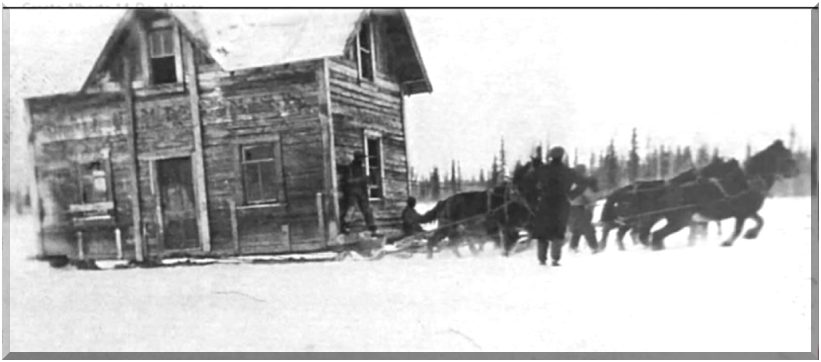
One remarkable surviving photograph shows men and horses moving Bob Tilt's restaurant from Lake Saskatoon to Wembley in 1925.
The photograph is preserved by the South Peace Regional Archives.
Consider the work involved.
A building had to be prepared for transport, moved onto a suitable support and pulled across the countryside without the modern heavy equipment available today.
Then it had to be placed on its new site and made ready for business again.
For the people involved, this was more than a construction project. It was an attempt to preserve their businesses, livelihoods and community.
Even the Church Had an Unusual Journey
The history of Wembley United Church provides another fascinating example of the community's determination.
According to the church's published history, a pool hall was moved from Lake Saskatoon to Wembley in 1925 and repurposed as a church.
A house purchased for use as a minister's residence was moved using a team of 32 horses.
Later, in 1956, the original Methodist church building from Lake Saskatoon was moved into Wembley to serve as a church hall and Sunday School room.
And the tradition of moving buildings continued.
In 1983, a former Presbyterian church building from Grande Prairie was relocated to Wembley for the congregation.
Few communities can claim such an extensive history of moving buildings to meet changing needs.
How Wembley Got Its Name
Wembley's name has an interesting international connection.
In 1924, the British Empire Exhibition was taking place at Wembley in England.
Historical accounts associate the Alberta community's name with that famous English location.
A small settlement in northwestern Alberta was therefore named after a place thousands of kilometres away.
The new townsite had been surveyed in 1923, and its post office opened in 1924.
On January 3, 1928, Wembley officially became a village, with a population of just over 200.
It became a town on August 1, 1980.
What Happened to Lake Saskatoon?
As businesses and services moved south, the original Lake Saskatoon settlement gradually lost its role as a commercial centre.
The community's history, however, did not disappear.
The surrounding agricultural area continued to have residents, and Lake Saskatoon remained an important place in local memory.
Its cemetery is one enduring connection to the original settlement and the families who built it.
The South Peace Regional Archives has preserved photographs, documents and accounts that help tell the story of the community before and after the railway changed its future.
Without those records, an extraordinary chapter of regional history could easily be forgotten.
From Railway Town to Dinosaur Country
Today, Wembley is known for much more than its unusual beginnings.
Agriculture remains an important part of its identity.
The community is also associated with the internationally significant dinosaur discoveries at nearby Pipestone Creek and the Philip J. Currie Dinosaur Museum.
Where the railway once helped determine the town's future, tourism, local businesses, agriculture and regional connections now contribute to its identity.
Wembley has changed enormously since the first buildings were hauled across the prairie.
But the determination of its early residents remains one of its most memorable stories.
A Lesson That Still Matters Today
There is something especially interesting about Wembley's history.
The people of Lake Saskatoon did not necessarily want to abandon their original community.
But a transportation decision changed the economic opportunities available to them.
In 1924, the railway was the infrastructure that mattered.
Today, communities make decisions about highways, industrial developments, water supplies, electrical infrastructure and new industries.
The circumstances are different, but the underlying question is familiar.
Who decides where development happens, and what becomes of communities left outside those decisions?
Wembley's history reminds us that decisions made today can shape the geography and prosperity of the Peace Country for generations.
Help Us Preserve Wembley's History
Swan City Now is launching Our Past, Our Peace Country, a series exploring the stories behind our towns, villages and rural communities.
We would love to hear from Wembley and Lake Saskatoon families.
Do you have old photographs, newspaper clippings, family stories or memories passed down through generations?
Perhaps your grandparents helped move a building, operated an early business or remember stories about the original settlement.
Your family's history could become part of a future feature.
We want these stories to come from the people who know their communities best.
Every community has a history. Every family has a story. Let's make sure those stories are not forgotten.
Swan City Speaks: What Do You Think?
- Did your family have connections to the original Lake Saskatoon settlement or Wembley's early years?
- Do you know of any buildings in Wembley today that were originally moved from Lake Saskatoon?
- What other stories from Wembley's past should we investigate?
Share your thoughts in the comments. Your opinion matters.
Historical Sources
- County of Grande Prairie — History and Heritage: https://www.countygp.ab.ca/parks-recreation-community/history-and-heritage/1898-to-1945/
- South Peace Regional Archives — Campbell Family Fonds: https://www.southpeacearchives.org/finding-aid/fonds-032-campbell-family-fonds/
- South Peace Regional Archives — County Cemetery Tour Brochure: https://www.southpeacearchives.org/wp-content/uploads/2013/08/County-Cemetery-Tour-Brochure.pdf
- Wembley United Church — Historical Records: https://beaverlodgeuc.ca/wp-content/uploads/2023/04/HISTORY-OF-WEMBLEY-UNITED-CHURCH.pdf
Historical photograph credit: South Peace Regional Archives, photograph 001.06.02.116, showing Bob Tilt's restaurant being moved from Lake Saskatoon to Wembley in 1925.