Sexsmith: The Little Prairie Town That Became the Grain Capital of the British Empire
Our Past, Our Peace Country — History told by the people who lived it.
A Small Town With an Extraordinary Claim to Fame
Drive north from Grande Prairie along Highway 2 and, after about 20 kilometres, you arrive in Sexsmith.
Today, it is a community of homes, schools, businesses and families. But there was a time when this little northern Alberta town held a remarkable distinction.
It was known as the Grain Capital of the British Empire.
Think about that for a moment.
A small community in the Peace Country, far from the great ports and commercial centres of the world, was celebrated for shipping extraordinary quantities of grain.
The Sexsmith & District Museum Society identifies 1938 through 1947 as the period when the community led the British Empire's inland grain-shipping terminals.
The title was a source of enormous local pride.
But how did a small prairie settlement become such an important agricultural centre?
The answer begins with the land, the settlers and a railway.
Before the Grain Elevators
Long before Sexsmith became a railway and farming community, the Peace Country was part of the traditional lands and travel networks of Indigenous peoples.
The arrival of agricultural settlement and railway development transformed the region, creating new communities and commercial opportunities while changing the landscape and its earlier patterns of land use.
Sexsmith developed in an area particularly well suited to grain farming.
The district's fertile black soil and relatively open prairie made cultivation attractive to settlers.
Families established homesteads, cleared land, planted crops and began building the agricultural economy that would define the community for generations.
But producing grain was only part of the challenge.
Farmers needed somewhere to sell it, store it and transport it to distant markets.
That required a railway.
The Railway Changes Everything
The railway reached the Sexsmith district in 1916.
For farmers, its arrival meant access to a transportation system capable of moving their harvests far beyond the Peace Country.
Before railway service, distance and transportation costs presented enormous difficulties for agricultural producers.
A railway connection changed the economics of farming.
Grain could be hauled from farms to local elevators, loaded into railway cars and shipped onward to larger markets.
The first grain elevators began appearing in Sexsmith in 1917.
South Peace Regional Archives records show that two companies, Gillespie Elevator Company and Alberta Pacific, were operating at Sexsmith during the 1916–1917 crop year.
This was the beginning of something much larger.
As more land came under cultivation and production increased, additional grain-handling facilities were needed.
The railway did more than carry grain. It helped make Sexsmith a commercial gathering place for the surrounding agricultural district.
Farmers came to town to deliver crops, purchase supplies, conduct business and meet their neighbours.
The fortunes of the town and the surrounding farms became closely connected.
The Grain Elevators That Defined a Skyline
For decades, grain elevators were among the most recognizable structures across Western Canada.
Tall wooden buildings stood beside railway tracks, often visible for kilometres across the prairie.
They were practical industrial facilities, but they also became symbols of agricultural prosperity.
Sexsmith had more than its share.
By the 1950s, nine grain elevators stood in the community, according to the Sexsmith & District Museum Society.
Imagine that skyline.
A row of towering wooden structures, railway cars waiting to be loaded, trucks and wagons arriving with grain, and workers handling the harvest.
Each elevator represented an important connection between local farms and the wider economy.
They were also places where farmers met elevator agents, discussed crops, compared prices and exchanged news.
The grain elevator was more than a building.
It was one of the centres of prairie community life.
The People Behind the Grain Trade
The history of Sexsmith's elevators is also a history of the people who operated them.
One example is the United Grain Growers operation.
According to records preserved by South Peace Regional Archives, United Grain Growers opened its Sexsmith elevator on August 6, 1925.
Its first manager was R. H. Baker, who remained in that position until July 1940.
The local United Grain Growers organization was established in March 1926.
Its first board included Alfred Ward, W. Spry, W. Alexander, R. J. Higginson, A. Abrahamsen and H. A. Tuffill.
These names represent part of the business and agricultural leadership that helped develop the community.
The United Grain Growers facilities expanded over time.
A storage annex was added in 1928.
In 1940, during the Second World War, emergency storage was constructed because wartime restrictions on ocean shipping made it difficult to move grain overseas.
This is an important reminder that events thousands of kilometres away could directly affect the farmers and grain handlers of Sexsmith.
Even a world war changed the way grain was stored in this little Alberta town.
The Grain Capital of the British Empire
Sexsmith's most celebrated period came during the late 1930s and 1940s.
According to the Sexsmith & District Museum Society, the community led inland grain-shipping terminals across the British Empire from 1938 to 1947.
That achievement earned Sexsmith its famous title.
There is an important historical distinction here: the museum describes the claim in terms of inland grain terminals, rather than suggesting Sexsmith was a seaport or exceeded the total grain traffic of every ocean port.
Nevertheless, the achievement was remarkable.
The Peace Country was geographically distant from major Canadian markets.
Its growing season was relatively short, and farmers faced weather and transportation challenges.
Yet the combination of productive farmland, agricultural investment, railway service and the work of local farm families made Sexsmith an important grain-handling centre.
The title became part of the town's identity.
And it remains a source of community pride.
When Farming Changed, So Did Sexsmith
The grain industry did not stand still.
Larger machinery, changing transportation systems, improved grain-handling technology and consolidation gradually transformed agriculture across Western Canada.
Many of the smaller wooden grain elevators that once stood along railway tracks disappeared.
Some were demolished.
Others were destroyed by fire.
Sexsmith experienced both change and loss.
United Grain Growers records document the destruction of one of its elevators by fire on November 13, 1961.
Decades later, another historic elevator was lost in a January 2015 fire.
The old skyline could not remain unchanged forever.
But the community's agricultural story continued.
In 1976, the Northern Alberta Rapeseed Plant began production in Sexsmith. According to the town's historical account, the facility employed approximately 80 people and attracted farmers from across northern Alberta.
It represented another chapter in the community's agricultural economy.
Rather than simply shipping crops elsewhere, agricultural processing offered another way to build local economic activity.
Sexsmith officially became a town in 1979.
Its identity continued to evolve as residential development, local services and new businesses joined the agricultural economy.
The Buildings That Refused to Disappear
Fortunately, some Sexsmith residents recognized that the community's history was worth preserving.
In 1977, an organization that became the Sexsmith & District Museum Society began gathering local history.
Its work helped produce the 1980 history book Wagon Trails Grown Over.
That book preserved accounts of settlement, families and community life that might otherwise have been forgotten.
The society went on to restore and protect historic buildings.
Among its important projects were the Nels Johnson Blacksmith Shop, the former Northern Alberta Railway station and other buildings associated with the town's early years.
The blacksmith shop restoration began in 1984 and was completed in 1989.
In 1990, the museum society moved the railway station back to its original location and began restoration work.
These were not simply projects to save old buildings.
They were efforts to preserve the physical places where generations of residents worked, travelled and built their community.
Saving the Last Grain Elevator
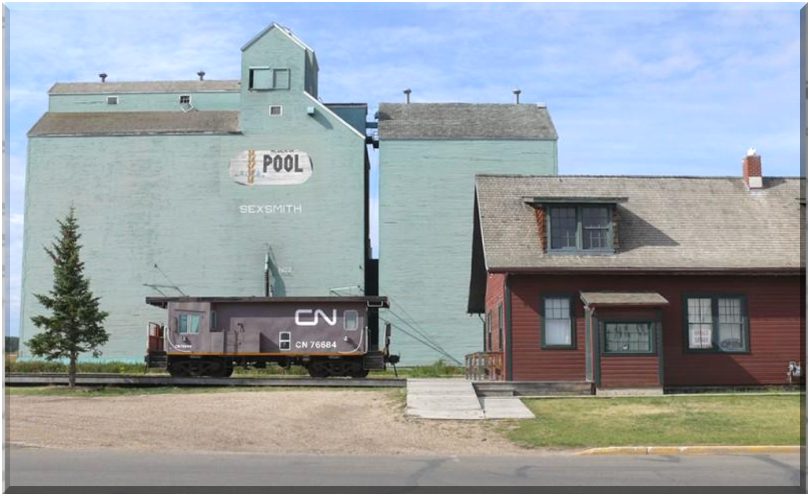
Perhaps the most symbolic preservation effort has involved the surviving Alberta Wheat Pool grain elevator.
The structure was built in 1961, with an extension added in 1978.
The museum society purchased it in 2004.
In December 2020, the elevator received municipal historic resource designation, an important step toward protecting the building.
Restoration work has included roofing, painting, cleaning, electrical improvements and preservation of historic equipment.
The museum society has worked toward making the elevator accessible for educational tours, including demonstrations and explanations by retired elevator agents.
That is especially valuable because an elevator can tell a story that photographs alone cannot.
Visitors can learn how grain was received, weighed, lifted, stored and loaded for shipment.
They can begin to understand the work involved in moving an entire region's harvest.
For younger generations who have never seen a working wooden grain elevator, that experience connects modern agriculture with its past.
A Downtown That Remembers
Sexsmith's heritage is not confined to a single building.
Its historic downtown includes buildings and streetscapes that recall an earlier period of northern Alberta community life.
The former railway station, blacksmith shop, churches, heritage houses and other preserved structures help tell the story of a town shaped by agriculture and transportation.
Historical plaques provide another connection to the past.
The museum society's work has helped make Sexsmith a place where residents and visitors can encounter local history simply by walking through town.
That is something worth celebrating.
Many communities have lost nearly all the physical reminders of their earliest commercial years.
Sexsmith has made a determined effort to keep some of those reminders standing.
What the Old Photographs Cannot Tell Us
There are photographs of Sexsmith's grain elevators, railway facilities and early downtown.
They show buildings, streets, equipment and the physical growth of the community.
But photographs leave many questions unanswered.
Who were the farmers delivering grain?
What was it like to work inside an elevator during harvest?
Which businesses depended on the grain trade?
What did children remember about growing up beside the railway tracks?
What happened to the families whose livelihoods changed as agriculture modernized?
And what stories have been passed down through local families that have never appeared in a history book?
These are the stories Swan City Now hopes residents will help preserve.
Our Past Is Still Part of Our Future
Sexsmith's grain-shipping glory days belong to another era.
The wooden elevator skyline has largely disappeared, and modern agriculture operates on a very different scale.
But the community's history remains relevant.
It reminds us how much the Peace Country was built through agriculture, transportation, entrepreneurship and the efforts of families willing to establish lives in a developing region.
It also shows how quickly important pieces of local history can disappear.
An old building is demolished.
A photograph is discarded.
A family story is forgotten.
And another connection to the past is lost.
The work of the Sexsmith & District Museum Society demonstrates what can happen when residents decide their history deserves to survive.
The Grain Capital of the British Empire may no longer be a commercial title.
But it remains part of Sexsmith's identity.
And that story deserves to be told.
Help Us Preserve Our Peace Country History
Swan City Now is launching Our Past, Our Peace Country, a continuing series exploring the history of communities throughout the region.
Our motto is simple:
History told by the people who lived it.
We invite residents to share old photographs, family memories, historical documents and stories about the people who helped build their communities.
Perhaps your grandparents worked at a grain elevator.
Perhaps your family operated an early Sexsmith business.
Perhaps you remember the railway, the old elevators or a building that no longer exists.
We would like to hear those stories.
Together, we can preserve a richer record of our Peace Country history for future generations.
Historical Sources and Further Reading
- Town of Sexsmith — The Story of Sexsmith's History: https://sexsmith.ca/the-story-of-sexsmith-s-history
- South Peace Regional Archives — United Grain Growers Local #423 Collection: https://www.southpeacearchives.org/finding-aid/fonds-183-united-grain-growers-local-432-collection/
- Sexsmith & District Museum Society — Grain Elevator Historical Designation: https://www.sexsmithmuseum.com/press-release
- Sexsmith & District Museum Society — Elevator Preservation Project: https://www.sexsmithmuseum.com/elevator-preservation-project
- Town of Sexsmith — Sexsmith & District Museum Society: https://sexsmith.ca/sexsmith-district-museum-society-1
- Spirit of the Peace Museums — Sexsmith Museum: https://spiritofthepeace.ca/our-museums/sexsmith-museum/
Swan City Speaks: What Do You Think?
- Does your family have a connection to Sexsmith's grain elevators, railway or early businesses? We would love to hear the story.
- Do you have old photographs of Sexsmith? Can you identify people, buildings or events that deserve to be remembered?
- What part of Sexsmith's history should we investigate next? Is there a forgotten business, family, community event or local character we should feature?
Share your thoughts in the comments. Your opinion matters.