Canfor Loses $77 Million in Three Months — Is Grande Prairie's Forestry Industry at Risk?
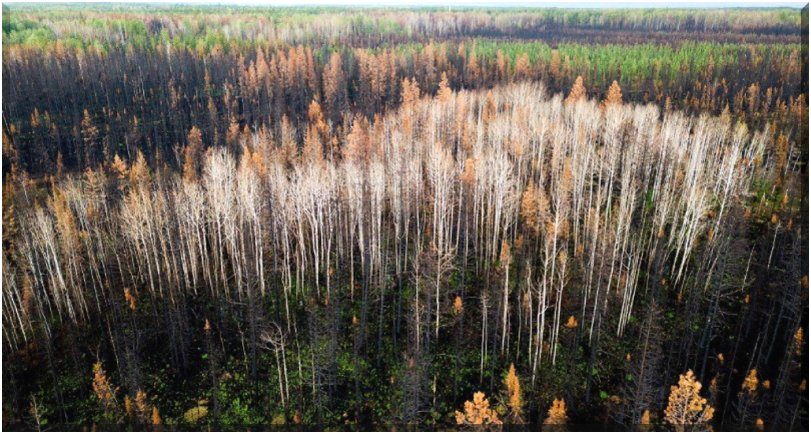
Fox Creek has already lost its sawmill. Canfor says it remains committed to Grande Prairie, but falling lumber demand, American trade duties and shrinking timber supplies are raising difficult questions about the future of one of the Peace Country's longstanding industries.
Back on top · first published Nov 6
A $77-Million Loss — But What Does It Mean Here?
One of Western Canada's major forestry companies has reported another difficult financial quarter, raising questions about the future of lumber production and forestry employment across the Peace Country.
On November 4, Canfor Corporation announced an operating loss of $76.6 million for the third quarter of 2026.
The company also reported a net loss attributable to shareholders of $88.2 million, equivalent to 75 cents per share.
These are company-wide figures, not losses attributed specifically to Grande Prairie.
Canfor's quarterly sales totaled approximately $1.28 billion, down from $1.53 billion in the preceding quarter.
The company remains a substantial business, with sawmills and other forest-products operations in Canada and overseas.
Its adjusted earnings before interest, taxes, depreciation and amortization — known as EBITDA — were positive at $98.1 million.
That distinction matters.
An accounting loss does not necessarily mean a company is running out of cash, and the latest results include significant costs associated with closing facilities.
Nevertheless, the results show that Canfor continues to operate in a difficult market.
For Grande Prairie, the most immediate concern is what has already happened nearby.
Fox Creek Has Already Lost Its Sawmill
In July, Canfor announced that its Fox Creek sawmill would permanently close.
Operations wound down in September.
The closure removed approximately 120 million board feet of annual lumber-production capacity.
It also ended an important industrial operation in a community where forestry has long supported employment and local businesses.
Canfor recorded a $31.8-million asset write-down and impairment charge associated with the closure, along with $4.6 million in restructuring costs during the third quarter.
The company cited several reasons for the decision:
- Prolonged weakness in lumber markets.
- High U.S. softwood lumber duties and tariffs.
- Changes to available timber supplies following wildfires.
- The conclusion of the mountain pine beetle management strategy.
The timber-supply issue is particularly important.
Fox Creek's sawmill had been destroyed by fire in 2008 and rebuilt in 2011.
The rebuilt facility was designed to process additional timber made available through efforts to manage forests susceptible to mountain pine beetle infestations.
As that strategy concluded and supplies of wildfire-damaged timber were largely exhausted, Canfor said there was insufficient fibre to sustain the operation over the long term.
In other words, the closure was not simply about the price of lumber.
It was also about the availability of trees that could be economically harvested and processed.
What About Grande Prairie?
Canfor continues to operate its Grande Prairie sawmill.
When announcing the Fox Creek closure, the company specifically identified Grande Prairie and Whitecourt among the Alberta operations it wanted to strengthen.
It also pointed to its value-added manufacturing businesses, including Spruceland and PinkWood.
That is encouraging, but it is not a guarantee against future changes.
Forestry companies continually evaluate the costs of operating individual facilities, the timber available to them, transportation expenses and the markets for their products.
A sawmill can be profitable in one year and face significant pressure in another.
The November 4 financial report did not announce a new closure, production shutdown or workforce reduction at Grande Prairie.
It also did not provide a separate profit-and-loss statement for the Grande Prairie mill.
Therefore, the company's overall $77-million operating loss cannot be used to conclude that the local operation is losing money.
The question is whether the conditions that contributed to Fox Creek's closure could eventually affect other facilities.
Why the Price of Lumber Matters to the Peace Country
Lumber prices are influenced by demand from homebuilders, renovation projects and industrial buyers.
When construction slows, demand for lumber often weakens.
Canfor says elevated mortgage rates, housing affordability problems and economic uncertainty have been affecting purchasing decisions.
Buyers have been cautious about building inventories.
This means a sawmill can face pressure even while continuing to produce large quantities of lumber.
If the selling price falls while wages, energy, transportation and equipment expenses remain high, profitability can deteriorate.
For Grande Prairie, the effects can extend well beyond the mill itself.
Forestry supports logging contractors, truck drivers, mechanics, equipment dealers, fuel suppliers and many other businesses.
Those employees and contractors spend money at local grocery stores, restaurants and other businesses.
A major reduction in forestry activity can therefore affect the wider regional economy.
The American Trade Problem
Canadian softwood lumber has been at the centre of a long-running trade dispute with the United States.
American producers have argued that Canadian lumber benefits from unfair government support through provincial timber-pricing systems.
Canadian producers and governments have disputed those allegations and challenged the resulting duties.
For companies such as Canfor, duties add costs and uncertainty to lumber exports.
That matters because the United States is an important market for Canadian wood products.
Even when a mill operates efficiently, trade barriers can reduce the amount it earns from lumber sold across the border.
Canfor expects lower softwood lumber duty rates that took effect in mid-October to provide some relief.
However, the company also expects to recognize an additional $45.9-million duty expense in the fourth quarter following the finalization of earlier trade-review rates.
The underlying dispute remains unresolved.
For workers in the Peace Country, decisions made in international trade proceedings can have consequences close to home.
What Happens When a Mill Closes?
The immediate effect of a closure is felt by employees and their families.
But the consequences can spread much further.
Logging contractors may lose customers.
Trucking companies may lose hauling work.
Equipment suppliers may see fewer orders.
Local businesses may experience reduced spending.
Municipalities can also face consequences if industrial property assessments and associated tax revenues change.
However, the size of any municipal revenue loss depends on the facility's assessed value, tax treatment and subsequent use of the property.
No verified estimate of municipal tax revenue lost because of the Fox Creek closure was established for this article.
A closure also raises questions about the future of the industrial site.
Can the property be reused?
Could another manufacturer take over?
What happens to roads and infrastructure developed to support the facility?
And what happens to workers who have built careers around an industry that is changing?
These questions deserve attention before a community faces a crisis.
Are There Enough Trees for the Future?
The Fox Creek closure highlights a fundamental challenge facing forestry.
A sawmill needs more than customers.
It needs a reliable, economically accessible supply of timber.
Wildfires can destroy commercially valuable trees or change when damaged timber must be harvested.
Mountain pine beetle infestations can also affect forest management and available timber supplies.
At the same time, forestry companies must operate within provincial harvesting rules and environmental requirements.
Timber supply is not unlimited.
For the Peace Country, several questions arise.
How much timber is currently allocated to local mills?
How much remains economically harvestable?
What impact have recent wildfires had on future harvest plans?
And how much reforestation will be required to sustain production over the coming decades?
These are important questions for both industry and the public.
Forests are economic resources, but they also provide wildlife habitat, recreation opportunities, carbon storage and other environmental benefits.
Long-term planning must account for all of those uses.
Could Value-Added Wood Manufacturing Help?
One possible response to difficult lumber markets is to manufacture more products from the timber already harvested.
Instead of selling only standard dimensional lumber, companies can produce engineered wood, building components and other higher-value materials.
Canfor recently acquired PinkWood, expanding its engineered wood manufacturing capacity.
Value-added manufacturing can create different opportunities for employment and may help diversify the products a company sells.
But it does not eliminate the need for competitive costs, reliable timber supplies and customers willing to buy the finished products.
The question for the Peace Country is whether more local manufacturing could help retain economic value within the region.
Could more wood products be manufactured here rather than shipped elsewhere for additional processing?
And what infrastructure, investment and workforce training would be required?
Is This Another Warning About Economic Dependence?
Grande Prairie's economy has long depended on resource industries.
Oil and gas, agriculture and forestry have supported generations of workers and businesses.
Those industries remain important.
But they are also exposed to commodity prices, international trade disputes, government policy and changes in technology.
The closure of one sawmill does not mean the entire forestry industry is collapsing.
It does, however, demonstrate how quickly economic conditions can change for a resource-dependent community.
That makes economic diversification more than a political slogan.
It is a practical question about how communities maintain employment and public services when major industries experience difficult periods.
New industries may create opportunities.
But established industries also deserve attention.
A community should not assume that jobs which have existed for decades will automatically remain for decades more.
What Does Canfor Expect Next?
Canfor expects North American lumber markets to remain challenging through the final quarter of 2026.
The company anticipates softer seasonal demand as construction activity slows.
It also expects mortgage rates and housing affordability to remain obstacles into 2027.
Some relief may come from lower lumber duties, but the company is not forecasting an immediate return to strong market conditions.
That outlook does not establish that Grande Prairie's sawmill is at risk of closure.
It does suggest that the broader economic pressures affecting the industry have not disappeared.
For local workers and businesses, the next several quarters will be worth watching.
The Story Isn't Over
Several important questions remain unanswered.
1. Grande Prairie employment: How many direct employees and contractors currently depend on Canfor's Grande Prairie operations?
2. Local profitability: Is the Grande Prairie sawmill operating profitably, and has production changed during 2026?
3. Timber supply: How have recent wildfires and forest-management decisions affected the long-term timber supply for the local mill?
4. Municipal finances: How much municipal property-tax revenue is associated with the Grande Prairie facility and its supporting industrial operations?
5. Economic diversification: Could additional wood-product manufacturing create more jobs and reduce reliance on basic lumber production?
6. Fox Creek's future: What plans, if any, exist for the closed sawmill property and the workers affected by the shutdown?
These are the questions that determine what Canfor's financial results mean for the Peace Country beyond the company's balance sheet.
Swan City Now — Because the story doesn't end with the headline.
Swan City Speaks: What Do You Think?
1. Are you or members of your family employed in forestry, logging, trucking or another business connected to the lumber industry? Have you noticed changes in work during the past year?
2. Should Alberta and local municipalities do more to encourage value-added wood manufacturing rather than relying primarily on traditional sawmills?
3. With Fox Creek's sawmill now closed, are you concerned about the long-term future of forestry jobs in Grande Prairie and the Peace Country?
Share your thoughts in the comments. Your opinion matters.
Sources
Canfor Corporation — Third Quarter 2026 Financial Results, November 4, 2026
https://www.canfor.com/newsroom/2026-11-04/canfor-reports-results-for-the-third-quarter-of-2026
MyGrandePrairieNow — Canfor to Close Fox Creek Sawmill, July 28, 2026
https://www.mygrandeprairienow.com/154042/news/business/canfor-to-close-fox-creek-sawmill/
GlobeNewswire — Canfor Third Quarter Results, Including Financial Tables
Editor's note: All financial figures are company-wide unless otherwise identified. No new closure or layoffs at the Grande Prairie sawmill were announced in the November 4 results. The article does not claim that the Grande Prairie operation is unprofitable.