Grande Prairie's $230-Million Budget: A 2.8% Tax Increase, a Property Sale and Some Big Financial Questions
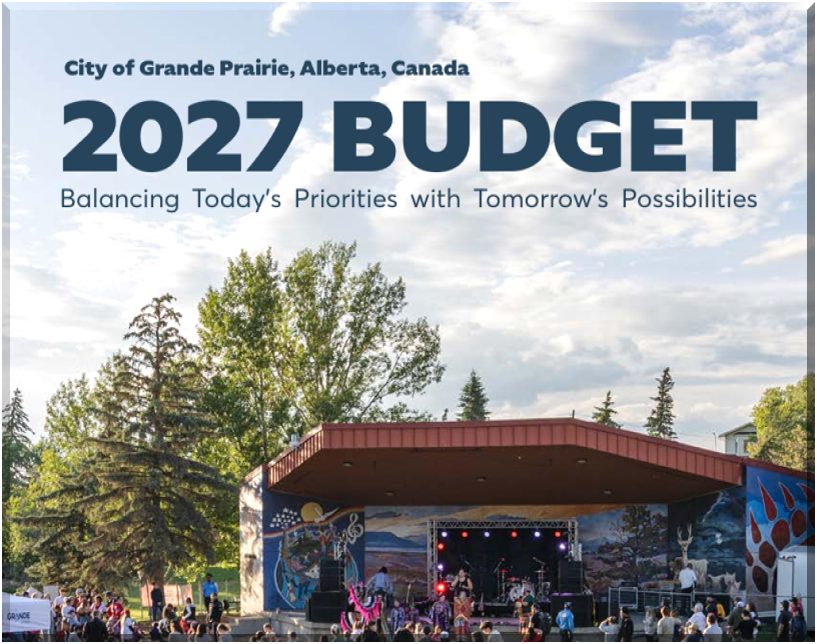
Grande Prairie's proposed 2027 municipal budget is about more than a 2.8% property tax increase.
Back on top · first published Nov 19
A $230-Million Budget — But What Are Taxpayers Really Buying?
Behind the headline number is a $230.2-million operating plan, $38.6 million in proposed capital investment, a significant transition in policing and emergency communications, and a financial strategy that includes selling City property and redirecting reserve funds.
The City's November 18 budget package provides a detailed account of the decisions facing Council.
It also raises an important question: Is Grande Prairie reducing the cost of government, or managing when some of those costs will be paid?
Those are not necessarily the same thing.
From 8.68% Down to 2.8%
According to the City's Chief Financial Officer, Danielle Whiteway, maintaining existing services initially produced an increase in required tax revenue of approximately $12.3 million, equivalent to 8.68%.
That was before adding new programs or service expansions.
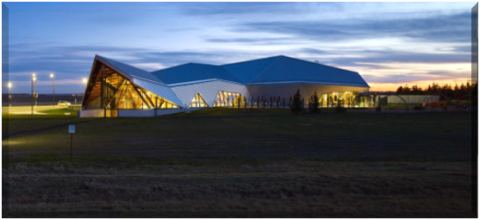
The pressures included employee salaries and benefits, contractual obligations, operating costs associated with the Multisport Dome and Public Safety Communications Centre, and funding requirements for infrastructure renewal.
Administration subsequently reduced the additional revenue requirement to approximately $3.96 million, or 2.8%.
The City attributes the reduction to efficiencies, revised financial assumptions, targeted spending reductions, deferred or reshaped expenditures, and strategies involving existing assets and reserves.
The difference is approximately $8.3 million.
But reducing the amount required from taxpayers in 2027 does not automatically mean the City has permanently eliminated $8.3 million in annual costs.
Some strategies involve changing the timing or source of funding.
That distinction matters when evaluating whether the lower tax increase can be maintained in future budgets.
What Will the Increase Cost Homeowners?
The City estimates that its proposed 2.8% municipal tax increase would cost the owner of a typical single-family dwelling approximately $99.60 annually, or $8.30 per month.
The calculation is based on an average 2026 single-family dwelling value of $378,000.
However, the municipal increase is not necessarily the increase residents will see on their entire property tax bill.
The City also collects provincial education property taxes and other requisitions on behalf of outside organizations.
Those amounts are determined separately.
The budget notes that the provincial education tax levy increased by 9% in 2025 and 6.7% in 2026.
Consequently, residents should not assume their total 2027 property tax bill will increase by only 2.8%.
Individual assessment changes can also affect the final amount.
Cedar Point: Selling an Asset to Finance Other Priorities
One of the more significant financial strategies involves the proposed sale of Cedar Point to the Province of Alberta.
The property has already been the subject of local reporting concerning its sale and the future of the people and services associated with it.
The City's 2027 budget now provides additional insight into how administration proposes to use the money.
According to the budget, sale proceeds would first retire outstanding debt associated with the City's original purchase and renovation of the property.
The remaining proceeds would then be allocated as follows:
| Proposed allocation | Amount |
|---|---|
| Infrastructure and facility renewal | $5.3 million |
| Multi-family housing tax rebates over four years | Approximately $1.9 million |
| Council's Strategic Initiatives Reserve | $1.9 million |
| Total | Approximately $9.1 million |
The proposed allocations raise questions about the overall financial outcome of the transaction.
How much did the City originally invest in the property?
How much debt remains?
What is the final sale price, and what will the City's net financial position be after the transaction?
The budget explains the intended use of the proceeds, but the figures in this section do not establish the City's complete gain or loss on the property.
There is also a distinction between selling an asset and creating a new source of recurring revenue.
A property can generally be sold only once.
The resulting proceeds can finance worthwhile investments, but they do not replace the need for sustainable annual revenue to maintain City services.
The budget describes the Cedar Point transaction as a proposed sale. The document alone does not establish that the sale has closed or that every allocation has received final Council approval.
Reserve Funds: Savings or Spending?
The City also proposes redirecting previously unallocated funding from its Future Expenditures Reserve.
Approximately $4.5 million was identified as unallocated, largely originating from capital taxes collected in previous budgets.
Of that amount, $2.5 million is proposed for facility and fleet renewal.
The remaining unallocated balance would stay in the reserve for future capital priorities.
Separately, the City proposes using $1.58 million from its Financial Stabilization Reserve to help manage the operating costs of the Public Safety Communications Centre in 2027.
That includes $650,000 in reserve capacity previously restricted for the streetlight transition.
These strategies may reduce immediate pressure on taxpayers.
They also create a question about the future: What happens when temporary reserve support is no longer available?
The City says it intends to phase significant operating commitments into future budgets.
That makes the financial forecasts for 2028, 2029 and 2030 just as important as the proposed 2027 tax increase.
Policing Remains a Major Expense
Public safety represents one of the City's largest areas of spending.
The budget's service overview identifies $42.6 million for police and public safety, while its separate policing appendix provides a more detailed breakdown of policing-related expenditures.
That appendix proposes approximately $36.75 million for Policing Services in 2027, compared with $37.19 million budgeted in 2026.
Within those totals, however, substantial changes are taking place.
The Grande Prairie Police Service's own operating allocation would rise from approximately $13.13 million in 2026 to $23.77 million in 2027.
At the same time, the former RCMP contract allocation and police transition budget are removed from the 2027 figures.
The City plans for 108 sworn officers by the end of 2027 and 110 by the end of 2028, including five provincially funded ALERT positions.
The appendix forecasts total Policing Services spending increasing to approximately $42.42 million by 2030.
These figures should not be interpreted as a direct comparison between the cost of the former RCMP contract and the complete cost of the new police service. The accounting categories and transition arrangements have changed.
Nevertheless, residents have a legitimate interest in understanding the total long-term cost of the policing transition and how those expenditures compare with the service being delivered.
Roads and Infrastructure: $38.6 Million in Capital Investment
The proposed capital budget totals $38.58 million across 40 projects.
Approximately 65.8% of that investment is directed toward roads and infrastructure, while 22.2% is allocated to machinery and equipment.
The City says approximately 98% of the capital program is associated with renewal, compared with 2% for growth and service expansion.
Funding is proposed through several sources:
| Funding source | Amount |
|---|---|
| Capital tax | $13.50 million |
| Local Government Fiscal Framework | $10.19 million |
| Reserves | $9.25 million |
| Building Communities Strong Fund | $5.07 million |
| Other government grants | $564,000 |
The budget also identifies the challenge of maintaining approximately $732 million in municipal infrastructure.
Roads, buildings, drainage systems, vehicles and recreation facilities eventually require repair or replacement.
Delaying maintenance can lower current spending, but it may increase future repair costs.
The financial question is whether the proposed investment is sufficient to maintain existing infrastructure without creating a larger burden for future taxpayers.
What Residents Told the City
The City's public engagement process ran from May through October 2026.
Online engagement attracted 923 visitors, with 134 submissions through its prioritization tool. In-person engagement reached 1,298 visitors.
Road maintenance and rehabilitation, snow and ice control, homelessness initiatives, recreation facilities and public safety were among the services identified as most valuable.
Interestingly, some services also appeared among those participants identified for potential reductions.
Homelessness initiatives, public safety, recreation and events appeared in both categories.
That illustrates the difficulty of translating public feedback into spending decisions.
Residents do not necessarily agree on what municipal government should prioritize, particularly when they are also concerned about taxes.
The City's separate 2026 Resident Satisfaction Survey involved 1,407 respondents. It found that 77% were satisfied with the level and quality of City services, while roads, homelessness, property taxes and snow removal remained significant concerns.
These findings provide useful context, although engagement participation should not be treated as a binding public vote on individual budget decisions.
The Longer-Term Financial Picture
The City emphasizes that its municipal tax rate increased by a cumulative 12.34% between 2017 and 2026, compared with approximately 31.7% inflation in Alberta over the same period.
That comparison helps explain the financial pressures facing municipal operations.
However, tax-rate increases and inflation are different measures. The comparison alone does not establish whether every City program is operating efficiently or whether the overall tax burden on individual properties has followed the same pattern.
The budget also anticipates increasing capital tax funding from $12.05 million to $13.5 million in 2027, with capital tax expenditures expected to reach $15.5 million by 2030.
At the same time, the City expects some reserve transfers to decline as temporary funding arrangements conclude.
That means the financial consequences of today's decisions will extend well beyond 2027.
The Story Isn't Over
The proposed budget answers many questions about how administration intends to finance City services.
Other important questions remain:
- What is the final sale price of Cedar Point, how much debt will be retired, and what is the City's total financial gain or loss?
- How much of the approximately $8.3 million reduction in the initial tax requirement represents permanent savings, compared with deferred costs or alternative funding?
- What additional municipal tax pressure is forecast for 2028 through 2030 as temporary reserve support ends?
- What will the complete policing transition cost taxpayers over the next several years, including communications, facilities, equipment and debt servicing?
- How much infrastructure renewal is required annually to maintain the City's existing assets, and is the current capital plan keeping pace?
- Which proposed budget items have been amended or approved by Council during deliberations?
These are questions about long-term financial accountability, not simply whether the 2027 increase should be higher or lower.
A 2.8% municipal tax increase may provide relief compared with the original 8.68% requirement.
But the more meaningful test will be whether the City can sustain its services, maintain its infrastructure and meet its future obligations without repeatedly depending on one-time financial measures.
For residents, the real cost of a municipal budget is measured not only by next year's tax bill, but by the commitments it leaves for the years that follow.
Source: City of Grande Prairie, 2027 Proposed Budget for Council Deliberations, November 18, 2026. See budget report pages 7, 9, 12–17, 18, 23–25, 27, 118–119, 123 and 167.
Editor's note: Figures reflect the administration's proposed budget presented for deliberations. Council amendments and final adopted figures must be checked separately before describing this as the approved 2027 budget.