Clairmont: The Village That Disappeared — Then Grew Bigger Than Ever
Our Past, Our Peace Country — Once a railway town with grain elevators, hotels, shops and its own council, Clairmont lost its village status. But that was far from the end of its story.*
A Town That Lost Its Government — But Not Its Future
Drive north from Grande Prairie today and Clairmont hardly looks like a community that once struggled to survive.
There are residential neighbourhoods, schools, commercial properties, industrial activity and municipal offices.
Highway 2 carries traffic through a community that has become an important part of the Grande Prairie region.
But Clairmont's past contains an unusual chapter.
It was once an incorporated village. Then it ceased to be one.
For many communities, losing municipal status might appear to be a final chapter in a story of decline.
Clairmont's experience was different.
It endured decades of economic and population change before experiencing substantial growth.
To understand how that happened, we need to return to a time when there were no modern subdivisions, no large industrial parks and no County administrative centre.
There were farms, lakes, trails and the expectation that a railway could change everything.
Before Clairmont, There Was Twin Lakes
The area around present-day Clairmont was commonly known as Twin Lakes.
The name reflected its location between two bodies of water, including what became known as Clairmont Lake and Ferguson Lake.
Like the rest of the Peace Country, the surrounding landscape was part of Indigenous history long before European homesteading and railway construction.
Indigenous peoples used the region's grasslands, forests, lakes and established travel routes for generations.
The later creation of surveyed farms and railway townsites changed land ownership and settlement patterns, but did not mark the beginning of human activity in the district.
In the early twentieth century, newcomers began establishing farms around the lakes.
One of the families whose history is particularly well documented is the Spencer family.
South Peace Regional Archives records that Melvin Spencer and his family arrived from Saskatchewan in 1910.
They established a farm on the western shore of what was then called Twin Lake.
Photographs preserved in the Beth Sheehan collection show the Spencer home, garden and farm buildings around 1917.
These photographs capture a community before the modern townscape existed.
They show the agricultural roots of a place that would eventually become a major residential centre.
The Railway Changes the Map
In the early 1900s, the future of many Peace Country settlements depended on railway routes.
A railway could make it practical for farmers to ship grain, merchants to receive supplies and residents to travel to larger centres.
But its route was not guaranteed.
The County of Grande Prairie's historical chronology records an important decision in 1915.
Railway developer J.D. McArthur changed his plans for the Edmonton, Dunvegan and British Columbia Railway.
Instead of extending westward from Spirit River Station toward Rolla, the company pursued a route south from the Spirit River Junction area, now Rycroft, toward Grande Prairie.
That decision helped shape the communities along the new line.
In 1916, the railway reached the Grande Prairie district from the north.
Townsites were subdivided at Benville, later Sexsmith, and Clairmont.
A siding was also established at Webster.
Clairmont was no longer simply a farming district beside a lake.
It had become a railway townsite.
And railway access could transform a settlement almost overnight.
1916: The Grain Elevators Arrive
The first grain elevator on the Grande Prairie was erected by the Gillespie Grain Company at Clairmont in 1916, according to the County's historical chronology.
That was an important milestone.
For farmers, an elevator was much more than a tall building beside the tracks.
It was a connection to the wider agricultural economy.
Grain could be brought from surrounding farms, stored and loaded onto railway cars.
The railway gave farmers a more practical route to distant markets.
The elevator also attracted activity.
Wagons brought grain into town.
Merchants supplied farming families.
Railway workers and grain buyers became part of local business life.
Other elevators followed.
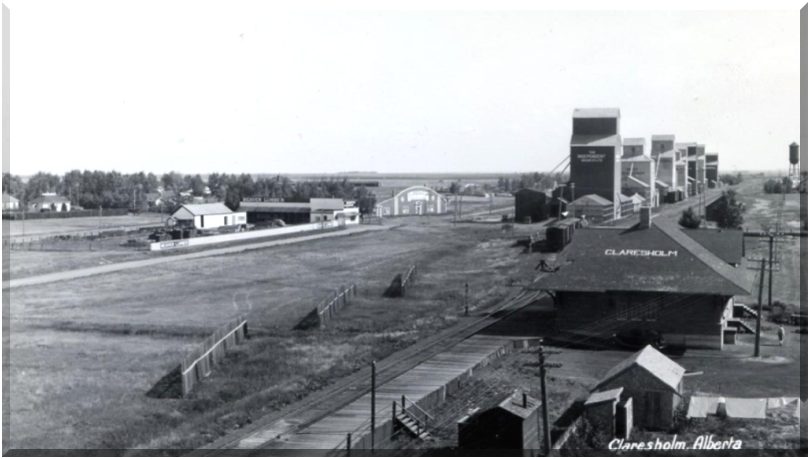
A photograph dating to approximately 1917, preserved by South Peace Regional Archives, shows three grain elevators and several prominent buildings.
The archive identifies a community hall, Cady & Evans Lumber Yard, Evans' house, a hardware store and George White's residence.
This photograph provides a remarkable view of Clairmont near the beginning of its railway-era development.
It shows how quickly a rural location could acquire the appearance of a commercial centre.
The Businesses That Built Early Clairmont
The railway helped attract a variety of businesses.
Early Clairmont included stores, lumber suppliers, hotel accommodation and services needed by farmers and travellers.
One of the best-documented early businesses was I.E. Gaudin's Departmental Store.
South Peace Regional Archives holds two copies of a photograph showing the store, which was erected in 1915.
The archive's description records that the store closed after a severe frost in the following year.
The explanation is revealing.
A poor crop could mean farmers had little money to spend.
When farm income disappeared, local merchants suffered.
The store's closure illustrates how closely the economy of an early railway town depended on agriculture.
The community might have a railway station, elevators and commercial buildings, but its prosperity was still vulnerable to weather and crop conditions.
Another early business was A. Patrick's store.
An archival photograph from approximately 1918 shows Lillian Moore, daughter of Arthur and Golda Patrick, sitting on a bench outside the store.
A hitching rail for horses is visible.
The archive records that the store burned in January 1920.
Such photographs preserve the small details that make history tangible.
They show where people shopped, how they travelled and who belonged to the community.
They also remind us that early commercial buildings were vulnerable to fire, an ever-present danger in settlements with extensive wooden construction.
Clairmont Becomes a Village
Clairmont was incorporated as a village in 1917.
The County's historical chronology records that the community had more than 100 residents when it gained municipal status.
The new council faced practical responsibilities.
Roads needed maintenance.
Fire protection had to be organized.
Police protection and animal control required attention.
Taxes had to be collected to pay for municipal services.
South Peace Regional Archives preserves records of the former Village of Clairmont, including council minutes, accounts and tax-related documents from 1935 to 1945.
Those records describe financial difficulties caused by unpaid taxes and problems associated with inexperienced staff.
They also show that the village gradually improved its administration.
There is a small but important historical discrepancy worth noting.
The County's historical chronology identifies Gerald Heller as the first municipal reeve, while the archival description of the Village of Clairmont fonds names Crofton Cady as the first reeve.
The surviving newspaper index includes notices about the first council election in June 1917.
The precise sequence of those early municipal offices deserves further examination of the original council and election records.
What is certain is that Clairmont became a self-governing village during the railway boom.
For residents, incorporation meant the ability to make local decisions about services and community development.
The Community Was More Than Its Businesses
Early Clairmont residents did not build only stores and grain elevators.
They also created places to gather.
The Village of Clairmont archival records identify a park, sports grounds, curling rink, skating rink and tennis court among the community facilities developed during the village years.
These facilities mattered.
Sports and recreation helped connect farm families with town residents.
Community halls provided space for gatherings.
Churches, clubs and volunteer organizations created networks of support.
The South Peace Regional Archives newspaper index also preserves references to Clairmont's early social activities.
A 1917 notice records a silver tea held by the Clairmont Women's Institute.
Entries from 1918 refer to a Young People's Society and efforts to organize motion-picture entertainment.
These records suggest that residents were already interested in recreation, social life and cultural activities even while the settlement's economic future remained uncertain.
A town is not defined solely by the number of businesses on its main street.
It is also defined by the people who organize events, maintain gathering places and build relationships.
A School Beside the Lake
Education was another important part of Clairmont's development.
The Clairmont Lake School District was established in the early settlement period.
South Peace Regional Archives records that the Clairmont Lake schoolhouse was built in 1918.
The school later became part of Grande Prairie School Division No. 14 when Clairmont lost its village status.
The original school closed in 1962.
An archival photograph from approximately 1950 shows the schoolhouse, while related images document the school barn and woodshed.
Those buildings recall an era when rural schools served families scattered across large agricultural districts.
Children travelled from farms to attend classes.
Schools also became important centres of community activity.
As the region developed, school organization changed.
Small rural schools were eventually replaced or consolidated as transportation improved and populations shifted.
Clairmont's educational history reflects those broader changes across the Peace Country.
The 1920s and 1930s: A Railway Town Faces Hard Times
Railway access offered opportunity, but it did not guarantee prosperity.
Clairmont was dependent on the surrounding agricultural economy.
Farmers faced changing grain prices, difficult growing seasons and transportation costs.
The wider economic problems of the 1920s and the Great Depression of the 1930s placed additional pressure on rural communities.
Businesses could close.
Families could move away.
Municipal tax revenue could decline.
Clairmont experienced these pressures.
The community continued to function, but its population was no longer large enough to support the same expectations of independent municipal government.
By the mid-1940s, the village's future as a separate municipality was in question.
The archival records describe a community whose population had decreased significantly.
Clairmont's early promise as a railway commercial centre had not disappeared entirely, but its circumstances had changed.
The Village That Became a Hamlet
In the mid-1940s, Clairmont lost its incorporated village status and became a hamlet under rural municipal administration.
The Village of Clairmont archival fonds describes the change as occurring by 1945.
The County's historical chronology also places the loss of village status in 1945.
The commonly cited formal dissolution date is January 1, 1946.
The distinction between the decision, administrative transition and legal effective date is worth preserving when describing this event.
What matters most is the result.
Clairmont no longer had its own village council.
Responsibility for local government shifted to the surrounding rural municipality.
This was a major change for a community that had governed itself since 1917.
It also raises an interesting question.
What makes a community independent?
Is it the presence of an elected council?
The ability to collect its own taxes?
Its businesses and institutions?
Or the sense of identity shared by the people who live there?
Clairmont lost its municipal independence.
But its community identity survived.
The Railway Town That Would Not Disappear
The loss of village status did not mean the end of Clairmont.
Farms continued operating.
Families remained in the district.
Community activities continued.
Archival photographs document Clairmont residents participating in sports, social events and regional celebrations during the years after the municipal change.
One photograph from approximately 1945 shows a horse-drawn cutter travelling along Clairmont's Main Street, now identified as 102 Avenue.
The archive identifies Harley Conrad driving, with Beth Sheehan and several other residents in the cutter.
Sim's Auto Service and Feed Barn appears in the background.
Another photograph from 1951 shows horses being paraded during a weight-guessing contest organized through the Clairmont Sports Association.
These images show a community that remained active even without its own council.
The town's political status had changed.
Its social life had not ended.
The Lake and the Swans
Clairmont Lake has always been part of the community's identity.
For local historian Beth Sheehan, it also became connected to an important conservation interest.
South Peace Regional Archives records that Sheehan became an early advocate for trumpeter swan conservation after observing a nesting pair on Clairmont Lake in the 1940s.
She later became widely known for her knowledge of the species and her conservation work.
The lake was not simply a backdrop to farms and buildings.
It was part of a living environment that included waterfowl and other wildlife.
An archival photograph from June 1970 shows a trumpeter swan on Clairmont Lake during its moulting period.
The County of Grande Prairie continues to identify the lake as an important environmental feature.
Its current stormwater management information describes bioswales designed to filter runoff and reduce erosion before water reaches the lake.
The relationship between development and the lake is therefore not just a historical subject.
It remains relevant as the community grows.
Beth Sheehan: The Woman Who Helped Save Clairmont's Memories
One of the most important people in the preservation of Clairmont's history was Beth Sheehan.
Born Beth Flint in the Beaverlodge district in 1920, she later married Clairmont farmer Everett Sheehan in 1943.
She became an active community volunteer, historian, writer and photographer.
Her best-known contribution to Clairmont history was the book Turn Back the Pages: Clairmont 1908–1992.
Published in 1992, the book brought together stories of residents, schools, churches, organizations, businesses and community events.
But the research behind the book is just as important as the finished publication.
South Peace Regional Archives preserves her files, manuscripts, clippings, maps and photographs.
The Clairmont history subseries includes 183 photographs documenting changes from the early twentieth century into the 2000s.
Some show businesses and buildings.
Others show farms, children, churches, sports and family life.
The collection also preserves photographs taken by other residents and passed along to Sheehan.
That work helped prevent countless local details from disappearing.
A building may be demolished.
A family may move away.
A business may close.
But photographs, written memories and properly identified records can preserve their place in the community's history.
Beth Sheehan's work is a reminder that local history often survives because someone takes the time to collect it.
The Community Begins Growing Again
During the second half of the twentieth century, Clairmont's relationship with Grande Prairie became increasingly important.
The city expanded.
Highway transportation improved.
Regional employment grew.
The County developed new services and facilities.
Clairmont's location north of Grande Prairie placed it close to the region's expanding commercial and industrial activity.
The community gradually changed from a small railway and agricultural settlement into a residential and service centre.
The transformation did not happen all at once.
It took decades.
Old farms were gradually surrounded by new development.
Roads carried more traffic.
Housing expanded.
Businesses serving the broader region established themselves nearby.
The community that had lost its village status because of declining population was entering a new period of growth.
From a Small Hamlet to Thousands of Residents
The scale of Clairmont's later growth is striking.
Historical census figures show that the community had only a small population during the decades following the loss of village status.
By the late twentieth century, however, it was growing rapidly.
The County of Grande Prairie reported a hamlet population of 5,135 in its 2021 census.
That figure illustrates how dramatically the community had changed.
The former village had once struggled to maintain an independent municipal administration.
Now thousands of people lived in Clairmont.
It had become one of the region's important population centres.
There is an important statistical distinction: Statistics Canada's population-centre boundaries do not necessarily match the County's hamlet boundaries. Figures from different census sources should therefore not be compared without checking their geographic definitions.
The broader trend is unmistakable.
Clairmont experienced a remarkable reversal in population growth.
A New School for a New Generation
One sign of Clairmont's transformation was the need for modern educational facilities.
A new school was constructed during the 2000s, opening in 2008.
It was a very different era from the one-room schoolhouse built beside Clairmont Lake in 1918.
The original school had served a small agricultural district.
The newer school served a growing residential community.
The contrast tells a larger story.
Clairmont's population had shifted from scattered farms and a small railway townsite to a much larger community of families.
Education remained central to community life, but the scale of the need had changed.
The County's Administrative Home
Clairmont also became the location of the County of Grande Prairie's municipal offices.
This development gave the community a role very different from the one it held as a railway village.
In 1917, Clairmont had its own council.
After the loss of village status, local government became the responsibility of the surrounding rural municipality.
Today, the community hosts the administrative centre of that larger municipality.
There is a certain historical irony in that change.
The village that once struggled to sustain its own municipal government became the place where a major regional government conducts its business.
Clairmont's importance was no longer determined solely by its grain elevators or railway station.
It had become an administrative, residential and commercial centre for a much larger area.
What Happened to the Grain Elevators?
For much of the twentieth century, grain elevators were among Clairmont's most recognizable landmarks.
They represented the community's agricultural origins and its connection to the railway.
An archival photograph from 1958 shows five elevators standing in Clairmont.
Another photograph, taken from a boat on Clairmont Lake in 1975, records the elevators from the water.
These images provide a useful way to understand how the community once looked.
The grain-handling industry later changed across western Canada.
Larger terminals, different transportation patterns and consolidation altered the role of traditional wooden elevators.
Many prairie communities lost their historic elevators.
Clairmont's railway-era landscape changed as well.
For residents who remember the elevators, their disappearance or changing surroundings may represent one of the most visible differences between old Clairmont and the community of today.
The photographs remain an important record of that earlier economy.
What Clairmont's History Tells Us
Clairmont's history is not a simple story of uninterrupted growth.
It is a story of opportunity, setback, survival and reinvention.
The railway created a town.
Agriculture supported its businesses.
Economic pressures reduced its population.
The village lost its municipal independence.
But residents maintained community life.
Later, new transportation patterns, regional employment and residential growth changed its future.
Today, Clairmont faces questions that earlier generations would recognize in different forms.
How should a growing community pay for roads, schools and public services?
How much local decision-making should residents have?
How can development proceed while protecting the lake and surrounding environment?
How should older neighbourhoods and historic places be remembered as new construction changes the landscape?
Clairmont's past does not provide automatic answers.
But it does show that a community's future can change dramatically over time.
The village government disappeared. The community did not.
And the settlement that once struggled to survive became larger than its early residents could easily have imagined.
Historical Photographs: Clairmont Then and Now
The following photographs are documented in the South Peace Regional Archives collection. They are recommended for this article, but publication-quality copies and reproduction rights should be confirmed with the archives.
1. Clairmont, Approximately 1917 — Recommended Cover Photograph
A black-and-white photograph showing three grain elevators and early community buildings.
Suggested caption: Clairmont around 1917, shortly after the railway arrived. Three grain elevators stand beside a growing settlement that included a community hall, lumber yard, hardware store and homes.
Credit: South Peace Regional Archives, Beth Sheehan fonds, item 0002.04.03.002. The photograph was given to Beth Sheehan by the Spencer family; original photographer not identified.
2. Gaudin's Department Store, 1915
Suggested caption: I.E. Gaudin's Departmental Store in Clairmont, built in 1915. The business closed after a severe frost in 1916, illustrating how dependent local commerce was on farm income.
Credit: South Peace Regional Archives, Beth Sheehan fonds, item 0002.04.03.001. The archives hold copies associated with the Sheehan family and Glenbow Archives.
3. Spencer Farm on Twin Lake, Approximately 1917
Suggested caption: Melvin Spencer's farm on the western shore of Twin Lake, later known as Clairmont Lake. The Spencer family arrived from Saskatchewan in 1910.
Credit: South Peace Regional Archives, Beth Sheehan fonds, item 0002.04.03.003. Photographer not identified.
4. Clairmont Main Street, Approximately 1945
Suggested caption: A horse-drawn cutter travels along Clairmont's Main Street around 1945. The photograph includes Harley Conrad, Beth Sheehan and other local residents, with Sim's Auto Service and Feed Barn in the background.
Credit: South Peace Regional Archives, Beth Sheehan fonds, item 0002.04.03.024. Photographer not identified.
5. Clairmont From Hart's Hill, 1958
Suggested caption: Clairmont in the winter of 1958, viewed from Hart's Hill south of the community. Five grain elevators remain prominent landmarks.
Credit: South Peace Regional Archives, Beth Sheehan fonds, item 0002.04.03.029. Photographer not identified.
6. Clairmont Grain Elevators, 1975
Suggested caption: Clairmont's grain elevators photographed from a boat on Clairmont Lake in 1975, recalling the community's railway and agricultural origins.
Credit: South Peace Regional Archives, Beth Sheehan fonds, item 0002.04.03.031. Photographer not identified.
Sources and Historical References
South Peace Regional Archives — Beth Sheehan Fonds
The principal local-history collection for this article, including photographs, research files, newspaper clippings and material used to prepare Turn Back the Pages: Clairmont 1908–1992.
https://www.southpeacearchives.org/finding-aid/fonds-002-beth-sheehan-fonds/
South Peace Regional Archives — Village of Clairmont Fonds
Original municipal records and administrative history covering Clairmont's village government and loss of municipal status.
https://www.southpeacearchives.org/finding-aid/fonds-064-village-of-clairmont-fonds/
County of Grande Prairie — Historical Timeline, 1898–1945
Chronology of railway development, the first Clairmont grain elevator, incorporation and municipal changes.
https://www.countygp.ab.ca/parks-recreation-community/history-and-heritage/1898-to-1945/
South Peace Regional Archives — Lake Saskatoon Journal Index
Contemporary newspaper references to Clairmont's 1917 municipal election, council activities and community organizations.
https://www.southpeacearchives.org/lake-saskatoon-journal-index/
South Peace Regional Archives — Grande Prairie School Division No. 14 Fonds
Historical records and photographs of Clairmont Lake School, including its construction in 1918 and closure in 1962.
https://www.southpeacearchives.org/finding-aid/fonds-063-grande-prairie-school-division-no-14/
South Peace Regional Archives — Oral History Collection
Includes a 2008 recorded interview with Beth Sheehan discussing her life, historical research and community involvement.
County of Grande Prairie — Rural Extension and Clairmont Lake Bioswale Project
Information about efforts to manage stormwater and protect the health of Clairmont Lake.
https://www.countygp.ab.ca/agriculture-livestock/rural-extension/
Swan City Speaks: What Do You Think?
Clairmont residents, former residents and families with roots in the district — your memories can help complete this story.
-
Do you remember Clairmont's grain elevators, railway station or old Main Street? What businesses, buildings or landmarks do you remember that are no longer there?
-
Do you have old family photographs? We'd particularly like to see Clairmont Lake, the original school, the railway, early stores, community sports, farms and neighbourhoods. Can you identify the people pictured?
-
Did your family live in Clairmont when it was still a village? What stories have been passed down about the railway years, the Depression or the community's later growth?
-
What should be added or corrected? Are there Indigenous histories, families, businesses, community leaders or important events that deserve more attention? Can you help clarify the early council records or the transition from village to hamlet?
When sharing historical photographs, please include any known names, dates, locations and ownership information.
Clairmont's history is not just the story of a village that lost its municipal status.
It is the story of people who stayed, raised families, built businesses, volunteered and helped their community find a new future.
Share your memories in the comments. Your opinion matters.