Canfor Reports Another Quarterly Loss — What Does It Mean for Grande Prairie's Sawmill?
A Corporate Loss With Local Questions
Canfor Corporation has reported another quarterly loss, raising questions about the future of forestry operations across Western Canada and the potential consequences for Grande Prairie.
The Vancouver-based forest products company reported a third-quarter operating loss of $76.6 million and a net loss attributable to shareholders of $88.2 million.
That compares with a shareholder loss of $172.4 million during the same quarter in 2025.
The latest loss was smaller than a year earlier, but the company continues to face difficult market conditions.
For Grande Prairie, the important question is not simply whether Canfor is profitable.
It is whether the company's financial pressures are affecting local production, employment and the businesses that depend on the forest industry.
What the Financial Numbers Actually Mean
Canfor reported approximately $1.28 billion in third-quarter sales, compared with $1.26 billion a year earlier.
Its lumber division recorded an operating loss of $19.9 million, compared with an operating profit of $41.2 million in the preceding quarter.
However, the quarterly figures include accounting adjustments and restructuring costs.
Canfor also reported adjusted earnings before interest, taxes, depreciation and amortization (EBITDA) of $98.1 million.
That is a company-defined financial measure, not the same thing as net profit.
The distinction matters.
A corporation can report a net loss while individual facilities continue operating profitably. Conversely, a company's overall financial performance does not establish whether any particular sawmill is financially secure.
Canfor's quarterly announcement does not provide a separate profit-and-loss statement for the Grande Prairie sawmill.
Fox Creek Has Already Lost Its Sawmill
The consequences of difficult lumber markets are no longer hypothetical in northern Alberta.
Canfor announced the permanent closure of its Fox Creek sawmill in July 2026, with operations winding down in September.
The closure contributed to a $31.8-million asset write-down and $4.6 million in restructuring costs during the third quarter.
The company has also announced the permanent closure of its Northwood pulp mill in Prince George, British Columbia, expected to take effect by the end of 2026.
These decisions show how changes in markets and operating costs can lead to permanent reductions in industrial capacity.
They do not, however, establish that Grande Prairie is facing a similar decision.
No such closure announcement for Grande Prairie was identified in Canfor's November 4 quarterly results.
Why Grande Prairie's Sawmill Matters
Canfor's Grande Prairie operations are connected to a much larger regional forestry economy.
The industry involves more than workers inside a sawmill.
It also supports activity involving:
- Logging and timber harvesting.
- Trucking and heavy equipment.
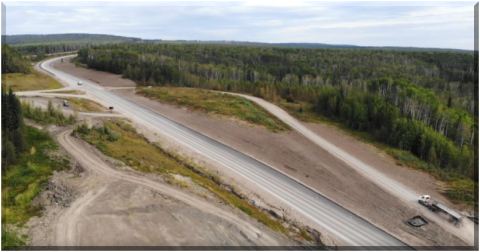
- Road construction and maintenance.
- Equipment repairs and industrial supplies.
- Fuel, transportation and logistics.
- Contractors and businesses serving forestry workers.
Canfor reports that it operates more than 3,000 kilometres of roads in and around Grande Prairie under its Alberta forest tenure agreements.
On busy days, those roads can be used by more than 3,000 vehicles.
Those figures demonstrate the scale of the company's regional transportation network, although not every vehicle using those roads is necessarily involved in Canfor's operations.
Changes in timber harvesting or mill production can have consequences beyond the sawmill gates.
What Is Putting Pressure on Lumber Producers?
Canfor identifies several challenges affecting the industry.
Weak lumber demand
Elevated mortgage rates and housing affordability concerns have weighed on construction activity and demand for lumber.
When fewer houses are built, demand for construction lumber can weaken.
Lumber prices
North American benchmark lumber prices declined modestly during the third quarter.
Lower selling prices can squeeze margins when production costs remain high.
International competition
Canfor operates in Canada, the United States and Europe, exposing the company to different markets, costs and trade conditions.
Its report describes continued weakness in some Asian markets and modest improvement in parts of Europe.
American softwood lumber duties
Trade duties remain an important financial consideration for Canadian lumber producers selling into the United States.
Canfor reported that finalized duty rates would result in an additional $45.9-million expense during the fourth quarter.
The company also expects lower duty rates effective in mid-October to provide some relief to lumber sales later in the year.
Operating costs
Energy, transportation, labour and timber costs can all influence a sawmill's competitiveness.
However, the quarterly announcement does not establish which of these costs, if any, have changed significantly at the Grande Prairie facility.
That requires location-specific information.
Is Grande Prairie's Mill in Trouble?
There is an important difference between financial pressure on Canfor as a corporation and evidence of trouble at an individual mill.
The company continues to identify Grande Prairie among its Canadian locations.
Its latest financial release does not announce a Grande Prairie closure or provide confirmed local layoff numbers.
That does not guarantee future production or employment levels.
It means the available evidence does not support a claim that the local sawmill is closing or that its workforce has been reduced because of the latest quarterly results.
A more complete local picture would require current information about employment, shifts, production levels, capital investment and operating costs.
The Bigger Question: What Makes a Sawmill Competitive?
Forestry companies operate in an international market, but many of their costs are determined locally.
A mill's competitiveness can depend on the price and availability of timber, the distance logs must travel, energy costs, labour productivity, equipment efficiency and access to customers.
A company with several sawmills may evaluate those factors differently at each location.
That makes the Grande Prairie operation's particular circumstances more important than the corporate loss alone.
It also raises a broader economic question for the Peace Country: how dependent should a regional economy remain on industries affected by global commodity prices and international trade decisions?
Forestry remains part of the region's industrial base, alongside agriculture, energy, construction and other businesses.
Understanding the risks facing each sector helps residents evaluate the region's long-term economic resilience.
The Story Isn't Over
Canfor's third-quarter loss is confirmed, as is the permanent closure of its Fox Creek sawmill.
The unanswered questions concern Grande Prairie:
- Has employment at the local sawmill changed during 2026?
- Have production schedules or operating shifts been reduced?
- What investments are planned for the Grande Prairie facility?
- How do local timber, transportation and electricity costs compare with competing mills?
- What does Canfor expect for Grande Prairie's production in 2027?
The quarterly financial report does not provide enough location-specific information to answer those questions.
Swan City Speaks: What Do You Think?
- How important is the forestry industry to Grande Prairie's economy today?
- Should communities do more to prepare for changes in major industries, even when local operations remain active?
- If you work in forestry, trucking or a related business, have you noticed changes in activity this year?
Share your thoughts in the comments. Your opinion matters.