We Can Cool the Computers — But Where Does the Heat Go?
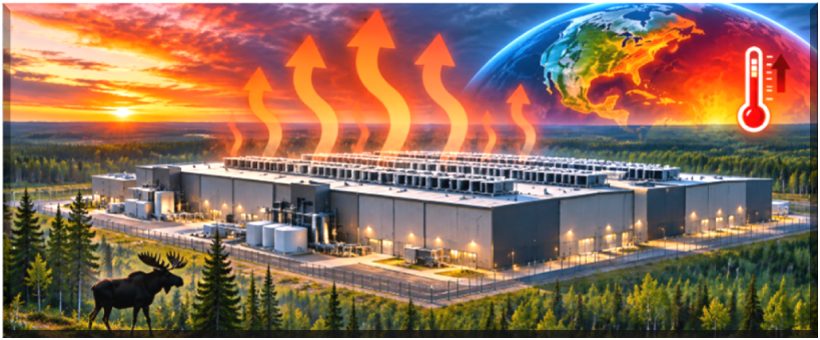
Wonder Valley could become one of the largest concentrated sources of industrial heat on Earth. As data centres multiply, is anyone calculating what all that heat means for our environment — and the planet's thermostat?
Back on top · first published Nov 3
What About the Heat?
Much of the discussion surrounding Alberta's proposed billion-dollar data centres has focused on electricity, water, jobs, taxes and economic development.
But there is another question that deserves considerably more attention.
What happens to all the heat?
Computers consume electricity. Powerful artificial intelligence processors consume enormous amounts of it.
And almost all the electricity consumed by a computer eventually becomes heat.
That heat must go somewhere.
Cooling systems can remove it from a building. Water can carry it through pipes. Fans can transfer it into the atmosphere. Heat exchangers can move it from one place to another.
But none of those systems makes the energy disappear.
That is not an environmental opinion.
It is a fundamental principle of physics.
And it raises a question that should concern anyone living near a proposed large-scale data centre.
If we are building machines that continuously produce extraordinary amounts of heat, shouldn't we know exactly where that heat will end up?
The First Law of Thermodynamics: Energy Does Not Disappear
Most of us learned a basic scientific principle in school.
Energy cannot be created or destroyed. It can only be transferred or transformed.
This is the first law of thermodynamics.
Electricity entering a computer becomes useful work in the form of electronic processing, but that work ultimately degrades into heat.
Fans, pumps, cooling towers and liquid-cooling systems can carry the heat away from sensitive electronic components.
They cannot eliminate it.
Imagine heating a pot of water on a stove.
You can remove the pot from the burner.
You can pour the hot water into another container.
You can use a fan to cool it faster.
But the heat has not vanished.
It has simply moved into the surrounding environment.
A data centre operates on the same physical principle, although its cooling systems are far more sophisticated.
There is also a second important distinction.
A data centre powered by a natural gas generating station creates heat at two stages: when fuel is burned to generate electricity and when computers consume that electricity.
Some energy may leave the site through other pathways, but most ultimately becomes heat.
For a massive, integrated power-and-computing development, both sources must be included in the environmental calculation.
The question is not whether heat will be produced. It will. The question is how much, where it will go, and what consequences it may have.
Twenty-Three Atomic Bombs of Energy Every Day?
A November 1 CBC News investigation brought this question into sharp focus.
Utah State University physicist Robert Davies conducted a preliminary analysis of the proposed Wonder Valley development for Sturgeon Lake Cree Nation.
Wonder Valley is the massive data-centre and power-generation project associated with investor Kevin O'Leary, proposed for the Municipal District of Greenview south of Grande Prairie.
Davies estimated that at full operation the development could release approximately 18 gigawatts of heat.
Over a day, that is roughly equivalent to the energy released by 23 Hiroshima-sized atomic bombs.
It is an extraordinary comparison.
But it needs to be understood correctly.
The facility would not be producing nuclear explosions, radiation or the destructive shock waves associated with an atomic bomb.
The comparison refers to the total quantity of energy released over time.
The heat would be generated continuously, not in a single explosive event.
Davies's estimate is also preliminary, based on publicly available project information. It is not a verified measurement of an operating facility.
Nevertheless, the scale of the proposed energy use deserves examination.
A continuous thermal output of 18 gigawatts means 18 billion joules of energy being released every second.
If that estimate proves accurate, the facility would represent an enormous concentrated source of industrial heat.
And the proposed development would be located in the Peace Country.
Cooling the Chips Does Not Cool the Planet
Data-centre developers frequently discuss advanced cooling technologies.
These may include liquid-cooled processors, closed-loop systems, cooling towers, heat exchangers and more efficient building designs.
Such technologies are important.
They can reduce water consumption, improve equipment performance and lower the amount of electricity required for cooling.
But cooling efficiency should not be confused with eliminating waste heat.
A liquid-cooled processor may operate at a safe temperature because circulating fluid removes heat from its surface.
That fluid must then transfer the heat somewhere else.
The final destination might be outside air, a water-based cooling system or another industrial process.
In some circumstances, the heat can be recovered to warm buildings, greenhouses or industrial facilities.
That is useful because it can replace energy that otherwise would have been consumed for heating.
But even recovered heat eventually enters the surrounding environment.
Cooling is a heat-management strategy, not a way around the laws of thermodynamics.
The environmental benefit comes from reducing total energy demand, recovering useful energy and controlling where and how heat is released.
Those distinctions matter when developers describe their projects as environmentally responsible.
Are We Creating an Artificial El Niño?
There is a temptation to compare massive industrial heat production with natural climate events such as El Niño.
The comparison is understandable, but scientifically they are different phenomena.
El Niño is a recurring change in tropical Pacific Ocean temperatures and atmospheric circulation.
It redistributes enormous amounts of heat and influences weather patterns around the world.
A data centre is a concentrated industrial heat source.
It does not create an El Niño event.
But the comparison raises a worthwhile question:
Could enough concentrated industrial heat alter local weather conditions, especially when multiple facilities are built in the same region?
That is a question for atmospheric scientists, hydrologists and environmental researchers.
A large industrial facility may influence its immediate surroundings through heat release, changes to land cover, air movement and moisture.
Whether those effects extend beyond the site — and how far — depends on the quantity of heat, the surrounding landscape, wind patterns, cooling methods and atmospheric conditions.
We should not assume that Wonder Valley will change regional weather.
But neither should we assume there will be no meaningful local effect without examining the evidence.
A project of this proposed scale warrants site-specific modelling.
Could Data Centres Change Earth's Thermostat?
Now consider the larger question.
The world is already experiencing climate change driven primarily by increasing concentrations of greenhouse gases.
Those gases interfere with Earth's ability to release heat into space.
Data centres add another dimension to the discussion.
They consume energy and release heat directly.
But there is an important scientific difference between these two effects.
Direct waste heat is the thermal energy released when electricity is generated and consumed.
Greenhouse-gas warming occurs when gases such as carbon dioxide and methane alter Earth's long-term balance between incoming sunlight and outgoing infrared radiation.
The second effect is the dominant cause of modern global warming.
Direct human-produced heat is much smaller than the planet-wide energy imbalance caused by greenhouse gases.
That means it would be misleading to suggest that the heat from one data centre could noticeably raise the average temperature of the entire planet.
It would also be misleading to suggest that every joule of waste heat accumulates permanently in Earth's atmosphere.
Earth continually releases energy into space.
But this does not make direct industrial heat irrelevant.
The global average can conceal important local effects.
A concentrated heat source can matter greatly near its point of release even when its contribution to global average temperature is small.
And if fossil fuels are burned to supply that electricity, the resulting greenhouse-gas emissions can create a much larger and longer-lasting climate impact than the direct heat alone.
For Wonder Valley, the environmental question involves both the heat released at the site and the emissions associated with producing the energy.
The Second Climate Question: Thirty Million Tonnes of Carbon Dioxide?
Davies's preliminary analysis also estimated that the proposed Wonder Valley development could produce approximately 30 million tonnes of carbon dioxide annually at full operation.
That is a substantial figure.
It is an estimate, not a confirmed annual emissions total.
Actual emissions would depend on the final generating equipment, operating capacity, fuel consumption, emissions controls and any carbon-capture systems.
The developer should have the opportunity to provide its own independently verifiable projections.
But the distinction between heat and carbon dioxide is critical.
The heat released today eventually disperses and is radiated away.
A significant portion of the carbon dioxide released today can influence the climate for decades to centuries and longer.
That is why a proper environmental assessment must examine both.
One affects the immediate thermal environment.
The other can contribute to long-term global warming.
They are connected through energy production, but they are not the same problem.
What Happens to the Boreal Forest?
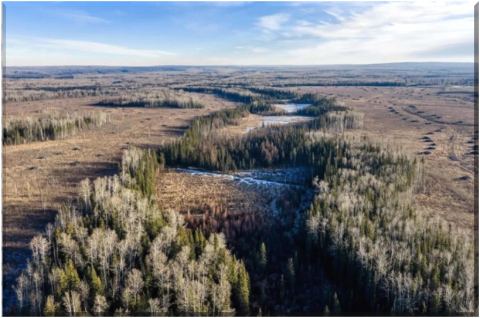
Wonder Valley is proposed for a landscape that is part of northwestern Alberta's boreal region.
The boreal environment includes forests, wetlands, soils, wildlife habitats and interconnected water systems.
Those systems already experience natural variations in temperature, moisture and seasonal conditions.
A major industrial development introduces new pressures.
But what would 18 gigawatts of heat actually mean for the surrounding landscape?
Would the heat disperse rapidly into the atmosphere?
Could there be measurable temperature changes near cooling equipment?
Would large cooling installations alter local humidity?
Could cooling-water discharges affect nearby aquatic environments?
Would winter conditions produce different effects from summer conditions?
Could heat emissions interact with existing industrial development in the region?
These questions cannot be answered responsibly by simply dividing the total heat output by the size of the property.
Heat moves through air and water, and its environmental effects depend heavily on the design and location of the facility.
Some impacts may prove manageable.
Others may require mitigation.
The important point is that they should be measured and modelled before conclusions are reached.
What About Water?
Heat and water are closely connected.
Water is an effective cooling medium because it can absorb and transport large quantities of thermal energy.
Some data centres use evaporative cooling, which can consume water as part of the cooling process.
Others rely more heavily on closed-loop liquid systems and air-cooled equipment.
The amount of water required varies considerably.
It would be incorrect to assume that every large data centre needs the same volume of fresh water.
But the public deserves to know the actual cooling design being proposed.
For Wonder Valley, that means identifying:
- The source of cooling water.
- Expected water withdrawals and consumption.
- Whether cooling water will be reused.
- How much water may be lost through evaporation.
- Whether heated water will be discharged.
- What safeguards will protect nearby water bodies and groundwater.
Water management and heat management should be examined together.
They are parts of the same engineering problem.
Can We Put the Waste Heat to Work?
There is another possibility worth considering.
Instead of treating all waste heat as something to dispose of, could some of it become a useful resource?
Some data centres already recover heat for district-heating networks.
In principle, waste heat can also support greenhouses, industrial processes and other applications.
For the Peace Country, that raises intriguing possibilities.
Could recovered heat support year-round greenhouse agriculture?
Could it help heat industrial buildings?
Could it serve nearby communities through a district-heating system?
Could a data centre become a supplier of useful thermal energy rather than simply an electricity consumer?
These possibilities deserve investigation.
However, they should not be accepted as promised benefits without engineering and economic evidence.
Waste heat from computers is often relatively low-temperature heat.
Moving it long distances can be expensive, and some applications require heat pumps or other equipment to raise its temperature.
There must also be a reliable customer for the heat.
A greenhouse cannot necessarily absorb the same amount of heat in July that it needs in January.
And a data centre operates continuously.
Heat recovery is therefore a potential benefit, not an automatic solution.
If developers claim that waste heat will be reused, residents should ask how much, by whom, at what cost and under what binding agreement.
The Province Says Existing Systems Are Proven
The Alberta government has defended its decision that Wonder Valley does not require a full provincial environmental impact assessment.
In comments reported by CBC, Alberta's Ministry of Environment and Protected Areas said the project would use established power and water technologies.
The ministry also said developers must still obtain required permits and provide technical assessments addressing environmental impacts.
That is an important distinction.
A project may use proven equipment while still operating at an unprecedented scale.
A natural gas generator is not new technology.
Neither is a cooling tower.
But thousands of pieces of familiar equipment operating together can create environmental conditions that differ substantially from those associated with a smaller installation.
Davies has argued that reviewing individual components is not the same as evaluating their combined effects.
That is the central issue.
Does a collection of individually approved systems necessarily add up to an environmentally acceptable development?
It is a question worth asking before construction, rather than after the consequences become apparent.
Sturgeon Lake Cree Nation Wants a More Complete Review
Sturgeon Lake Cree Nation has challenged provincial decisions involving Wonder Valley.
The First Nation has raised concerns about consultation and the adequacy of environmental review.
Its legal proceedings include a challenge to the decision that the project does not require a full environmental impact assessment.
Those proceedings should not be interpreted as a court finding that the proposed project will cause the predicted environmental effects.
The questions remain contested.
But the First Nation's challenge raises a broader public-interest issue.
When a development has the potential to affect land, water, air and surrounding communities, who decides whether the overall consequences have been adequately examined?
And what opportunity should affected residents and Indigenous communities have to examine the supporting science?
These are questions that extend beyond Wonder Valley.
What Does This Mean for the County of Grande Prairie?
The County of Grande Prairie is also considering how to regulate data-centre development.
Its proposed new zoning rules are scheduled for a public hearing on December 2.
The County's Emerson Trail data-centre development is a separate proposal from Wonder Valley.
The two projects should not be treated as identical.
Their proposed capacities, generating systems, water requirements and heat emissions may differ substantially.
But the underlying physics does not change.
Every operating data centre consumes electricity.
Almost all of that electricity ultimately becomes heat.
If power is generated on site using fossil fuels, additional heat and emissions must be considered.
So should the County require developers to provide an independently reviewed thermal-impact assessment?
Should it require the same disclosure of cooling systems, water requirements and heat-recovery plans?
Should neighbouring municipalities such as Grande Prairie and Sexsmith have access to that information when potential environmental effects could cross municipal boundaries?
And should cumulative impacts be examined when several data centres are proposed within the same region?
These are reasonable questions to raise before new rules are adopted.
One Data Centre Is a Project. Hundreds Become a Global Question.
Wonder Valley may be an unusually large proposal.
But it is part of a much broader expansion of computing infrastructure.
Artificial intelligence, cloud services and digital communications are driving demand for increasingly powerful data centres.
Each facility has its own electrical load.
Each has cooling requirements.
Each produces waste heat.
And each may create additional greenhouse-gas emissions, depending on its electricity source.
The global concern is not that the waste heat from data centres will somehow become trapped forever.
It will not.
The concern is that rapidly expanding energy demand may increase fossil-fuel consumption and greenhouse-gas emissions while also creating concentrated local environmental impacts.
That is where the climate discussion becomes especially important.
If a data centre is powered by additional fossil-fuel generation, its long-term climate consequences may be substantially greater than those of a comparable facility powered by low-emission electricity.
Efficiency, electricity sources, operating practices and heat recovery all matter.
The environmental impact of computing is not determined by the number of buildings alone.
It depends on the complete energy system supporting them.
The Question We Should Be Asking
Perhaps the most important lesson from the Wonder Valley controversy is that cooling a computer and protecting the environment are not necessarily the same thing.
A cooling system can work perfectly from an engineering standpoint.
The processors remain within their safe operating temperatures.
The equipment performs as designed.
The data centre stays online.
But the heat removed from the processors still enters another part of the environment.
That does not automatically mean the heat causes unacceptable damage.
It means the environmental consequences must be evaluated separately from whether the cooling system protects the computers.
We should be asking developers to show us the complete energy picture.
How much fuel or electricity goes in?
How much useful computing is produced?
How much heat comes out?
Where does that heat go?
How much carbon dioxide is released?
How much water is consumed?
What happens when multiple facilities operate in the same region?
And who independently verifies the answers?
A successful cooling system is not, by itself, proof of a successful environmental outcome.
The Story Isn't Over
The next questions deserve documented answers:
-
The heat calculation: Can Wonder Valley's developer provide an independently verified estimate of total heat output, including its generating station?
-
The environmental impact: Has anyone modelled how the proposed heat release could affect local air temperatures, humidity, vegetation and nearby water systems?
-
The carbon footprint: What are the developer's projected annual greenhouse-gas emissions, and how do they compare with Davies's estimate?
-
The cooling system: How much water will be consumed, and where will the rejected heat ultimately go?
-
The approval process: Should Alberta require a comprehensive environmental impact assessment for projects of this scale, even when their individual technologies are already familiar?
-
The County's new rules: Will the December 2 discussion address thermal emissions and cumulative environmental effects, or primarily land use and development requirements?
If the answers become available, we will report them.
If there is no meaningful new information, we will say so.
Swan City Now — Because the story doesn't end with the headline.
Swan City Speaks: What Do You Think?
-
Should every major data-centre proposal be required to disclose exactly how much waste heat it will produce and where that heat will go?
-
If a company can cool its computers successfully, does that mean it has adequately protected the surrounding environment?
-
Should the Province require a full environmental assessment before approving developments with unusually large energy demands, even when the technology is already proven?
The Peace Country may benefit economically from data centres.
But economic development and environmental accountability should not be competing ideas.
Share your thoughts in the comments. Your opinion matters.
Sources and Further Reading
-
CBC News, November 1, 2026 — Wonder Valley heat analysis and Sturgeon Lake Cree Nation's legal challenge: https://www.cbc.ca/news/canada/edmonton/wonder-valley-slcn-court-physicist-9.7403677
-
Yahoo News republication of the CBC investigation: https://ca.news.yahoo.com/proposed-data-centre-release-23-150000553.html
-
International Energy Agency — Energy and AI: https://www.iea.org/reports/energy-and-ai
-
NASA — Evidence of climate change: https://science.nasa.gov/climate-change/evidence/
-
IPCC — Sixth Assessment Report, Synthesis Report: https://www.ipcc.ch/report/ar6/syr/
-
County of Grande Prairie — Municipal information and public notices: https://www.countygp.ab.ca/