Data Centres: Show Me the Money — Who Really Profits From the AI Gold Rush?
**"Show me the money!"**
Back on top · first published Nov 18
Show Me the Money!
Remember the 1996 movie Jerry Maguire?
Tom Cruise plays a sports agent whose client, portrayed by Cuba Gooding Jr., delivers one of Hollywood's most memorable lines:
"Show me the money!"
It was funny, memorable and refreshingly direct.
Thirty years later, perhaps those four words should be heard at every public meeting involving a proposed multibillion-dollar data centre.
Because behind the promises of artificial intelligence, technological transformation, economic diversification and enormous investment lies a much older business question.
Who is putting up the money?
Who is getting paid?
And who gets left holding the bill if the promises don't materialize?
A Simple Question at a Local Meeting
At a recent meeting at the Philip J. Currie Dinosaur Museum, a speaker discussing a proposed data centre was asked a straightforward question.
Who is going to be the tenant?
According to an attendee's account, the speaker replied that no tenant had yet been secured.
The exchange has not been independently verified against a recording or transcript, and the precise status of any commercial negotiations remains unconfirmed.
Nevertheless, it raises an important question.
How far can a development advance before the people who will actually use it have been identified?
There may be perfectly legitimate reasons why a tenant has not been announced.
Commercial negotiations can be confidential. Developers sometimes construct facilities before securing customers. Other projects are developed for specific companies whose identities may not initially be disclosed.
But those possibilities lead to different financial situations.
A project with a signed 20-year lease from a financially strong customer is not the same investment as a project hoping to attract customers after construction.
And a developer with sufficient capital to assume that risk is in a different position from one whose construction plans depend on obtaining financing against anticipated future revenue.
The public may not need to know every commercial secret.
But when a development could affect land use, electricity infrastructure, water supplies and neighbouring properties, residents have a legitimate interest in understanding whether its economic promises rest on contracts or expectations.
Have We Seen This Movie Before?
History offers some interesting comparisons.
During gold rushes, not everyone who made a fortune discovered gold.
Merchants sold supplies. Transportation operators moved prospectors. Landowners and speculators profited from the rush of people and investment.
Some fortunes were made by supplying the people who hoped to become wealthy.
Railway expansion brought another version of the story.
Railways transformed economies and opened enormous opportunities. But railway booms also attracted speculation in land, financing and anticipated future settlement.
Not every projected route or commercial opportunity justified the money invested.
Then came the real-estate booms familiar to Canadians.
Developers acquired land, obtained approvals, marketed condominium units and sought financing to complete construction.
Presales could help demonstrate demand and support lending.
Sometimes the model worked exceptionally well.
Other times, buyers encountered delays, construction deficiencies, unsuitable units or developments whose economics deteriorated before completion.
These examples are not proof that today's data-centre developments are following the same path.
But they illustrate a recurring feature of speculative investment.
The expectation of future demand can become valuable long before that demand is demonstrated.
And that expectation can help drive land values, investment decisions and financing.
The question is whether today's AI boom is creating infrastructure for customers who are ready to pay, or whether some developments are being advanced in the hope that those customers will eventually appear.
Something Interesting in the County's Own Records
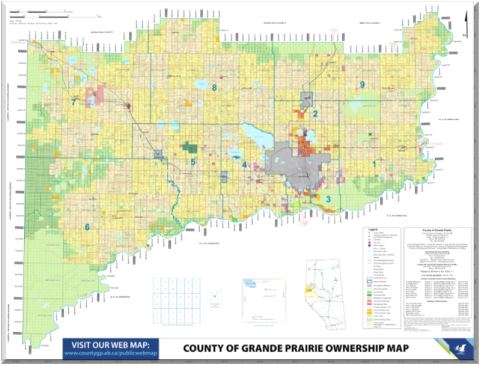
The County of Grande Prairie has published information about three development permits in the Emerson Trail industrial area.
The permits are not identical.
One, approved in May 2026, was for a data processing establishment on industrially zoned land.
Another, PLDEV20260127, was approved for five speculative buildings and associated infrastructure.
The County explicitly states that this permit does not approve a specific use for those buildings.
A third, PLDEV20250629, was issued September 4, 2026, for a data processing establishment with five buildings, 15 generators and 15 cooling or make-up air units.
These are separate approvals, and they should not be treated as evidence of a single financing arrangement or common ownership without further documentation.
But the term speculative buildings is worth understanding.
In real estate, speculative construction generally means building space before a final occupant has been secured.
It is an established business practice.
It can be profitable when demand is strong.
It can also expose developers and lenders to losses when demand falls short.
The County's records do not establish whether the Emerson Trail speculative buildings have prospective tenants, binding leases or secured construction financing.
Nor do they establish that the other two approved developments lack customers.
That is the information missing from the public picture.
The Biggest Technology Companies Are Spending Enormous Amounts
There is no question that major technology companies are investing heavily in computing infrastructure.
Amazon, Microsoft, Alphabet and Meta reported approximately US$508 billion in combined capital expenditures during the first nine months of 2026, according to an analysis of their financial disclosures.
Those expenditures include more than AI. They cover other infrastructure and business investments, and the companies use different accounting methods.
Nevertheless, AI-related infrastructure is a major driver of the increase.
The International Energy Agency estimated that data centres consumed approximately 415 terawatt-hours of electricity worldwide in 2024.
Its central projection puts that figure near 945 terawatt-hours by 2030.
That is more than double the estimated 2024 consumption.
But projected electricity demand is not the same thing as guaranteed revenue.
Someone must ultimately pay to use all that computing capacity.
And the financial return depends on what those customers are willing to pay compared with what the facilities cost to build, finance, power, cool and maintain.
Who Actually Uses These Facilities?
The term data centre covers several different businesses.
Some facilities provide cloud computing for banks, hospitals, governments, retailers and ordinary businesses.
Others support artificial intelligence.
Their customers may use enormous computing systems to train AI models, generate text and images, develop software, analyze information or operate automated services.
Still others may be involved in cryptocurrency processing.
These activities have different economic purposes and different equipment requirements.
A Bitcoin mining operation, for example, is not the same thing as an AI computing facility.
Bitcoin miners use specialized equipment to perform calculations that secure the Bitcoin network.
AI facilities use different processors and systems to train and operate models.
Both can consume substantial electricity, but their sources of revenue are different.
That distinction matters when a community is told it is welcoming a data centre.
What exactly will the computers be doing?
Will they support businesses and scientific research?
Will they generate AI products sold to customers?
Will they process cryptocurrency transactions?
Will they operate advertising and recommendation systems?
Or will they provide computing capacity to another company whose eventual customers remain unknown?
There is no comprehensive public ranking showing exactly how much electricity each individual customer consumes across the world's data centres.
And a development permit alone does not necessarily identify the eventual workload.
That makes the identity and business model of the operator particularly important.
The People Selling the Shovels
There is another lesson from the gold rush.
The people selling the equipment may have a more predictable source of revenue than the people searching for gold.
Today's AI expansion has its own suppliers.
Nvidia sells advanced computing processors.
Other companies supply servers, memory, networking equipment, cooling systems, transformers and electrical infrastructure.
Engineering firms design facilities.
Construction companies build them.
Energy producers may supply electricity or natural gas.
Landowners may benefit from property sales or leases.
Consultants, lawyers and financial advisers can earn fees as projects advance.
None of these activities is inherently improper.
They are ordinary parts of industrial development.
But their timing matters.
A supplier can receive payment for equipment before a data centre earns operating revenue.
A contractor can be paid to construct a building before its owner secures a tenant.
A landowner can realize a gain before the proposed industrial development is completed.
In other words, some participants can earn money from the construction boom even if the eventual operator struggles to earn a profit.
That does not mean they are hoping for failure.
It means their financial exposure may be very different from that of the investors who must make the completed facility profitable.
The Exit Strategy Nobody Talks About
This brings us to a less comfortable question.
At what point has a developer or investor made enough money to walk away?
Private investment structures can involve development fees, management fees, financing fees, asset sales and ongoing returns.
A developer might acquire land, secure approvals, increase its commercial value and sell the project to another investor.
An investment manager might receive fees for managing capital or overseeing a development.
A completed facility might be sold to a pension fund, infrastructure investor or another operator.
These are established business arrangements.
But they raise questions about incentives.
Does the developer earn most of its return by completing a successful, occupied facility?
Or can substantial returns be realized earlier through land appreciation, development fees or the sale of an approved project?
Are management fees tied to performance?
Does the original developer retain meaningful financial exposure after selling the project?
Who guarantees construction completion?
And if operating revenue falls short, who absorbs the loss?
A developer's ability to sell a project or earn fees does not establish that investors are being misled.
Nor is there verified evidence that any particular Peace Country data-centre developer intends to abandon an unsuccessful project.
But these are precisely the questions investors, lenders and affected communities should understand.
An exit strategy for one investor is not necessarily an exit strategy for the community hosting the development.
The buildings remain.
The altered land remains.
And any long-term infrastructure obligations must still be addressed.
Even the Bankers Are Asking Questions
Concerns about data-centre financing are not confined to rural Alberta.
International financial reporting in November 2026 described the Bank of England examining lenders' exposure to speculative data-centre construction — projects financed before tenants have agreed to occupy them.
The central bank's inquiries do not establish that such lending is improper.
They demonstrate that financial regulators are paying attention to the risks.
Other major projects have encountered increasingly demanding financing conditions.
A September 2026 Reuters Breakingviews analysis described a multibillion-dollar financing arrangement involving data-centre developer CyrusOne in which construction funding could not be drawn until required permits and leases were secured.
That is an important distinction.
Obtaining financing commitments is not always the same as being able to spend the money.
Lenders may require signed customer agreements, regulatory approvals, guarantees and other protections before releasing funds.
The reason is straightforward.
A large building filled with expensive technology has limited financial value if customers are unwilling to pay enough to use it.
And computing equipment can become outdated as technology advances.
A facility that appears commercially attractive today may face different economics five or ten years from now.
Wonder Valley: Billions in Proposed Investment
The proposed Wonder Valley AI Data Centre Park in the Municipal District of Greenview illustrates the extraordinary scale of Alberta's ambitions.
The Alberta government's Major Projects inventory lists its first phase as a proposed $12-billion development.
The same listing describes a potential $70-billion investment upon full buildout.
These figures are project estimates and ambitions, not proof that the money has been committed or spent.
The provincial listing identifies O'Leary Digital Limited as the developer and describes plans for major dedicated power infrastructure to support hyperscale computing.
Such proposals may bring investment, construction activity and long-term economic opportunities.
But the size of an announcement does not answer the questions that determine whether the development will ultimately succeed.
Which customers have committed to purchase capacity?
What financing has been secured?
What conditions must be met before construction proceeds?
How much investment depends on later phases?
What permanent employment is contractually committed rather than projected?
And what happens if demand changes before the entire development is completed?
These questions are not accusations.
They are the basic questions that separate a proposal from a financially committed project.
What Does the Peace Country Get?
The discussion cannot stop at what investors may earn.
Communities are being asked to consider developments that could transform industrial land use and create new demands on infrastructure.
The potential benefits include construction employment, purchases from local businesses, tax assessment growth and opportunities for energy suppliers.
Some developments may bring specialized technical employment.
But projected benefits should be separated from guaranteed commitments.
How many permanent jobs will remain after construction?
How much property tax will actually be paid?
Which equipment will be assessable?
Will local businesses receive contracts?
Will the development require publicly funded roads, services or other infrastructure?
And who pays if a project is abandoned?
The County of Grande Prairie states that applicants are responsible for funding required project infrastructure and improvements.
That is an important protection, but it does not answer every question about future public costs, municipal services or the financial security available if obligations are not fulfilled.
The County also confirms that the Emerson Trail development permit does not establish the facility's eventual electricity or water requirements.
Those matters depend on final designs and separate regulatory processes.
So residents are being asked to evaluate developments while some of the most important economic and environmental details remain unsettled.
That is not necessarily evidence of wrongdoing.
It is a reason to ask whether the public approval process provides enough information at the right time.
The AI Gold Rush May Be Real. So May the Risks.
There is a temptation to divide this debate into two camps.
Those who believe data centres represent the future.
And those who believe they are an environmental and financial mistake.
The reality is more complicated.
Artificial intelligence is already being used in medicine, research, engineering, manufacturing, agriculture and business.
Demand for computing is real.
But real demand does not guarantee that every proposed facility will find customers, obtain financing or produce an acceptable return.
History shows that genuine technological revolutions can attract excessive speculation.
Railways changed the world.
So did telecommunications and the internet.
Yet those industries also experienced failed companies, overinvestment and financial losses.
The technology can succeed while individual investments fail.
That may be the most important lesson for the Peace Country.
The question is not simply whether artificial intelligence has a future.
It almost certainly does.
The question is whether every proposed development represents a sound investment — and whether the public is being given enough information to distinguish one from another.
The Story Isn't Over
Before more land is committed and more development approvals are granted, several questions deserve clear answers:
- Who owns the proposed developments, and who ultimately controls the companies involved?
- Are tenants secured, under negotiation or not yet identified?
- What percentage of planned computing capacity is covered by binding customer commitments?
- How much financing has actually been secured, and what conditions remain?
- Are development and management fees being paid before the projects generate operating revenue?
- Can the original developers sell their interests before construction or operation is completed?
- What guarantees protect contractors, investors and the public if a project fails?
- How much of the announced investment will actually be spent in the Peace Country?
- How many permanent jobs and how much municipal tax revenue are supported by enforceable commitments?
- Who pays to restore the land or remove obsolete infrastructure if the development is abandoned?
These questions deserve answers supported by contracts, financial disclosures, regulatory filings and other verifiable records wherever those documents can lawfully be made available.
Show Us the Money — and the Risk
In Jerry Maguire, the demand was simple.
Show me the money.
For the Peace Country, the question needs to go further.
Show us the customers.
Show us the financing.
Show us the benefits.
Show us the guarantees.
And show us who carries the risk.
Because an investor can sell an interest in a development.
A financial manager can move on to another investment.
A construction company can complete its contract and leave.
But a community cannot simply relocate when the economics of an industrial development change.
The land is still here.
The neighbours are still here.
And the consequences of decisions made during an investment boom can remain long after the excitement has faded.
The AI gold rush may create extraordinary wealth. The public deserves to know who will receive it, what will be left behind and who will pay if the gold turns out to be harder to find than promised.