La Glace: The Community Built by Homesteaders — and Held Together by Volunteers
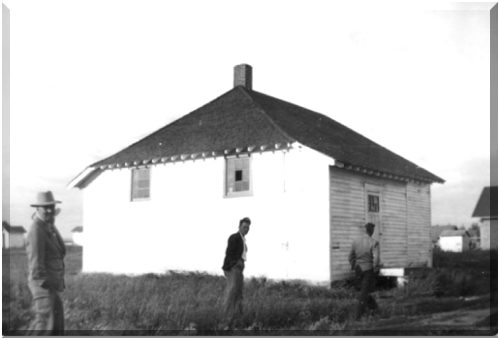
Our Past, Our Peace Country — Behind a small hamlet northwest of Sexsmith lies a history of Indigenous displacement, immigrant families, one-room schools, community women who raised money for their neighbours, and a skating rink that became much more than a place to play hockey.
A Small Place With a Much Bigger Story
Drive northwest from Sexsmith along Highway 59 and you reach La Glace.
There are farms, homes, community facilities and the familiar landscape of the northern Peace Country.
It is not a large municipality.
La Glace is a hamlet within the County of Grande Prairie, rather than a separately incorporated town.
The County's 2026 Municipal Development Plan identifies it as a rural service centre at the intersection of Highways 59 and 724.
The County's 2024 municipal census counted 174 residents.
But those numbers tell only part of the story.
The community serves a much larger agricultural district.
Families who live outside the hamlet use its school, recreation facilities, businesses and gathering places.
Its history includes immigration, farming, education, community service and a remarkable tradition of volunteer work.
And the name La Glace carries a story that reaches back before the arrival of homesteaders.
Who Was La Glace?
The name La Glace means ice in French.
But an account preserved by the South Peace Historical Society offers a more complicated explanation for the community's name.
Historian Dorthea Horton Calverley wrote that the name came from a Dane-zaa, or Beaver, leader known to settlers as La Glace.
Her account describes his family's connections to the country around the lakes and prairies west and northwest of Grande Prairie.
The history includes an interview conducted by Rick Belcourt in 1973 with a man identified as the former leader's son.
That interview is particularly significant.
It preserves recollections of a family whose history was connected to the land before large-scale agricultural settlement.
The account describes hunting, trapping, travel, family life and the effects of newcomers occupying traditional territory.
It also describes the loss of access to land as settlers and railway development advanced.
The historical article was written through the perspective and terminology of its time. Some descriptions of Indigenous people are outdated, and the account should not be treated as a complete Indigenous history.
The connection between the place name and the leader is documented in this regional historical account, but the precise naming process has not been independently established through an original government naming record.
That distinction matters.
The name should invite further historical research, including the knowledge held by Dane-zaa families and communities.
The Land Was Not Empty
Early settler histories often describe families arriving to establish farms on seemingly open land.
But the La Glace district was not an empty landscape.
Indigenous peoples had used the area's lakes, forests, grasslands and travel routes for generations.
The arrival of homesteaders introduced a different system of land ownership and agricultural settlement.
The regional historical account describes the effects of that change on the family associated with the name La Glace.
Its central point deserves attention: the development celebrated in many pioneer histories also involved the displacement of Indigenous people from traditional territory.
Both histories belong in the record.
The experiences of the families who built farms deserve recognition.
So do the experiences of those whose access to the land was reduced or lost.
1911: The Kinderwater Brothers Arrive
One of the best-documented early settler families in the district is the Kinderwater family.
South Peace Regional Archives preserves a collection of family photographs and historical information covering the years 1900 to 1944.
William J. Kinderwater, known as Bill, travelled into the Peace Country over the Edson Trail in 1911.
He had previously worked as a teacher in Minnesota.
His wife, Tilly, died of tuberculosis in 1908, leaving him with a young son.
Bill hoped to improve his health and establish a new life.
He also wanted to create an opportunity for his younger brother, Frank.
On September 19, 1911, he filed on homesteads in the La Glace district for himself and Frank.
He then returned to Wisconsin.
The brothers gathered horses, wagons and supplies and travelled back to the Peace Country.
They arrived on December 27, 1911.
Imagine reaching a new homestead in northern Alberta just days before Christmas.
There were no modern roads, electricity or established farm buildings waiting for them.
Their first priority was survival and shelter.
A Log Cabin and a Family's Beginning
Frank Kinderwater returned to Wisconsin to marry Pauline Gergen.
The couple travelled to the Peace Country over the Edson Trail, arriving in May 1912.
Their early work included building a log cabin measuring approximately 20 by 28 feet.
They also needed to put up enough hay to feed their animals through the winter.
In 1913, Frank and Bill's parents, Adolph and Anna, arrived with their daughter Louise and Bill's son Norbert.
The family enlarged the cabin into a two-storey home.
The Kinderwater story illustrates the work required to establish a homestead.
Building a house was only one task.
Families needed water, fuel, food, shelter for animals and a way to transport supplies.
Fields had to be cleared and cultivated.
The first years were often spent creating the basic conditions necessary for a farm to operate.
The family also experienced loss.
Adolph Kinderwater died in 1916.
Anna died in 1917.
Both were buried at the Catholic cemetery associated with St. Vincent's Mission near Bear Creek.
Their story is preserved because family photographs and records survived.
Many other early families left fewer documents.
1916: The Community Plans a School
As more families settled in the district, education became an important priority.
South Peace Regional Archives records that La Glace School District No. 3371 was organized in 1916.
The district sought provincial approval to construct a school.
But a purpose-built school was not immediately available.
The first school year, 1918–19, took place in Albin Hoflin's cabin.
Mary Collette was the first teacher.
The arrangement says a great deal about rural education at the time.
A family home could become a classroom.
Parents and trustees had to arrange buildings, teachers and supplies.
Children from surrounding farms travelled to school under conditions that varied with the seasons.
Education depended heavily on local organization.
In 1921, the district built its first schoolhouse on the southeast quarter of Section 8, Township 74, Range 8, west of the Sixth Meridian.
It was an important milestone.
La Glace now had a dedicated school building.
From One-Room Schools to a Central School
For many years, small rural schools served children across the surrounding countryside.
These schools were important neighbourhood institutions.
They brought families together for education and community activities.
But the system gradually changed.
Transportation improved.
School districts consolidated.
Larger schools could offer more classrooms and a broader range of instruction.
In 1938, a high school was constructed in La Glace.
Two years later, the elementary school was moved into the community.
As smaller one-room schools closed, La Glace became a centralized school location.
A new multi-room school facility followed.
The school division's archival records include correspondence with inspectors, trustees, teachers and the provincial Department of Education.
They also preserve photographs of the buildings.
These records show that education was not simply a service delivered from outside.
It was something local families helped establish and maintain.
The Teachers Who Helped Build a Community
The school records preserve the names of many early La Glace teachers.
After Mary Collette, the list includes Mrs. Pickering, E.H. Keith, F.G. McNaughton, Mr. Strong, Miss Mann, Miss Metcalf, Mr. Williamson, Edith Lechelt, Parker Norden, Lucy Hardman, Miss Krantz, Miss Cunningham, Doris Eide and Miss Clarke.
Some taught during the one-room school years.
Others served as the district developed.
Their names deserve recognition because rural teachers often became important figures in community life.
The school was a place where children learned, but it was also a meeting point for families scattered across the district.
School concerts, sports, celebrations and community gatherings helped connect neighbours.
For former students, a photograph of an old schoolhouse may bring back memories of teachers, classmates and families whose names are missing from official histories.
A Norwegian Family Makes La Glace Home
Another valuable family collection at South Peace Regional Archives documents the Lunde family.
Ole and Kasbara Lunde left Norway on July 5, 1927, with their three sons and Ole's sister Marie.
They arrived in Sexsmith on July 30.
In February 1928, they filed on a homestead in the La Glace area.
Their daughter Lilly was born in 1931.
As Ole's health declined, his son Jorgen took over the family farm.
Jorgen continued farming until 1977.
He then sold the land and moved into La Glace.
The family's history reflects the importance of Scandinavian immigration in the northern Peace Country.
Families brought agricultural experience, traditions and languages from their former homes.
They established farms, raised children and became part of the district's community life.
Over generations, those family histories became intertwined with La Glace itself.
Farming Was the Economic Foundation
Agriculture shaped the district's early economy.
Families needed seed, tools, machinery, fuel, groceries and repairs.
Local businesses developed to meet those needs.
A collection preserved by South Peace Regional Archives provides an unusually practical view of that economy.
The Lee Oilund collection includes farm business receipts from 1929 to 1963.
Among the businesses represented are C.L. Larson, General Merchant, La Glace; P.M. Haugen Garage; Maple Leaf Garage; and Olson's Garage.
The collection also includes records involving stores, garages and equipment suppliers in neighbouring communities.
These receipts may seem ordinary.
But they document where farmers shopped, which businesses served the district and how agricultural operations depended on a network of local merchants.
A receipt for fuel or machinery repairs can reveal as much about a community's economy as a formal municipal report.
It shows how people actually conducted business.
The Women Who Organized During the War
During the Second World War, women in La Glace organized a Red Cross Club.
After the war, they continued their activities.
The organization became known as the La Glace Ladies Club and later the JUSTAMERE Ladies Club.
South Peace Regional Archives preserves its records and 62 photographs.
The archival history names early members including Mrs. Norman Edgar, Mrs. Oscar Anderson, Mrs. Frank Kinderwater, Mrs. Roy Robinson, Mrs. John Soderquist, Mrs. Doris Atkinson, Mrs. Fred Bohn, Mrs. Carl Larson, Mrs. Harvey Webber, Mrs. Arnold Saunders, Mrs. Jack Robinson and Mrs. Arnold Christianson.
The club's work extended well beyond social gatherings.
Members raised money for community projects, including the hall.
They supported the Red Cross, cancer and heart charities, the Canadian National Institute for the Blind and other causes.
At one point, the club also helped finance the education of a girl in Korea who had a disability.
That is a remarkable connection between a small Peace Country community and a family thousands of kilometres away.
The club's history shows how local volunteer organizations could make contributions far beyond their immediate district.
The JUSTAMERE Ladies Had Fun, Too
The women did not limit themselves to fundraising meetings.
They organized entertainment, performed skits and musical numbers, and entered parade floats.
The archives record that the club won first place for a float in Grande Prairie's County Fair parade in 1975.
It also received parade awards in La Glace in 1982 and 1983.
Members gathered in one another's homes for monthly meetings and lunches.
Later, they met at the local café.
The club's surviving photographs offer an opportunity to recognize women whose contributions might otherwise be overlooked.
Community histories often devote considerable attention to the first homesteaders, business owners and municipal leaders.
But organizations like JUSTAMERE helped sustain the social life of rural communities.
Their fundraising and volunteer work supported facilities and services used by many families.
The Edgar Family and Three Generations of Business
The history of the Edgar family provides another connection between farming, community institutions and local business.
A South Peace Regional Archives cemetery-tour publication describes the family's involvement in the Scenic Heights district.
Norman Edgar became one of the early school bus drivers when rural schools consolidated toward La Glace.
Norman and his wife Elsie moved into La Glace in 1951.
He became a bulk fuel agent, first for Federated Co-op and later UFA.
After Norman died in 1958, his son and then grandson followed him in the business.
The archives describe it as a three-generation enterprise.
The family farm also continued through generations.
This is the kind of local history that can disappear when businesses change hands or families move away.
A fuel agency may not seem like a historic landmark.
But for farm families, dependable fuel delivery was an essential service.
The people providing it were part of the district's agricultural infrastructure.
The Rink That Became a Gathering Place
By the 1950s, La Glace residents were building another important institution.
Volunteers constructed a skating arena.
Over the years, the building was expanded and improved.
The old rink became a place for hockey, skating, community gatherings and recreation.
It served generations of children and families.
Parents met neighbours.
Young people developed friendships.
Volunteers maintained facilities and organized activities.
The arena was more than an ice surface.
It was part of the social life of the district.
As the decades passed, however, the building aged.
Its condition eventually made replacement necessary.
The problem was familiar to rural communities across Alberta.
A facility built through volunteer effort can serve for generations, but major replacement costs can exceed what a small community can easily raise.
A New Generation Takes on the Challenge
The La Glace and District Agricultural Society began working toward a new regional recreation facility.
The project required years of fundraising, planning and construction.
The society's community website describes the Tamarack Valley Regional Recreation Centre as a multi-purpose gathering place, with space for sports, meetings and events.
Its construction proceeded in stages as funding became available.
In 2026, the new facility reached an important milestone with the installation of arena boards and the return of skating activities.
The project reflects the same pattern seen throughout La Glace's history.
Residents identify a need.
Volunteers organize.
Money is raised.
Facilities are built or improved.
The scale of the new centre is much larger than the first school classroom in Albin Hoflin's cabin.
But the underlying community effort is familiar.
The Population Doesn't Tell the Whole Story
La Glace's official population is small.
The County of Grande Prairie's 2024 municipal census counted 174 residents in the hamlet.
The County's Municipal Development Plan nevertheless identifies La Glace as a rural central node, recognizing its commercial and community services.
That distinction matters.
A hamlet's population does not necessarily represent the number of people who depend on its facilities.
The surrounding agricultural district includes families who use the school, sports facilities, businesses and other services.
A hockey game or community event can bring together people from far beyond the hamlet boundaries.
This is one reason small rural centres remain important.
They connect people who may live many kilometres apart.
What Makes La Glace Different?
Many Peace Country communities grew around railways.
Others developed because of highways, resource industries or major commercial projects.
La Glace's documented history emphasizes something different.
It is a story of agricultural families and institutions built to meet local needs.
The early school began in a cabin.
The school district developed as families settled.
Immigrant households established farms.
Women organized fundraising and community service.
Local merchants supplied agricultural businesses.
Volunteers built recreation facilities.
A new generation raised money to replace an aging arena.
The history does not depend on a single grand development.
It is a record of many smaller decisions made over generations.
The History Still Being Written
La Glace has changed considerably since the first Kinderwater homesteads and one-room school.
Modern farming equipment has replaced much of the manual labour of early agriculture.
Roads connect the district to Grande Prairie and other communities.
School transportation has changed how children attend classes.
Local businesses and community facilities have evolved.
But some of the same questions remain.
How does a small rural community maintain important services?
Who pays to replace aging facilities?
How can volunteer organizations attract new generations of members?
How should the histories of Indigenous families, immigrant settlers, teachers, business owners and community volunteers be preserved?
La Glace's past provides examples of how residents responded to earlier challenges.
It also reminds us that community history is not limited to buildings and official anniversaries.
Sometimes it survives in a family photograph, an old business receipt, a school record or a name written on the back of a parade picture.
The Community That Kept Building
The La Glace district has experienced more than a century of change.
Its history includes Indigenous connections to the land, agricultural settlement, immigration, education and local enterprise.
It includes families who arrived with wagons and supplies.
Teachers who worked in small classrooms.
Women who raised money for neighbours and charities.
Farmers and business owners who supported the local economy.
And volunteers who built places where people could gather.
The buildings changed.
The generations changed.
But the willingness to work together remained a recurring part of the community's story.
La Glace may be small on the map. Its history shows what a community can accomplish when generations of neighbours keep showing up.
Historical Photographs Worth Sharing
The following photographs are documented in South Peace Regional Archives collections. The archival descriptions identify the subjects, but publication-quality copies and reproduction rights should be confirmed before use.
1. La Glace School, Approximately 1950 — Recommended Historical Cover
The Grande Prairie School Division No. 14 fonds contains a black-and-white photograph of La Glace School, identified as item 0063.02.051.1.
Suggested caption: La Glace School around 1950, during the period when rural one-room schools were being consolidated into larger community schools.
Credit: South Peace Regional Archives, Grande Prairie School Division No. 14 fonds, item 0063.02.051.1. Photographer not identified in the accessible catalogue.
2. La Glace School Buses
The archives' County Cemetery Tour publication reproduces a photograph of school buses lined up outside La Glace School.
Suggested caption: School buses outside La Glace School, reflecting the consolidation of rural education and the growing role of La Glace as a central school location.
Credit: South Peace Regional Archives, item 0483.01.25-03. Date and photographer should be confirmed before publication.
3. The Original School Building, Photographed in 1979
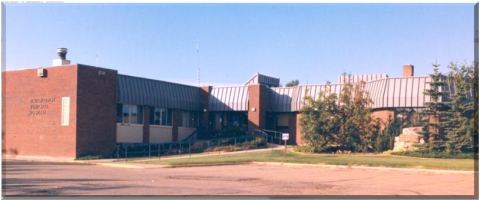
The County of Grande Prairie Financial Management sous-fonds contains a 1979 appraisal photograph of a school storage building identified as the former La Glace School, constructed around 1921.
Suggested caption: The former La Glace School building, originally constructed around 1921, photographed during a municipal property appraisal in 1979.
Credit: South Peace Regional Archives, County of Grande Prairie Financial Management sous-fonds, item 0306.06.42. Photograph taken for Sunalta Appraisals Ltd.
4. La Glace Recreation and Agriculture Centre, 1979
The same collection includes a photograph of the recreation and agriculture centre, identified as having been built in 1962.
Suggested caption: La Glace's Recreation and Agriculture Centre in 1979, documenting the community facilities that served generations of residents.
Credit: South Peace Regional Archives, County of Grande Prairie Financial Management sous-fonds, item 0306.06.44. Photograph taken for Sunalta Appraisals Ltd.
5. The JUSTAMERE Ladies Club
The JUSTAMERE Ladies Club fonds contains 62 photographs documenting the organization's activities.
Suggested caption: Members of La Glace's JUSTAMERE Ladies Club helped raise money for community facilities and charities while preserving an active social tradition.
Credit: South Peace Regional Archives, JUSTAMERE Ladies Club fonds, collection 0481. A specific photograph and item number must be selected and verified before publication.
6. The New Tamarack Valley Regional Recreation Centre
A contemporary photograph of the new facility would provide a strong contrast with the archival images of the old school and recreation centre.
Suggested caption: The Tamarack Valley Regional Recreation Centre represents a new chapter in La Glace's long history of volunteer-built community facilities.
Credit: Photographer or supplying organization to be identified. Obtain permission from the La Glace and District Agricultural Society if using its photographs.
Sources and Historical References
South Peace Regional Archives — Kinderwater Family Fonds
Original family history and photographs documenting the Kinderwater family's arrival and early homesteading in the La Glace district.
https://www.southpeacearchives.org/finding-aid/fonds-624-kinderwater-family-fonds/
South Peace Regional Archives — Grande Prairie School Division No. 14 Fonds
Original school district records documenting La Glace School District No. 3371, early teachers, school buildings and consolidation.
https://www.southpeacearchives.org/finding-aid/fonds-063-grande-prairie-school-division-no-14/
South Peace Regional Archives — Lunde Family Fonds
Family records documenting Norwegian immigration and homesteading near La Glace beginning in 1928.
https://www.southpeacearchives.org/finding-aid/fonds-517-lunde-family-fonds/
South Peace Regional Archives — JUSTAMERE Ladies Club Fonds
Original records and photographs documenting wartime Red Cross work, fundraising, community projects and social activities.
https://www.southpeacearchives.org/finding-aid/fonds-481-just-a-mere-ladies-club-fonds/
South Peace Regional Archives — Lee Oilund Collection
Farm business receipts and agricultural records documenting La Glace-area merchants, garages and agricultural services.
https://www.southpeacearchives.org/finding-aid/fonds-274-lee-oilund-collection/
South Peace Regional Archives — County of Grande Prairie Financial Management Sous-fonds
Original 1979 photographs of La Glace's school buildings, fire hall, recreation centre and other facilities.
South Peace Regional Archives — County Cemetery Tour Brochure
Original local historical research including the Edgar family's connection to La Glace and a photograph of school buses.
https://www.southpeacearchives.org/wp-content/uploads/2013/08/County-Cemetery-Tour-Brochure.pdf
South Peace Historical Society — The Beaver Indian La Glace
Dorthea Horton Calverley's historical account of the Indigenous leader associated with the community's name, including Rick Belcourt's 1973 interview. This is a historical secondary account whose Indigenous terminology and interpretations require critical reading.
https://calverley.ca/article/01-127-the-beaver-indian-la-glace/
County of Grande Prairie — Municipal Development Plan, Bylaw 3255
Official municipal planning information identifying La Glace's location, population and role as a rural service centre.
https://www.countygp.ab.ca/media/v4emzguo/3255-municipal-development-plan.pdf
La Glace Community Website
Community information and the Tamarack Valley Regional Recreation Centre project.
Alberta Association of Agricultural Societies — La Glace and District Agricultural Society
Original organizational listing describing the society's recreation facilities and responsibilities.
https://www.albertaagsocieties.ca/agsocieties/division-no-19/la-glace-district-ag-society/
Swan City Speaks: What Do You Think?
La Glace residents, former residents and families from the surrounding farming district — your memories can help preserve this history.
-
Do you have old photographs of La Glace? Especially the first schools, stores, garages, farms, community hall, skating rink or early streets? Can you identify the people pictured?
-
Did your family attend one of the original rural schools? What do you remember about teachers, school buses, concerts, sports or the move to centralized schooling?
-
Does your family have a connection to the Kinderwater, Lunde, Edgar or other early farming families? Are there letters, diaries or photographs that could add to the record?
-
Do you remember the JUSTAMERE Ladies Club? Who were the women involved, and what community projects or fundraising events do you remember?
-
What stories should be included from Dane-zaa and other Indigenous families? Are there oral histories or records that can help clarify the origin of the La Glace name and the experiences of people who lived in the district before agricultural settlement?
-
What are your memories of the old arena? Who helped build it, maintain it or organize the activities that brought families together?
-
Can you correct or expand this history? Historical records are valuable, but family memories and photographs can help identify missing people, places and events.
When sharing an old photograph, please include any known names, approximate dates, locations and information about who owns the image.
La Glace's history belongs to more than the people whose names appear in official records.
It also belongs to the neighbours who helped build the schools, maintain the rink, organize community events and keep the district connected.
Share your memories and thoughts in the comments. Your opinion matters.