Hythe: The Little Peace Country Town That Followed the Railway — and Refused to Disappear
Our Past, Our Peace Country — How settlers, traders, railway workers, farmers and generations of volunteers built a community that survived fires, economic change and the loss of its village status.
A Town With Two Beginnings
Imagine standing beside the Beaverlodge River more than a century ago.
There is no Highway 43 carrying traffic between Grande Prairie and Dawson Creek.
No modern commercial centre.
No established railway station.
Instead, there are homesteads, trails, a stopping place, a trading post and families trying to establish new lives in the western Peace Country.
That was the beginning of Hythe as a settler community.
But the Hythe people recognize today was not built in exactly the same place.
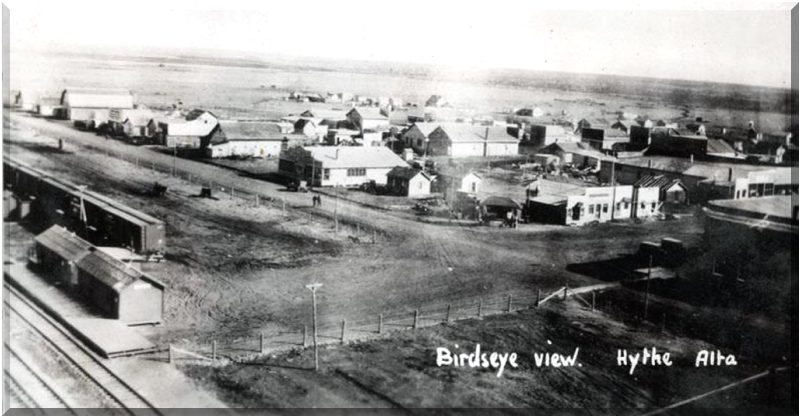
Like neighbouring Beaverlodge, Hythe experienced a dramatic transformation when the railway arrived.
The old settlement was near the river.
The new townsite was established about half a mile north.
Businesses and residents began shifting toward the railway.
For a time, Hythe became an important railway terminus and shipping point for a large surrounding district.
It was a place where farmers, merchants, travellers and people seeking land came together.
The railway helped create a new commercial centre.
But Hythe's history is about more than trains.
It is also about people who built schools, cared for mothers and babies, organized sports, operated businesses, fought fires and preserved the memories of their neighbours.
Before the First Homesteads
The history of the Hythe district did not begin with European settlement.
The surrounding Peace Country was part of the traditional territories and travel networks of Indigenous peoples, including the Dane-zaa (Beaver) and Cree.
The County of Grande Prairie's historical account recognizes Indigenous habitation in the wider region thousands of years before European contact.
The Beaverlodge River and surrounding landscape formed part of a much older history of travel, hunting, trade and relationships with the land.
The establishment of homesteads, roads, farms and railway infrastructure brought significant changes to the area.
Those changes are part of the history of settlement, but they should not be mistaken for the beginning of human history in the district.
The stories of Indigenous families and communities deserve a place alongside the records of settlers, railway companies and municipal governments.
The First Settlers and the Old Town
An Alberta government survey of Hythe, revised in June 1958, provides an unusually detailed account of the settlement's beginnings.
It records that land in the district was surveyed for homesteads in 1909.
That autumn, settlers travelled over the Edson Trail to establish homes between the present townsite and the Beaverlodge River.
The survey identifies George "Kelly" Sunderman and a settler named Waddel among the earliest non-Indigenous settlers.
Much of the original hamlet developed on Sunderman's quarter-section.
Waddel and Sunderman operated a stopping place, along with freighting and land-locating services.
These were essential businesses in an area where transportation was difficult and new arrivals needed help finding land.
A stopping place could provide food, shelter, information and assistance to travellers.
Freighting businesses helped move goods through a region where rail transportation had not yet arrived.
In 1912, a trader named Abdo built a log cabin near the Beaverlodge River.
According to the government survey, his trading post became the first store in the original hamlet.
Around the same period, John McCauley and William Coldwell operated a fur-trading business called the Selkirk Trading Company.
The early settlement was therefore more than a cluster of farms.
It was becoming a service point for a developing agricultural district.
Why Is It Called Hythe?
The community's name came from England.
The early post office was established on H. Hartley's farm near the Beaverlodge River.
The 1958 government survey identifies Hartley as the first postmaster and records the post office's establishment in 1913.
It says the name Hythe was chosen after the town in England where Hartley had previously lived.
A later provincial municipal report dates the naming of the post office to 1914.
The records therefore differ slightly on the precise postal date.
What is consistent is the English connection.
The name Hythe, familiar to residents today, originated with an early settler's connection to the town of Hythe in Kent.
It is one of many Peace Country place names that reflect the origins and memories of immigrant families.
A School Before the Railway
Families needed more than land and stores.
They needed schools.
On November 10, 1914, the Happy Valley School District No. 3194 erected its first school, according to the government survey.
Miss C. Robson was identified as the teacher.
The school served children in the developing district.
In those early years, rural education could be difficult.
Families were scattered across a large area.
Roads were primitive.
Winter weather made travel challenging.
Yet settlers placed considerable importance on education.
The school became one of the institutions that helped transform a settlement into a lasting community.
A school was not simply a place where children learned reading and arithmetic.
It also represented the belief that families intended to remain in the district and build a future.
In 1928, a school was constructed at the new townsite.
The district's name was officially changed from Happy Valley to Hythe in 1931.
The evolution of the school reflected the wider transformation of the community.
The Railway Changes Hythe's Future
For early Peace Country farmers, transportation was one of the greatest obstacles to prosperity.
Growing crops was only part of the challenge.
Grain had to reach buyers.
Machinery and supplies had to reach farms.
Businesses needed access to freight.
The railway promised to change all of that.
The new Hythe townsite was surveyed in 1928 on land formerly owned by William Swanston.
It was located about half a mile north of the original settlement.
The government survey records that railway steel reached Hythe in December 1929.
Other historical accounts describe the railway's arrival more generally as occurring during the 1928–1929 period.
These dates may reflect the difference between railway construction, townsite development and the arrival of completed track.
The important historical fact is that railway development transformed the community.
Residents and businesses began relocating from the old settlement toward the new railway townsite.
Hythe became a railway terminus.
That meant trains ended their journeys there until the line was extended farther west.
For a period, Hythe was a major shipping point for the surrounding district.
Farmers brought agricultural products toward the railway.
Merchants received goods.
People looking for land passed through the community.
The railway created opportunities for businesses serving travellers, farmers and new settlers.
The town experienced a period of rapid development.
But its position as a railway terminus was temporary.
The government survey records that the railway was extended farther west about two years later.
Hythe remained an agricultural and commercial centre, but its special role as the end of the line did not last.
This was a familiar pattern in railway history.
A town could experience a boom when it became the terminus.
Then the railway moved on.
The community had to adapt.
The Hythe Hotel and the New Main Street
The relocation created opportunities for new businesses.
According to the 1958 survey, construction of the Hythe Hotel began on August 1, 1930.
The survey identifies it as the first building commenced on the new townsite.
The hotel was an important part of the railway-era economy.
Travellers needed accommodation.
Land seekers needed somewhere to stay.
Merchants and businesspeople needed places to meet.
A hotel could become one of the busiest gathering places in a small town.
Over time, other businesses developed along Hythe's streets.
The South Peace Regional Archives collection assembled by longtime resident Donna Shail contains photographs and business records documenting the community's commercial history.
Among the businesses represented are Oakfords, Pearson Garage, McLeod & Inkster, Chartier Brothers and numerous other local enterprises.
These names are more than entries in an old business directory.
They represent people who invested money, time and labour in the community.
Some businesses survived for decades.
Others disappeared as transportation, shopping habits and the economy changed.
Old photographs of Hythe's main street provide a record of those changes.
They show how the community developed from a railway settlement into an established rural service centre.
Fire: A Repeated Threat to the Community
One of the most striking statements in the 1958 government survey concerns fire.
The survey reports that major fires nearly destroyed the settlement on three occasions.
It does not provide a complete chronology of those fires in its brief historical section.
That leaves important questions.
When did each fire occur?
Which buildings were lost?
How did residents rebuild?
Were the fires concentrated in the original settlement or the later townsite?
These are questions that local newspapers, insurance records, photographs and family memories may help answer.
Fire was a serious danger in early prairie communities.
Many buildings were constructed of wood.
Heating systems, lamps and early electrical installations presented risks.
Water supplies and firefighting equipment could be limited.
A major fire could destroy businesses that had taken years to establish.
Hythe's survival through repeated fires is therefore an important part of its history.
The community continued rebuilding.
By 1956, Hythe had completed a new brick fire hall.
The 1958 survey recorded a 23-member volunteer fire brigade, supported by additional civil-defence firefighters.
That detail reveals how seriously the community took fire protection.
It also illustrates the importance of volunteers in small-town life.
Hythe Becomes a Village
On August 31, 1929, Hythe officially incorporated as a village.
W.A. Stinson was its first mayor, according to the provincial survey.
Incorporation gave the community a formal local government responsible for municipal affairs.
The village could make decisions about streets, services, development and local facilities.
It was a major step in Hythe's development.
But municipal government did not eliminate the challenges of operating a small rural community.
Residents still needed reliable roads, electricity, schools, medical care, fire protection and places to gather.
Over the following decades, the village worked to provide those services.
From a Three-Bed Maternity Hospital to a Community Hospital
Health care is one of the most important parts of Hythe's history.
The 1958 government survey records that Mrs. Miller operated a private three-bed maternity hospital from 1932 to 1937.
For families in the surrounding district, local maternity care could be especially important.
Travel to larger centres was not always easy.
Winter conditions, distance and limited transportation could make childbirth and medical emergencies particularly difficult.
The establishment of a small maternity facility reflected the needs of a growing community.
In 1948, Hythe constructed a ten-bed municipal hospital.
The hospital represented a major improvement in local health services.
It also became part of the community's identity.
Medical care brought patients, families and health workers together.
The hospital was more than a building.
It was an institution that affected generations of residents.
Hythe's later hospital history, including changes to services and the eventual closure of the facility, deserves careful examination through health authority records and local accounts.
Those changes also connect Hythe's history with a continuing question across rural Alberta: how can smaller communities maintain access to essential health services?
A Look Inside Hythe in 1958
One of the most valuable historical documents about Hythe is the Alberta government's 1958 survey.
It provides a snapshot of everyday life that goes far beyond major historical events.
At that time, the survey recorded a community with gravelled streets, sidewalks, electrical service, sewer infrastructure, a hospital, schools, churches, businesses and recreational facilities.
It described tree-lined streets and gardens producing vegetables and small fruits.
The document recorded a 25-room hotel and a local government treasury branch.
The village had a doctor and a ten-bed hospital.
Schools offered Grades 1 through 12, with buses transporting rural students.
The community also had a library located in the fire hall.
Movies were shown in Jubilee Hall.
These details help us imagine what Hythe was like in the late 1950s.
It was not simply a collection of homes beside a highway.
It was a community with many of the services and institutions that residents expected in a small town.
The survey also recorded a striking housing detail.
A four-room home rented for approximately $50 a month.
That figure should not be compared directly with modern rents without accounting for inflation, wages and changing housing standards.
But it provides a useful glimpse into the economy of the period.
The Arena That Brought People Together
Sports played a major role in Hythe's community life.
The 1958 government survey described the Memorial Arena as a centre for entertainment and recreation.
The hockey arena had seating for approximately 1,200 spectators.
That was a substantial facility for a small village.
The community also had a covered curling rink with two sheets of natural ice.
Hockey and curling provided more than recreation.
They brought families together during long winters.
Games attracted spectators.
Volunteers maintained facilities.
Young people developed friendships and skills.
Community events created opportunities for neighbours to meet.
The South Peace Regional Archives holds photographs of the Hythe Memorial Arena, local hockey teams and community celebrations.
One archival photograph from 1954–1955 shows the arena and curling rink, along with nearby businesses.
Another records the Hythe Mustangs hockey team.
These images help explain why sports facilities were so important to community life.
They were places where people gathered, cheered, volunteered and formed memories.
The Grain Elevators and Agricultural Economy
Hythe's economy was closely tied to surrounding farms.
The railway provided a way to move grain toward larger markets.
Grain elevators became prominent features of the community's landscape.
They were places where farmers delivered their harvests and where grain was weighed, graded, stored and loaded for shipment.
The South Peace Regional Archives holds photographs of Hythe's elevators and railway facilities.
One photograph of a 1964 flood shows grain elevators in the background.
That image is a reminder that the elevators were not merely industrial buildings.
They were landmarks that helped define the town's skyline.
The agricultural economy supported many other businesses.
Farmers needed equipment, fuel, repairs, groceries, financial services and transportation.
A successful farming district helped sustain the town.
As grain transportation changed, the traditional wooden elevator system declined across western Canada.
Larger facilities, improved highways and modern trucking reduced the importance of many small railway delivery points.
Hythe experienced those changes as part of the broader transformation of Prairie agriculture.
The disappearance of traditional elevators represented more than an industrial change.
It also altered the physical appearance of the community.
Donna Shail: The Woman Who Helped Save Hythe's Memories
One of the most valuable historical resources about Hythe exists because of the dedication of a local resident.
Her name was Donna Shail.
Donna Bain was born in Hythe.
Her parents, Dan Bain and his wife, came from Biggar, Saskatchewan, in 1929.
That was the same year Hythe incorporated as a village.
Donna attended Happy Valley School.
In 1950, she married Eldon Shail, a grain buyer for Alberta Pacific Grain Company.
They raised two children, Randy and Terri, in Hythe.
Donna spent almost her entire life in the community.
She volunteered with the United Church, taught Sunday school, participated in community organizations and helped care for the small Hythe museum and tourist booth.
But she also did something that would become extraordinarily important to future generations.
She collected Hythe's history.
Donna assembled scrapbooks containing photographs, newspaper clippings, stories, business records and other material documenting community life.
The collection now held by South Peace Regional Archives includes 458 photographs and eight negatives, along with textual records.
The photographs span much of the twentieth century.
They document businesses, schools, churches, railway facilities, sports, parades, floods, families and community events.
The collection also includes albums from the 1978 Hythe Homecoming, the opening of the Golden Age Craft Centre in 1981 and the 1989 Celebrate Hythe event.
There are memorial cards documenting people who lived in the community.
This collection demonstrates the importance of local historical preservation.
A photograph without a name or date can gradually lose its meaning.
A newspaper clipping may be discarded.
A business receipt may seem unimportant.
But together, these items can help reconstruct the life of a community.
Donna Shail's work preserved material that might otherwise have disappeared.
Her contribution is a reminder that history is not saved only by professional historians.
Sometimes it is saved by neighbours who understand that ordinary community life deserves to be remembered.
The Photographs That Bring Old Hythe Back to Life
The Donna Shail collection contains several especially interesting photographs.
One shows downtown Hythe in 1930.
Businesses visible in the photograph include J.H. McCann Real Estate, the Bank of Montreal and a farm-lands business.
Another photograph from 1930 shows people waiting for a train at the Hythe station.
A 1929 photograph records a sports-day parade.
A 1928 photograph shows a parade in the old townsite.
The archival description of that image includes names and locations supplied by Norma Clarke Lassons.
It identifies Ma Brainard, Mrs. Clarke, Mrs. Fisher, local stores, a saddlery and other buildings.
This is exactly the kind of information that makes historical photographs valuable.
Without the accompanying description, the picture might simply show an unidentified street scene.
With names and details, it becomes a record of people and businesses.
Other photographs document floods, schoolchildren, weddings, grain elevators and everyday life.
These records provide an opportunity for present-day residents to connect their family histories with the community's past.
Hythe's Volunteers and Community Spirit
Hythe has long depended on residents who contributed their time to community organizations.
The historical record documents churches, service clubs, recreational groups, youth organizations and museum volunteers.
The Hythe Junior Forest Wardens provide one example.
According to South Peace Regional Archives, the local club was originally organized in Goodfare by Ann and Vern Steinke.
It later moved to Hythe, where Irene McCallister took over with assistance from Vicky Miller, Ali Jenner and Knute Knutson.
The club promoted care for wood, water, soil and wildlife.
Members participated in fundraising activities and highway cleanups.
It was one of many organizations through which residents contributed to their community.
Volunteerism helped maintain recreational facilities, organize events, preserve history and support local services.
That contribution is difficult to measure in dollars.
But without it, the history of many small Peace Country communities would look very different.
A Village Becomes a Hamlet
Hythe remained an incorporated village for more than 90 years.
But in 2021, residents faced another major change.
A provincial viability review examined the community's municipal circumstances and future options.
Residents voted on whether Hythe should remain an independent village or dissolve and become a hamlet within the County of Grande Prairie.
On March 31, 2021, the County reported that residents had voted in favour of dissolution.
The Alberta government subsequently approved the change.
On July 1, 2021, Hythe officially became a hamlet within the County of Grande Prairie.
The change ended the community's status as a separate municipal government.
Responsibility for municipal services and administration shifted to the County.
But the change did not erase Hythe's history or identity.
The community remained Hythe.
Its residents, businesses, families and community organizations continued to be part of the western Peace Country.
The decision also raises broader questions relevant to small communities across Alberta.
What does municipal independence mean?
What services can a small municipality afford?
When does joining a larger municipality provide advantages?
And what should be done to preserve local identity and representation after a change in governance?
Hythe's experience is an important part of the region's municipal history.
What Hythe's History Teaches Us
Hythe's story is one of repeated adaptation.
The first settlers established farms and businesses along the Beaverlodge River.
The railway encouraged the community to develop a new townsite.
Fires forced residents to rebuild.
Agricultural transportation changed.
Schools, hospitals and recreational facilities developed as the population's needs evolved.
Volunteers helped sustain community life.
And in 2021, the community changed its municipal structure.
Through all of those changes, Hythe retained its identity.
That may be the most important lesson in its history.
A community is more than its legal status.
It is more than a railway station, a grain elevator, a hotel or a municipal office.
It is the people who live there, the institutions they create, the relationships they build and the memories they pass to future generations.
Hythe's history also reminds us how easily important local stories can disappear.
Without the 1958 government survey, many details of early settlement and village life would be harder to reconstruct.
Without Donna Shail's scrapbooks, hundreds of photographs and records might have been lost.
Without families preserving names, dates and memories, even surviving photographs can become difficult to interpret.
That is why community history matters.
The Story Isn't Over
Several parts of Hythe's history remain open to further documentation.
- The old townsite: Which buildings were moved or rebuilt when the railway arrived? Do any survive today?
- The fires: Can local records establish the dates, damage and rebuilding efforts associated with the three major fires described in the 1958 survey?
- The railway: Who worked at the station and grain elevators? What photographs and records remain?
- The hospital: What memories and records survive from Mrs. Miller's maternity hospital and the later municipal hospital?
- The arena: Who remembers the Hythe Mustangs, curling competitions and community events?
- Indigenous history: What additional accounts can Indigenous knowledge holders contribute about the land and its history before and during settlement?
These are questions, not claims that the answers are already known.
The historical record can be expanded through archival documents, family photographs, oral histories and the knowledge of residents.
Historical Photographs Worth Sharing
1. Main Street Hythe, 1929
South Peace Regional Archives holds a photograph showing the main highway through Hythe in 1929.
Suggested caption: Main Street in Hythe in 1929, during the period when railway construction and a new townsite were transforming the community.
Credit: South Peace Regional Archives, Hythe Homecoming 2016 fonds, item 0637.01.001. Photographer not identified in the catalogue. Confirm reproduction permission.
2. Hythe Railway Station, 1930
A photograph in the Donna Shail collection shows people waiting for a train on the platform, with village buildings in the background.
Suggested caption: Passengers wait at Hythe's railway station in 1930, shortly after the railway helped establish the community's new commercial centre.
Credit: South Peace Regional Archives, Donna Shail collection, item 0573.02.03. Original photographer not identified. Confirm reproduction permission.
3. The Old Town Parade, 1928
A photograph shows a parade in the original Hythe townsite, accompanied by a detailed description identifying residents and businesses.
Suggested caption: A parade passes through Hythe's old townsite in 1928. Historical notes identify several residents and businesses visible in the photograph.
Credit: South Peace Regional Archives, Donna Shail collection, item 0573.02.11. Identification notes attributed to Norma Clarke Lassons. Confirm reproduction permission.
4. Hythe Arena and Curling Rink, 1954–1955
An archival photograph shows the arena, curling rink and nearby businesses.
Suggested caption: Hythe's arena and curling rink in the mid-1950s, when winter sports and community gatherings were central to village life.
Credit: South Peace Regional Archives, Hythe Homecoming 2016 fonds, item 0637.01.003. Photograph attributed in the catalogue to Dreng Homme. Confirm reproduction permission.
5. Downtown Hythe, 1930
A historical street photograph shows early businesses including J.H. McCann Real Estate and the Bank of Montreal.
Suggested caption: Hythe's commercial district around 1930, showing businesses that served residents, farmers and railway travellers.
Credit: South Peace Regional Archives, Donna Shail collection, item 0573.02.02. Original photographer not identified. Confirm reproduction permission.
Historical Sources and References
Alberta Government — Survey of Hythe, Revised June 1958
A primary historical document covering settlement, early businesses, the railway, schools, health care, municipal services, recreation and village development.
https://archive.org/details/surveyofhythe00albe
Digitized PDF: https://upload.wikimedia.org/wikipedia/commons/a/a7/Survey_of_Hythe_%28IA_surveyofhythe00albe%29.pdf
South Peace Regional Archives — Donna Shail Collection, Fonds 573
Contains 458 photographs, scrapbooks, business records, historical descriptions and community memorabilia.
https://www.southpeacearchives.org/finding-aid/fonds-573-donna-shail-fonds/
South Peace Regional Archives — Hythe Homecoming 2016 Fonds, Fonds 637
Includes historical photographs of Main Street, the railway-era community, the arena, curling rink and local sports.
https://www.southpeacearchives.org/finding-aid/fonds-637-hythe-homecoming-2016-fonds/
South Peace Regional Archives — Hythe Junior Forest Wardens, Fonds 568
Records of local youth activities, volunteer leaders and environmental stewardship.
https://www.southpeacearchives.org/finding-aid/fonds-568-hythe-junior-forest-warden/
County of Grande Prairie — Hythe Viability Review Report
Provincial municipal review containing settlement background, incorporation history and information about Hythe's municipal circumstances.
https://www.countygp.ab.ca/media/xw4l3f3f/hythe-report.pdf
County of Grande Prairie — Hythe Transition
Official information on the 2021 dissolution vote, provincial approval and transition from village to hamlet.
https://www.countygp.ab.ca/council-administration/council/council-initiatives/hythe-transition/
County of Grande Prairie — History and Heritage
Regional historical overview, including Indigenous history and the development of the County.
https://www.countygp.ab.ca/parks-recreation-community/history-and-heritage/
Swan City Speaks: What Do You Think?
Hythe residents, former residents and families with connections to the community — what do you remember?
-
Do you have old photographs of Hythe? We'd especially like to see pictures of the railway station, grain elevators, original townsite, Main Street, schools, hospital and arena. Can you identify the people in them?
-
Does your family have a story to share? Perhaps your parents or grandparents operated a business, worked on the railway, played for the Hythe Mustangs, attended Happy Valley School or helped build the community.
-
Can you help correct or expand the historical record? Are there important people, events, Indigenous histories, businesses or community traditions that deserve greater recognition?
When sharing photographs, please include any known names, dates, locations and information about ownership or permission to publish.
Share your thoughts in the comments. Your opinion matters.