Spirit River: The Town That Moved for the Railway — Then Rose From the Ashes
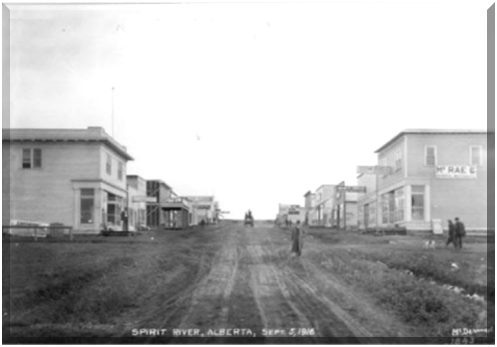
Our Past, Our Peace Country — Before Spirit River became a Central Peace service centre, its original settlement stood beside a river. The railway brought a new townsite, but a devastating fire nearly destroyed the commercial heart of the community.*
Before There Was a Town, There Was a River
Spirit River's story begins with a name that predates the railway, the grain elevators and the municipal boundaries.
Chepe Sepe.
The name is Cree and is commonly translated as Ghost River or Spirit River.
The Town of Spirit River preserves several traditional explanations for the name, involving sounds, reflections and experiences along the river.
These accounts are part of the area's recorded oral traditions. They should not be presented as a single established explanation, particularly without identifying the Indigenous knowledge holders and communities from which each account originated.
What is certain is that the river had a name and significance long before the modern town existed.
The Central Peace was part of the traditional territories and travel networks of Indigenous peoples, including Dane-zaa and Cree communities.
The river valleys, grasslands and forests provided travel routes, hunting areas and connections between communities.
European fur-trade activity later became concentrated around Dunvegan on the Peace River.
The North West Company and Hudson's Bay Company operated in the region, and missionary activity followed.
The history of Spirit River is therefore older than its incorporation date.
The modern municipality is one chapter in a much longer story.
The First Settlement Was Somewhere Else
The Spirit River that residents know today was not built on the original settlement site.
In 1888, the Hudson's Bay Company established a cattle ranch on the banks of the Spirit River, several kilometres southeast of the present townsite.
The ranch supplied the trading operations associated with Fort Dunvegan.
Farming and ranching gradually expanded in the surrounding district.
A settlement developed along the river, with trading activity, religious institutions and services for nearby families.
The original community was commonly called the Spirit River Settlement.
Its location made sense before the railway.
The river was an important geographical feature, and the settlement was connected to established overland routes.
But transportation technology was changing.
The railway would soon make a different location more attractive.
And that decision would reshape the community.
Getting to the Peace Country Was an Expedition
Before the railway arrived, transporting goods into the Central Peace was difficult and expensive.
The Municipal District of Spirit River's historical account describes freight being hauled by horse team from Edmonton.
An empty trip could take approximately 20 days.
With a loaded wagon, the journey could take 25 days to two months.
Weather, road conditions and the weight of supplies made a tremendous difference.
Consider what that meant for an early merchant.
Every bag of flour, tool, piece of machinery and household item had to be transported over long distances.
The cost of freight affected the price of goods.
Delays could leave stores waiting for essential supplies.
Farmers faced similar problems when trying to move their produce to market.
A productive farm was not necessarily a profitable farm if transportation costs consumed too much of its value.
That is why the promise of a railway mattered so much.
It offered a way to connect the Central Peace to larger markets and the provincial economy.
The Surveyors See the Possibilities
In 1909, J.B. Saint Cyr surveyed the Spirit River district for the federal government.
The Municipal District's historical account records that he was impressed by the fertility and beauty of the land.
The district attracted settlers interested in agriculture.
Promotional material circulated in Canada, the United States and Europe encouraged people to consider the Peace Country.
The advertisements emphasized inexpensive fertile land, transportation opportunities and employment prospects.
Those promises helped attract families, but settlement required considerable work.
Newcomers had to clear land, build homes, establish farms and obtain supplies.
Many arrived with limited resources.
Their success depended on weather, crop yields, transportation and access to markets.
The early Spirit River district was a place of opportunity, but also substantial uncertainty.
The Winchell Family's Six-Week Journey
One of the families whose experience survives in the historical record is that of Avery and Ida Winchell.
South Peace Regional Archives preserves a collection of their photographs and family records.
The Winchells had previously lived in South Dakota and Nebraska.
On May 7, 1913, they set out for the Peace Country with another couple.
Their journey along the Edson Trail took six weeks.
They eventually settled on land approximately one mile north of Spirit River.
The family spent its first winter in a sod shack.
They hauled logs for a house and barn and gradually improved their farm.
Photographs in the archival collection show the family's early log homes in 1914.
In 1926, they built a larger house.
The family remained connected to Spirit River for decades.
In 1940, Avery and Ida sold their farm and moved into town.
Avery died in 1943, while Ida remained active in community life and the United Church.
Her memories were preserved in a letter written to relatives in 1962.
The Winchell story offers a glimpse into the work required to establish a farm before modern roads, equipment and services.
It is also a reminder that historical records often survive because families preserved letters and photographs.
The Railway Decides Where the Town Will Be
In 1915, the Edmonton, Dunvegan and British Columbia Railway established a new townsite northwest of the original settlement.
The railway company secured land in Section 22 for its station and commercial development.
The new location was known as Spirit River Station.
For merchants and residents, the decision created a practical choice.
Remain beside the river, away from the railway, or move closer to the station where goods, passengers and agricultural shipments would arrive.
Many chose to move.
The old settlement gradually lost its commercial importance.
Businesses and residents established themselves at the railway townsite.
This was not unusual in the early Peace Country.
Railway routes influenced where towns grew, which businesses prospered and which settlements declined.
Spirit River's experience demonstrates how transportation infrastructure could determine the geography of an entire community.
The railway did more than connect the town to the outside world.
It helped decide where the town would exist.
January 17, 1916: The First Train Arrives
The Town of Spirit River records January 17, 1916, as the arrival date of the first train.
For residents who had endured long freight journeys over rough trails, rail service represented a major change.
Supplies could arrive more readily.
Passengers could travel more efficiently.
Farmers gained access to rail shipment.
Businesses could operate with a more dependable connection to outside markets.
Spirit River briefly became an important railway endpoint.
The railway grade had been prepared farther west toward the British Columbia Peace, but the track was not completed along that route.
Instead, railway construction turned south toward Grande Prairie.
The unfinished grade to the west became useful as an overland route.
Farmers from farther west could haul grain along what became known as the Spirit River Trail to reach the elevators at Spirit River.
Even a railway that did not reach its originally proposed destination could transform transportation across a large region.
June 1916: Spirit River Becomes a Village
On June 13, 1916, Spirit River became an incorporated village.
The timing was significant.
Only months earlier, the first train had arrived.
Now the railway townsite had an official municipal identity.
A village council could manage local services, roads, taxation and other responsibilities.
The growing community included merchants, agricultural businesses, hotels and institutions serving the surrounding rural population.
The railway helped make Spirit River a commercial centre for farmers who lived well beyond the village boundaries.
But the new community's future was not guaranteed.
It depended on agriculture, railway activity and the ability of local businesses to survive changing economic conditions.
The First Bank Was in a Corner of a Trading Post
One of the more revealing details of Spirit River's early history concerns its first bank.
A branch of the Union Bank of Canada opened in 1915.
According to the Town's historical account, the bank initially occupied a corner of the Revillon trading establishment.
Its money and records were kept in a compartment of the business's safe.
There was no grand banking hall.
There was simply a small banking operation established because the community needed financial services.
The bank was important to merchants and farmers.
It provided a connection to the financial system at a time when local commerce was expanding.
In 1925, the Union Bank was absorbed by the Royal Bank of Canada.
The Town's history records that the Spirit River banking operation did not break even until 1944.
That detail illustrates the uncertainty facing financial institutions in small agricultural communities.
Even essential services could take decades to become profitable.
The Grain Elevators That Defined the Skyline
The Gillespie Grain Company built Spirit River's first grain elevator in 1915.
It appeared before the first train reached the community.
The elevator was a statement of confidence in the railway's arrival and the agricultural future of the district.
Farmers brought grain to the railhead using horses and wagons.
Some travelled from communities farther west, using the prepared railway grade as a hauling route.
Over time, more elevators were constructed.
Eventually, six grain elevators served the district.
Three belonged to the Alberta Wheat Pool, two to United Grain Growers and one to National Grain, later associated with Cargill.
For generations, these tall wooden structures were among Spirit River's most recognizable landmarks.
They represented the connection between local farms and distant markets.
A successful harvest meant wagons and later trucks arriving with grain.
The elevators provided storage, handling and shipment.
They also made the town an important gathering place for rural residents.
Farmers came to deliver grain, purchase supplies, conduct business and meet neighbours.
The Town's Own Newspaper
Spirit River also developed its own newspaper.
The Spirit River Echo published its first edition on August 15, 1917.
South Peace Regional Archives preserves surviving issues and records the names of its early editors.
G.A. Poole served as publisher and editor from 1917 until April 1918.
G. Caruthers Findlay followed through the end of 1918.
F.H. Cramer edited the newspaper from 1919 until 1921.
The newspaper carried community announcements, advertisements, agricultural information and news from beyond the district.
Its pages provide a valuable record of everyday life.
Advertisements reveal what local businesses sold.
Community notices document meetings, events and organizations.
News stories show which issues mattered to residents.
The newspaper ceased publication in April 1921.
The archives record that the reason for its closure is unknown.
By May of that year, the Grande Prairie Herald was carrying Spirit River-area news.
The surviving issues of the Echo are an important resource for anyone researching the community's earliest railway years.
June 25, 1921: The Day Main Street Burned
Five years after incorporation, Spirit River experienced one of the most destructive events in its history.
On June 25, 1921, fire broke out in a general store.
The flames spread along Main Street.
Businesses on both sides of the street were destroyed across approximately two blocks.
According to the Town of Spirit River's historical account, the fire destroyed 21 businesses and one residence.
The losses included:
- Three hotels.
- Three general stores.
- Two hardware stores.
- Two meat markets.
- Two restaurants.
- A barber shop, confectionery and other commercial establishments.
- A harness and furniture business, shoe repair shop and additional services.
The Town estimates the damage at approximately $300,000 in 1921 dollars.
That was an enormous loss for a small agricultural community.
The fire destroyed much of the commercial infrastructure that had developed around the railway.
It affected not only business owners, but also the farmers and families who depended on those establishments.
Residents needed groceries, equipment, repairs, accommodation and other services.
Suddenly, much of that commercial network was gone.
How Does a Town Rebuild After Losing Its Businesses?
The fire raises a question that remains relevant to communities facing disasters today.
How does a small town recover when its commercial centre is destroyed?
Spirit River's businesses had already faced difficult transportation conditions and agricultural uncertainty.
Now many had lost their buildings and inventories.
Rebuilding required money, materials and confidence that the community still had a future.
The Town's historical account confirms the extent of the destruction but does not provide a complete business-by-business reconstruction timeline.
That distinction matters.
It would be inaccurate to suggest that every destroyed business reopened or that recovery happened immediately.
What is clear is that Spirit River survived.
Commercial activity continued.
The community maintained its role as a service centre for the surrounding agricultural district.
Its history after 1921 is evidence that the fire did not end the town.
A Second Blow to the Grain Elevators
The 1921 Main Street fire was not the last major fire to affect Spirit River's economy.
In 1948, another fire destroyed most of the community's grain elevators.
The Town's historical account states that all but one annex were lost.
The elevators were subsequently rebuilt.
Eventually, six elevators again served area farmers.
The repeated destruction of important buildings demonstrates the vulnerability of wooden commercial and agricultural infrastructure.
Grain elevators were essential to the economy, but they were also susceptible to fire.
The 1948 disaster affected a different part of the town's commercial life from the 1921 Main Street fire.
Both events required the community and its businesses to adapt.
Two Governments With the Spirit River Name
The history of Spirit River includes an important distinction between the town and the surrounding rural municipality.
The Municipal District of Spirit River was established separately from the village.
The rural municipality was incorporated by provincial order on November 8, 1916, with the order taking effect December 11.
It was originally known as the Rural Municipality of Spirit River No. 829.
Its first council meeting was held on January 2, 1917, at the Spirit River Hotel.
The original councillors were W.S.O. English, A.H. Parks, S. Mageau, J.A. Bell and G. Galvin.
R.H. Rycroft served as the first secretary-treasurer.
His home initially functioned as the municipal office.
The rural municipality later rented and purchased office space.
One municipal office building burned in 1922.
A replacement was built, and later offices followed as the municipality developed.
In 1945, the municipality was renumbered as the Municipal District of Spirit River No. 133.
The town and rural municipality have separate councils and responsibilities, even though they share a name and a closely connected history.
That relationship reflects a familiar Peace Country pattern.
Urban communities provide services and businesses for surrounding farms, while rural economic activity supports the towns.
Churches, Schools and Community Life
Spirit River's early institutions were not limited to businesses and government.
Religious organizations and schools helped shape community life.
The Town's history records an Anglican mission in the original settlement during the early twentieth century.
St. Andrew's Anglican Church was constructed between 1929 and 1931.
A parish hall now located on the grounds of the Spirit River Museum was originally associated with the Willowvale Church and was moved from a location south of town in 1959.
The Spirit River School District No. 2109 was established in 1910, before the railway townsite became a village.
Schools served families who were establishing farms and businesses across the district.
Churches and community halls offered places for worship, meetings and social gatherings.
These institutions helped maintain community connections during difficult economic periods.
They also preserved local traditions and family histories.
1951: Spirit River Becomes a Town
Spirit River eventually moved beyond village status.
Municipal records identify its incorporation as a town in 1951.
The change reflected the community's development into an established Central Peace service centre.
By then, Spirit River had experienced decades of change.
The original river settlement had given way to the railway townsite.
The First World War and Great Depression had affected the region.
Main Street had suffered a devastating fire.
The grain elevators had been destroyed and rebuilt.
Agricultural families had established farms, businesses and community institutions.
Town status represented another milestone in that long process.
The community was no longer a new settlement hoping the railway would arrive.
It was an established town with a history of its own.
The Railway Eventually Leaves
For much of the twentieth century, the railway remained central to Spirit River's economy.
But transportation patterns changed.
Roads improved.
Trucks became increasingly important for moving agricultural products and commercial goods.
The grain-handling industry consolidated into larger terminals.
Traditional wooden elevators became less central to agricultural transportation.
The Town records that rail service to Spirit River was discontinued in 1998.
The remaining elevators were eventually dismantled or destroyed by fire.
Farmers increasingly delivered grain to larger regional terminals.
The railway that had created the modern townsite was no longer the defining feature of its economy.
It was a profound reversal.
In 1915, businesses had moved because they needed to be near the railway.
By the end of the twentieth century, the town had to continue without the railway service that had helped establish it.
The People Who Saved the Old Settlement's History
In the 1980s, local residents organized to preserve Spirit River's historical sites and stories.
South Peace Regional Archives records that the Spirit River Settlement Historical Society developed after a field trip to the old Catholic Mission site and a search for the original townsite in the autumn of 1985.
The first executive included:
- Gerard Dufour, president.
- Elaine Rein, secretary.
- Harold Imes, treasurer.
- Pete Bondar, vice-president.
The society identified three principal goals.
It wanted to restore important historical sites, establish a museum incorporating a pioneer-village concept, and prepare a local history book.
These efforts helped preserve the distinction between the original river settlement and the later railway town.
Without that work, it would be easier for future generations to assume that Spirit River had always occupied its present location.
Historical preservation helps communities remember not only what survived, but also what disappeared.
A Century of Spirit River
In 2016, Spirit River and the surrounding municipal district marked their centennial.
The anniversary provided an opportunity to reflect on the transformations since 1916.
A century earlier, the first train had arrived and a village had been established.
The community had survived major fires, changing agricultural markets and the eventual loss of rail service.
Its institutions and economy had changed.
But its role as a service centre for the surrounding district continued.
The history of Spirit River is not simply about the buildings that stood beside the railway.
It is about the families, farmers, merchants, teachers, municipal officials and volunteers who sustained the community.
What Spirit River's History Tells Us Today
Spirit River offers an important lesson about the relationship between transportation and community development.
The original settlement developed beside the river.
The railway moved the centre of commerce to a new townsite.
Grain elevators attracted agricultural activity.
Roads and larger terminals later changed how farmers transported their crops.
At each stage, the community had to adapt.
The story also shows how vulnerable small towns can be to disasters.
The 1921 fire destroyed much of Main Street.
The 1948 fire devastated the grain-handling infrastructure.
Yet Spirit River continued.
Today, questions about transportation, agricultural markets, rural services and municipal sustainability remain important across the Peace Country.
How can small towns maintain services when industries change?
What happens when businesses close or transportation routes shift?
How should communities preserve historic buildings and photographs while adapting to new economic realities?
Spirit River's history does not provide simple answers.
But it demonstrates that the future of a community is not determined by a single railway, business or disaster.
Spirit River moved to follow the railway. It rebuilt after fire. And it continued after the trains stopped coming.
That is a history worth remembering.
Historical Photographs Worth Sharing
The following images are documented in local archival collections. Publication-quality copies and reproduction permission should be confirmed before use.
1. Spirit River Main Street, 1920 — Recommended Cover Photograph
A photograph shows Main Street with horse teams, dogs and businesses along both sides. The Club Café and Bakery and a rooming house are among the identified buildings.
Suggested caption: Main Street in Spirit River around 1920, shortly before the devastating June 1921 fire. Horse-drawn teams, businesses and pedestrians reflect the town's early railway-era commercial life.
Credit: South Peace Regional Archives, Photograph Collection, item 2006.023.09. Original photographer not identified.
2. Spirit River Village, 1917–1918
A photograph from the Avery and Ida Winchell collection shows the young village during its early railway years.
Suggested caption: Spirit River during its first years as an incorporated village, after the railway established a new townsite northwest of the original settlement.
Credit: South Peace Regional Archives, Avery and Ida Winchell fonds, item 0397.05. Photographer: J. Martinos, Griffin Creek. The catalogue lists 1917 while its description refers to the village in 1918; the precise year should be checked against the original print.
3. The Winchell Family's First Homes, 1914
A photograph shows the first and second log homes built on the Winchell farm.
Suggested caption: Early log homes on the Avery and Ida Winchell farm near Spirit River in 1914, illustrating the work of establishing a homestead before modern roads and services.
Credit: South Peace Regional Archives, Avery and Ida Winchell fonds, item 0397.01. Photographer not identified.
4. The Winchell Family's Town Home, Approximately 1940
A photograph shows the home built after Avery and Ida Winchell sold their farm and moved into Spirit River.
Suggested caption: The Winchell family's home in Spirit River around 1940, following decades of farming in the district.
Credit: South Peace Regional Archives, Avery and Ida Winchell fonds, item 0397.09. Photographer not identified.
5. The Municipal District of Spirit River, Approximately 1933
A historical map preserved by South Peace Regional Archives shows the surrounding rural municipality.
Suggested caption: A map of the Municipal District of Spirit River around 1933, showing the agricultural district connected to the town's commercial and municipal services.
Credit: South Peace Regional Archives, item 2014.07.
Sources and Historical References
Town of Spirit River — Official Community History
The primary municipal source for the original settlement, railway arrival, bank, Main Street fire, grain elevators and later changes to railway service.
https://www.townofspiritriver.ca/about/
Municipal District of Spirit River — Official History
Early settlement, transportation, surveying, school district and incorporation.
https://mdspiritriver.ab.ca/visitors/history/
South Peace Regional Archives — Municipal District of Spirit River No. 133 Fonds
Original municipal records, incorporation history, council members, administrative changes and local government development.
https://www.southpeacearchives.org/finding-aid/fonds-550-municipal-district-of-spirit-river-no-133/
South Peace Regional Archives — Avery and Ida Winchell Fonds
Family records and photographs documenting the Edson Trail journey, early homesteading and life in Spirit River.
https://www.southpeacearchives.org/finding-aid/fonds-397-avery-and-ida-winchell-fonds/
South Peace Regional Archives — Spirit River Echo Fonds
Original local newspaper issues and information about the community's first newspaper.
https://www.southpeacearchives.org/finding-aid/fonds-616-spirit-river-echo-fonds/
South Peace Regional Archives — Spirit River Settlement Historical Society Fonds
Records of efforts to preserve the original settlement, historical sites and community stories.
South Peace Regional Archives — Historical Photograph Collection
Includes Main Street Spirit River, approximately 1920, item 2006.023.09.
South Peace Historical Society — Did You Hear a Whistle?
Historical account of railway construction, the Spirit River Trail and the changing railway routes across the Peace Country.
https://calverley.ca/article/03-012-did-you-hear-a-whistle/
Swan City Speaks: What Do You Think?
Spirit River residents, former residents and families with roots in the Central Peace — your memories can help preserve the community's history.
-
Do you have photographs of old Main Street? Especially photographs taken before or after the 1921 fire? Can you identify the people, businesses or buildings shown?
-
Does your family remember the original Spirit River Settlement? Are there stories about the move to the railway townsite, the old mission, the first farms or the early trading businesses?
-
Did your family work on the railway or at the grain elevators? What do you remember about the trains, grain deliveries and the changes after rail service ended?
-
Who else belongs in this story? Are there Indigenous histories, Métis families, early settlers, business owners, teachers, community leaders or important events that should be recognized?
-
Can you correct or expand the record? Family photographs, diaries, letters, newspaper clippings and personal memories may help clarify dates and identify people whose names have been lost.
When sharing an old photograph, please include any known names, approximate dates, locations and information about who owns the image.
Spirit River's history belongs to more than its buildings and municipal records.
It belongs to the people who lived through its changes and the families who remember them.
Share your memories and thoughts in the comments. Your opinion matters.