Where Is Our Cut? The Billion-Dollar Data Centre Question Facing the Peace Country

We provide the land, the water, the energy and the community. Big technology companies could collect the profits. Should local residents receive more than property taxes and promises of jobs?
A new kind of industrial development is arriving in Alberta, and the Peace Country is becoming part of the conversation.
Massive data centers are being proposed to support artificial intelligence, cloud computing and an increasingly digital economy.
The potential investment is enormous.
So are the questions.
Who is actually behind these developments? Who will eventually own them? How much water and electricity will they require? What taxes will they pay? And what happens if the technology becomes obsolete or the operators walk away?
For communities around Grande Prairie and Sexsmith, another question deserves equal attention.
Where is our cut?
If local communities are expected to provide the land, natural resources and infrastructure that make these facilities possible, should they also share in the long-term financial rewards?
And should we negotiate those benefits before approving development, rather than hoping they arrive afterward?
First, What Exactly Is a Data Center?
A data center is a building or collection of buildings filled with computers, servers, networking equipment and supporting infrastructure.
Every time someone uses an online banking service, watches a streaming movie, stores photographs in the cloud or asks an artificial intelligence system a question, computers in data centers are doing much of the work.
Traditional data centers have been operating for decades.
But artificial intelligence is changing the scale.
Training and operating advanced AI systems can require thousands of powerful processors working together, supported by enormous electrical and cooling systems.
These facilities can resemble industrial campuses more than conventional office buildings.
They require reliable electricity, sophisticated cooling, fiber-optic connections, backup systems, security and land.
And the global demand for computing capacity is growing.
The question is not whether data centers are useful. They are. The question is whether the communities hosting them are receiving a fair share of their value.
Who Is Really Behind These Projects?
A data center development can involve several different parties.
The person or company applying for municipal approvals may not be the company that eventually operates the facility.
A typical project can involve:
- A local landowner who sells or leases the property.
- A development company that assembles land and obtains approvals.
- Investors who provide the financing.
- A construction company that builds the facility.
- A specialized data center operator.
- A major technology company that leases computing space or purchases computing capacity.
- Financial institutions or investment funds that eventually own some or all of the assets.
These arrangements are not inherently improper.
Large industrial projects frequently involve developers, financing partners and operating companies.
However, they can make it difficult for the public to determine who ultimately controls a development and who will receive its profits.
A locally registered company may be the applicant while the long-term economic beneficiaries are investors elsewhere in Canada or abroad.
That possibility should not be confused with proof that local applicants are acting as fronts for undisclosed interests.
But it does raise a legitimate question.
Before a municipality approves a major data center, should the public know the ultimate controlling interests, the intended operator and the parties responsible for long-term obligations?
Commercial confidentiality may protect certain business arrangements. It should not automatically prevent reasonable scrutiny of a development's public impacts.
What Is Happening in the County of Grande Prairie?
The County has already issued development permits for data processing establishments in the Emerson Trail industrial area between Grande Prairie and Sexsmith.
One permit, PLDEV20250629, was approved September 4, 2026, for a property at 732041 Range Road 62, north of Highway 672.
The approved proposal includes five buildings, 15 generators and 15 cooling units.
The County has explained that data processing establishments were already permitted under industrial zoning provisions dating back to 2003.
Because of that classification, the September permit was approved administratively rather than through a new public hearing specifically about the data center.
The resulting controversy prompted the County to review its procedures.
On October 5, Council gave first reading to proposed amendments creating a dedicated Data Center Campus zoning district.
A public hearing is scheduled for December 2.
Importantly, the County says the development permit does not establish the project's ultimate electricity consumption or water requirements.
Those matters depend on the final design and separate regulatory approvals.
The permit also does not guarantee that construction will proceed.
These are significant unanswered questions for a project that could have long-term implications for neighboring residents.
Where Is Our Cut?
This may be the most important economic question of all.
Data center developers frequently emphasize construction spending, employment, investment and municipal property taxes.
Those benefits can be real.
Construction can generate substantial work for local trades, contractors and suppliers. Operating facilities can employ technicians, electricians, security personnel and other specialized workers.
Municipalities can also receive property tax revenue.
But there is a detail many residents may not realize.
The most expensive part of an AI data center may not be subject to municipal property tax.
According to Alberta Municipalities, the land, buildings, power-generation equipment and various supporting systems are generally assessable.
The computing equipment itself is not.
That equipment can represent the majority of a data center's total development cost.
Consider a hypothetical $5-billion project.
If $3.5 billion of that investment consists of computing equipment, a municipality would not simply assess and tax the entire $5 billion as ordinary industrial property.
The actual assessment would depend on provincial rules and the property's assessable components.
That distinction matters.
A project can be described as a multibillion-dollar investment without producing property taxes on every dollar invested.
So when a developer announces a large investment, the County should be asking:
How much of that investment will actually be taxable, and how much annual revenue will our municipality receive?
Are Developers Receiving Tax Breaks?
Alberta has made attracting AI data centers an economic priority.
Its provincial strategy emphasizes competitive taxation, power availability, sustainable cooling and economic growth.
The province has also described a data center levy of up to two per cent on computing equipment.
That is separate from ordinary municipal property taxation.
However, a provincial levy is not necessarily revenue paid directly to the municipality hosting the facility.
There is another distinction worth making.
Swan City Now has not verified that the Emerson Trail proponents have received a municipal property tax exemption, rebate or special incentive.
Residents should not assume such concessions exist without documentary evidence.
But they should ask whether any are being negotiated.
If a developer receives favorable land arrangements, infrastructure assistance, tax incentives or other financial benefits, the public deserves to know their value and the expected return.
The County should publish a clear financial statement showing projected municipal revenue, infrastructure costs and any proposed incentives before residents are asked to support a major development.
Should the County Own 20 Per Cent?
Here is a proposal worth debating.
Instead of receiving only property taxes and indirect economic benefits, what if the County negotiated an ownership interest in certain major data center developments?
For example, a 20 per cent equity stake.
That could potentially give the community a share of profits, future appreciation or proceeds from a sale.
But there are important complications.
An ownership interest is not the same as a guaranteed 20 per cent share of revenue.
A project might generate billions in sales while producing little distributable profit after financing, equipment replacement, electricity and operating costs.
Equity can also create financial risks.
If a project fails, shareholders can lose their investment. If additional financing is needed, ownership interests may be diluted.
A municipal investment would also have to comply with Alberta's municipal legal framework and be structured with appropriate financial safeguards.
Therefore, the proposal should not be treated as an automatic entitlement or a simple condition that Council can impose on every development permit.
It is a possible negotiating model that would require legal, financial and public scrutiny.
Other options might include:
- A negotiated community-benefit agreement.
- Annual contributions to a dedicated local infrastructure fund.
- Revenue-sharing arrangements tied to clearly defined financial measures.
- Local workforce training and apprenticeship commitments.
- Infrastructure investments paid for by the developer.
- Financial security to cover future closure and site restoration.
The objective should be straightforward.
The community should receive measurable long-term value without assuming an unreasonable share of the developer's financial risk.
If 20 per cent equity is too risky or legally impractical, what arrangement would deliver comparable benefits?
That is a question worth putting to County Council.
Whiskey Is for Drinking, Water Is for Fighting Over
An old saying often attributed to Mark Twain goes:
"Whiskey is for drinking; water is for fighting over."
Whether Twain actually said it is disputed, but the message is particularly relevant in the Peace Country.
Water is a precious resource.
Farmers, ranchers, rural homeowners, municipalities, industry and the natural environment all depend on it.
Some data centers use water-intensive cooling systems. Others rely on air cooling, closed-loop liquid systems or designs that substantially reduce water consumption.
The actual impact depends on the facility.
That is why the public needs specific information rather than general assurances.
How many cubic meters of water will a proposed data center consume annually?
Will that water come from groundwater, surface water or a municipal system?
Will it be recycled?
How much will be lost through evaporation?
Could the development affect neighboring wells or other licensed users?
What happens during drought conditions?
The County has acknowledged that the Emerson Trail development permit does not determine the facility's water requirements.
Those questions must be addressed through subsequent design and regulatory processes.
But shouldn't the public understand the expected water demand before a major development becomes difficult to reverse?
Water should not be treated as an unlimited resource simply because an investor is prepared to spend billions of dollars.
Our Land, Our Electricity, Our Air — Who Benefits?
Water is only part of the equation.
Data centers can require enormous amounts of electricity.
Some proposals include dedicated natural gas generation, while others seek connections to the provincial grid.
Either approach can have consequences.
New power generation may create emissions, noise and infrastructure requirements.
Grid-connected facilities can require transmission upgrades and careful planning to avoid shifting costs onto other electricity users.
Large projects may also affect land values, road maintenance, traffic patterns and neighboring agricultural operations.
Alberta's data center strategy says developers should contribute to economic growth without compromising affordable and reliable electricity.
That is an important objective.
But the public should be able to see how it will be achieved for each individual project.
Who pays for new power infrastructure?
Who pays for road improvements?
Who bears the cost if an industrial facility becomes uneconomic?
And who benefits if it becomes extraordinarily profitable?
These questions should be answered in dollars, not just promises.
Will Big American Technology Companies Collect the Profits?
The global AI economy is dominated by large technology businesses, many headquartered in the United States.
Companies such as Microsoft, Amazon, Google and Meta operate or purchase substantial computing capacity.
Their scale gives them considerable influence over the market.
But not every data center is owned by one of these companies.
Some facilities are developed by independent operators and leased to multiple customers. Others are built for a single large customer.
Canadian investors, pension funds, infrastructure funds and private companies may also participate.
Without confirmed ownership and contractual information, it would be inaccurate to claim that a particular Peace Country development will ultimately belong to an American technology company.
Nevertheless, the broader economic question remains.
If Alberta becomes a major supplier of land, electricity and cooling capacity for global AI companies, how much of the resulting wealth will stay in Alberta?
Could local businesses obtain affordable computing services?
Could schools, researchers and entrepreneurs benefit?
Could a portion of the value generated support public infrastructure or reduce pressure on local taxpayers?
The province has considered approaches involving both financial levies and access to computing resources for Alberta organizations.
These are examples of ways communities and governments might share in the emerging AI economy beyond conventional property taxes.
Moore's Law and the Risk of Obsolete Data Centers
There is another issue that deserves attention before construction begins.
Technology changes rapidly.
Moore's Law historically described the tendency for transistor counts on integrated circuits to approximately double every two years.
It does not mean that an entire data center becomes obsolete every 18 months.
Buildings, electrical infrastructure, cooling systems and fiber connections can remain useful for decades.
However, the computers inside may need replacement much sooner.
AI processors are expensive, power-hungry and subject to rapid technological improvement.
A facility designed around today's hardware may require substantial reinvestment to remain competitive.
New computing architectures, more efficient chips and changes in AI software could also alter the economics of existing facilities.
Quantum computing may eventually transform certain specialized workloads, but it is not currently a general replacement for the conventional computing infrastructure used to operate AI and cloud services.
The real concern is not that every data center will suddenly become useless.
It is that some facilities may eventually become uneconomic, particularly if they are poorly located, heavily indebted or unable to secure customers.
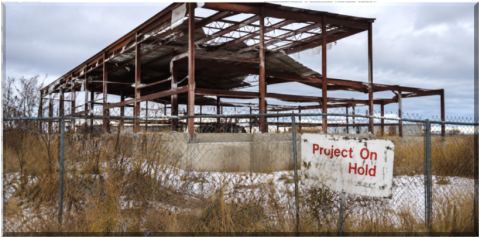
What happens to the land and buildings when the investors decide the project is no longer profitable?
Could Data Centers Become the Next Orphaned Wells?
Albertans already understand the consequences of industrial facilities being left behind after the economic opportunity disappears.
The province has spent years dealing with inactive and orphaned oil and gas wells.
An orphan well is one for which no responsible or financially capable operator remains to meet closure obligations.
The Orphan Well Association manages qualifying orphan oil and gas sites, funded primarily through industry levies.
Data centers are not oil wells.
Their environmental risks, operating structures and regulatory obligations are different.
But the underlying financial question is similar.
What happens when a profitable industrial venture stops being profitable and the company responsible for the property can no longer pay?
A vacant data center could leave behind large buildings, electrical infrastructure, cooling systems, generators, fuel storage and other industrial equipment.
Depending on the site, there could be contamination or restoration requirements.
Specialized buildings may also be difficult to convert to another use.
The landowner, lenders, operating company and applicable regulators may all have different responsibilities.
There is no basis for assuming taxpayers would automatically be responsible for every failed data center.
But neither should communities assume that all future costs will be covered without examining the legal and financial arrangements.
Alberta's orphan well experience offers a lesson.
Financial security for closure and reclamation is far easier to negotiate before a project is built than after the operator becomes insolvent.
Should Developers Post a Cleanup Bond?
One possible safeguard would be to require adequate financial security for decommissioning and site restoration, where legally authorized.
That could include a bond, letter of credit, funded reserve or another enforceable financial instrument.
The amount should reflect a credible estimate of the costs of removing equipment, addressing contamination, restoring infrastructure and making the property safe.
Security requirements might also need periodic review as facilities expand or change.
The important point is that closure obligations should not depend entirely on the future financial health of a company.
A large development should arrive with a credible exit plan.
And that plan should identify who pays.
Growth Is Welcome. Giving Away the Future Is Not.
The Peace Country has a long history of supporting major industries.
Agriculture, forestry, oil and gas, transportation and manufacturing have all contributed to the region's prosperity.
Data centers may become another important part of that economy.
They could create opportunities for local businesses, attract investment and contribute substantial municipal revenues.
But economic development should not require communities to accept every proposal without questioning the terms.
The emergence of AI also raises a larger issue: the concentration of wealth.
If a relatively small number of technology companies capture enormous profits from AI while host communities bear substantial infrastructure and environmental burdens, the economic benefits may be distributed unevenly.
That outcome is not inevitable.
Governments and communities have choices about taxation, investment, public benefits, environmental protection and financial security.
The Peace Country should be part of that discussion before the industry becomes firmly established.
Ten Questions County Council Should Answer
Before supporting further large-scale data center development, residents deserve answers to these questions:
1. Who ultimately owns and controls the project?
Are the applicant, developer, operator and principal investors clearly identified?
2. Who will receive the profits?
Will the facility be operated locally, sold to an investment fund or leased to a major technology company?
3. How much property tax will the County actually collect?
What is the projected annual assessment, and which components are exempt from assessment?
4. Are any tax concessions or public incentives being offered?
If so, what is their total value?
5. How much water will the facility require?
Where will it come from, and what safeguards protect existing users?
6. How much electricity will it consume?
Who pays for generation, transmission and related infrastructure?
7. What are the long-term local employment benefits?
How many permanent jobs are expected after construction ends?
8. Should the County negotiate an equity interest or community-benefit agreement?
Could residents receive a direct share of the long-term economic value?
9. What financial security protects the community if the project fails?
Who is legally responsible for decommissioning, cleanup and restoration?
10. Are residents being consulted early enough to influence the outcome?
Or are the most important financial and development decisions already being made before the public understands the proposal?
The Real Question Is Not Whether We Need Data Centers
We do.
Modern society increasingly depends on computing infrastructure, and artificial intelligence is likely to increase that demand.
The Peace Country may have genuine advantages for certain developments.
But being attractive to investors does not mean accepting whatever terms they offer.
We should welcome investment that delivers lasting value.
We should insist on transparency about ownership and resource requirements.
We should protect water, electricity affordability and neighboring landowners.
And we should make certain that future cleanup obligations are adequately secured.
Most importantly, we should ask whether the community is receiving a fair share of the wealth generated from the resources it contributes.
If the Peace Country is helping power the future of artificial intelligence, shouldn't the Peace Country share in the rewards?
Swan City Speaks: What Do You Think?
1. Should the County of Grande Prairie negotiate a direct ownership stake — perhaps 20 per cent — in major data center developments, or would a guaranteed community-benefit payment be a better approach?
2. Should developers be required to publicly disclose their ultimate ownership, expected water and electricity consumption, and financial arrangements before major approvals are granted?
3. Should data center operators provide financial security for future decommissioning and cleanup, similar in principle to the safeguards Alberta needs for oil and gas facilities?
4. If a data center generates enormous profits for investors outside Canada, what would constitute a fair return for the local community?
Share your thoughts in the comments. Your opinion matters.
Sources and further reading:
County of Grande Prairie — Data Centers, permits, public consultation and proposed zoning changes:
https://www.countygp.ab.ca/business-building-development/data-centers
Alberta Municipalities — Property Taxes Generated from a Data Center, April 7, 2026:
https://www.abmunis.ca/news/property-taxes-generated-data-center
Government of Alberta — Artificial Intelligence Data Centers Strategy:
https://www.alberta.ca/artificial-intelligence-data-centers-strategy
Government of Alberta — AI Data Centers in Alberta:
https://www.alberta.ca/datacentres/index.html
Government of Alberta — Data Center Levy Engagement:
https://www.alberta.ca/data-centre-levy-engagement
Alberta Energy Regulator — Orphan Energy Sites:
County of Grande Prairie — Public Consultation on Proposed Data Center Land Use Changes:
https://engagecountygp.ca/proposed-data-centre-land-use-bylaw-changes
Three Important Facts Residents Should Know
Before deciding whether data centers are good for the Peace Country, residents should understand three important issues.
1. A billion-dollar data center doesn't necessarily mean a billion-dollar property assessment.
Alberta Municipalities confirms that computing equipment inside data centers is generally excluded from municipal property assessment.
That means a facility worth billions of dollars may pay municipal property taxes on only a portion of its total investment.
The question: How much annual property tax revenue will the County actually receive, and is that enough compensation for the land, infrastructure and resources being used?
Source — Alberta Municipalities:
https://www.abmunis.ca/news/property-taxes-generated-data-centre
2. We still don't know the full water and electricity requirements.
The County has stated that the Emerson Trail development permit does not establish the project's final water or electricity consumption. Those figures depend on final designs and separate regulatory approvals.
The County has scheduled a December 2, 2026, public hearing concerning proposed changes to data center land-use regulations.
The question: Should major industrial developments receive approval before residents know how much water and electricity they will require?
Source — County of Grande Prairie:
https://www.countygp.ab.ca/business-building-development/data-centres
3. What happens if a data center becomes obsolete or financially unviable?
Alberta's experience with orphaned oil and gas wells provides an important lesson about industrial development.
When a company becomes insolvent, responsibility for closing and restoring an industrial site can become complicated and expensive.
Data centers are not oil wells, and there is no evidence that the proposed Peace Country facilities will become abandoned.
However, rapid technological change makes long-term financial responsibility an important consideration.
The question: Should data center developers be required to provide financial security for eventual closure, equipment removal and site restoration?
Source — Alberta Energy Regulator:
Questions Swan City Now Wants County Council to Answer
Rather than relying entirely on promises of investment and employment, Swan City Now believes residents deserve specific answers.
1. Property taxes: What is the projected annual municipal property tax revenue from the Emerson Trail data center development?
2. Tax incentives: Have any property tax reductions, exemptions, rebates or other financial incentives been offered or discussed?
3. Ownership: Who are the ultimate controlling owners, investors and intended operators of the development?
4. Community benefits: Has the County considered negotiating a community-benefit agreement that would provide additional annual revenue or infrastructure investment?
5. A share of ownership: Could the County legally and financially negotiate an ownership interest, perhaps 20 per cent, or another form of revenue sharing that allows local residents to benefit from future profits?
6. Water: What is the anticipated annual water consumption, where will that water come from, and how will existing water users be protected?
7. Electricity: How much power will the development require, and who will pay for additional generation, transmission or related infrastructure?
8. Future cleanup: What financial security will ensure that taxpayers are not left with unpaid decommissioning and restoration costs?
These questions are not accusations against developers or County officials.
They are questions that deserve public answers before communities commit valuable resources to major long-term developments.
Swan City Speaks: Where Is Our Cut?
This is where we want to hear from the people who live, work, farm and operate businesses in Grande Prairie and the Peace Country.
Artificial intelligence is changing the world. Data centers will play an important role in that future.
But should the communities providing the land, water and energy receive a greater share of the wealth being created?
1. Where Is Our Cut?
Should the County receive only ordinary property taxes, or should major data center developers negotiate additional revenue sharing, community-benefit payments or even a municipal ownership interest?
2. Who Should Own the Profits?
If American technology companies and international investors ultimately receive much of the financial benefit, should a greater portion of those profits remain in the communities supplying the resources?
3. Is Our Water Worth More Than the Jobs?
Water is precious in the Peace Country. Should data centers be required to disclose their anticipated water consumption and demonstrate that their operations will not compromise existing users?
4. Are We Giving Away Too Much Too Soon?
Should the County require more detailed financial, environmental and infrastructure information before approving major industrial developments?
5. Who Pays When the Technology Changes?
If a data center becomes obsolete or closes, should developers be required to have sufficient money set aside for cleanup and site restoration?
6. What Would You Ask County Council?
If you could ask the Reeve and County councilors one question about the proposed data centers, what would it be?
Your Opinion Matters — And We Want to Hear It
Swan City Now is an independent local newspaper built around a simple idea:
The community tells us what's happening. We find out why it matters.
We welcome thoughtful opinions from residents, farmers, landowners, business operators, industry workers and elected officials.
You don't have to agree with this article.
In fact, we particularly welcome informed arguments from people who believe data centers will bring substantial benefits to the Peace Country.
Do you support these developments, oppose them, or believe they should proceed only with stronger protections and a better financial return for local communities?
Tell us why.
Share your thoughts in the comments. Your opinion matters.
Join Swan City Now — free to read, free to participate: